
Mind map
FUNDAMENTAL FORCES
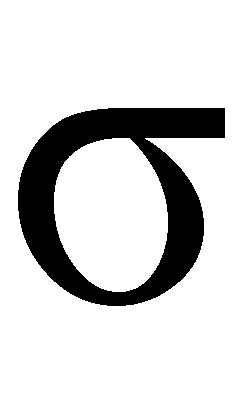
Map content
FUNDAMENTAL FORCES
STRONG NUCLEAR FORCE
- STRONGEST & DUE TO COLOR CHARGE (such as in nucleons)
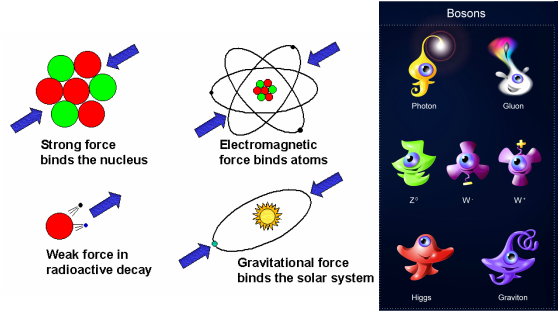
- QUARKS posses either RED, GREEN or BLUE color. Strong force is attractive between these and mediating particles called GLUONS .
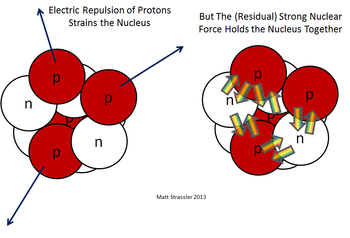
- Holds together the subatomic particles of the nucleus
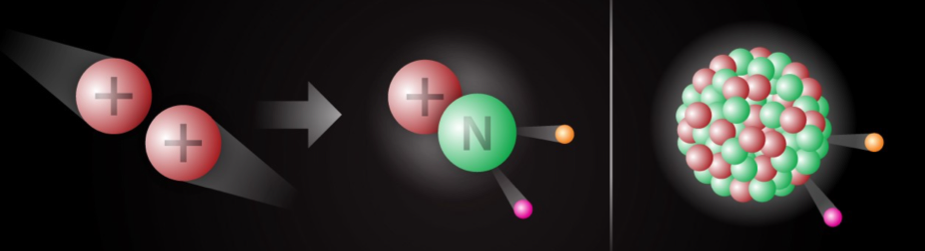
- Created between nucleons (protons and neutrons) by the exchange of particles called MESONS.
- Overcomes the repulsive force between to protons.
- Keeps HADRONS ( a subatomic particle including the BARYONS and MESONS that can take part in the strong interaction.together) (Brtiannica, n.d.).
- Relative Strength: 1
- Force carriers are called GLUONS (no mass, made up of 1 color and 1 anti-color, no electrical charge and spin of 1) which hold the QUARKS together, and the PIONS which hold the protons and neutrons together.
- Force Range: 10^-15 (size of a medium sized nucleus)
- Particles must be really close.
- EXAMPLE 1: Release of energy when heat is generated in Nuclear Power Plant to generate steam for generating electricity (Physics Edu, n.d.).
- QUARKS are colored charges which feel this force.
- EXAMPLE 2: When a Nuclear Weapon detonates, energy is released which is due to strong nuclear forces. (Physics Edu, n.d.).
- STRONGEST & DUE TO COLOR CHARGE (such as in nucleons)
WEAK NUCLEAR FORCE
- Acts on the subatomic level (reflects on the nucleus)
- Involves exchange of intermediate vector bosons, W & Z.
- FORCE CARRIERS: W bosons (one with a charge +1 and one with a charge of -1) + Z boson (no charge)
- Involves exchange of intermediate vector bosons, W & Z.
- Acts on really short distances.
- FORCE RANGE: 10^-18 (0.1% diameter of a proton)
- RELATIVE STRENGTH: 10^-6
- Changes the flavor of a QUARK inside a particle, thus the WHOLE identity of the particle changes (crucial in the structure of the UNIVERSE) (Thacker, 1995).
- Changes QUARKS --> other QUARKS and LEPTONS --> other LEPTONS
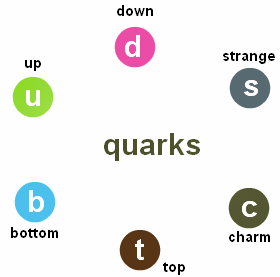
- FLAVORS OF QUARKS
- UP, DOWN, charm, strange, top & bottom
- Neutrons and protons have difference of 1 quark flavor.
- PROTONS: 2 up quarks + 1 down quark
- NEUTRONS: 1 up quark + 2 down quarks
- Neutrons and protons have difference of 1 quark flavor.
- UP, DOWN, charm, strange, top & bottom
- Force of interaction between QUARKS (thus reflected on neutrons and protons) & LEPTONS
- LEPTONS= subatomic particles like electron, muon, tauon (spin of +/- 1/2)or neutrinos (spin 1/2) that don´t interact with Strong Force (Barberio, 2014).
- Allows BETA DECAY to happen, changing a neutron into a proton and electron, therefore, RADIATION (protons to neutrons)
- Causes the desintegration of NUCLEAR PARTICLES (decay)
- EXAMPLES: burning of Sun, beta decay. radioactive decay, initiating the process of H fusion in stars, radio luminescense and production of deuterium (Physics Edu, n.d.).
- Acts on the subatomic level (reflects on the nucleus)
GRAVITATIONAL FORCE
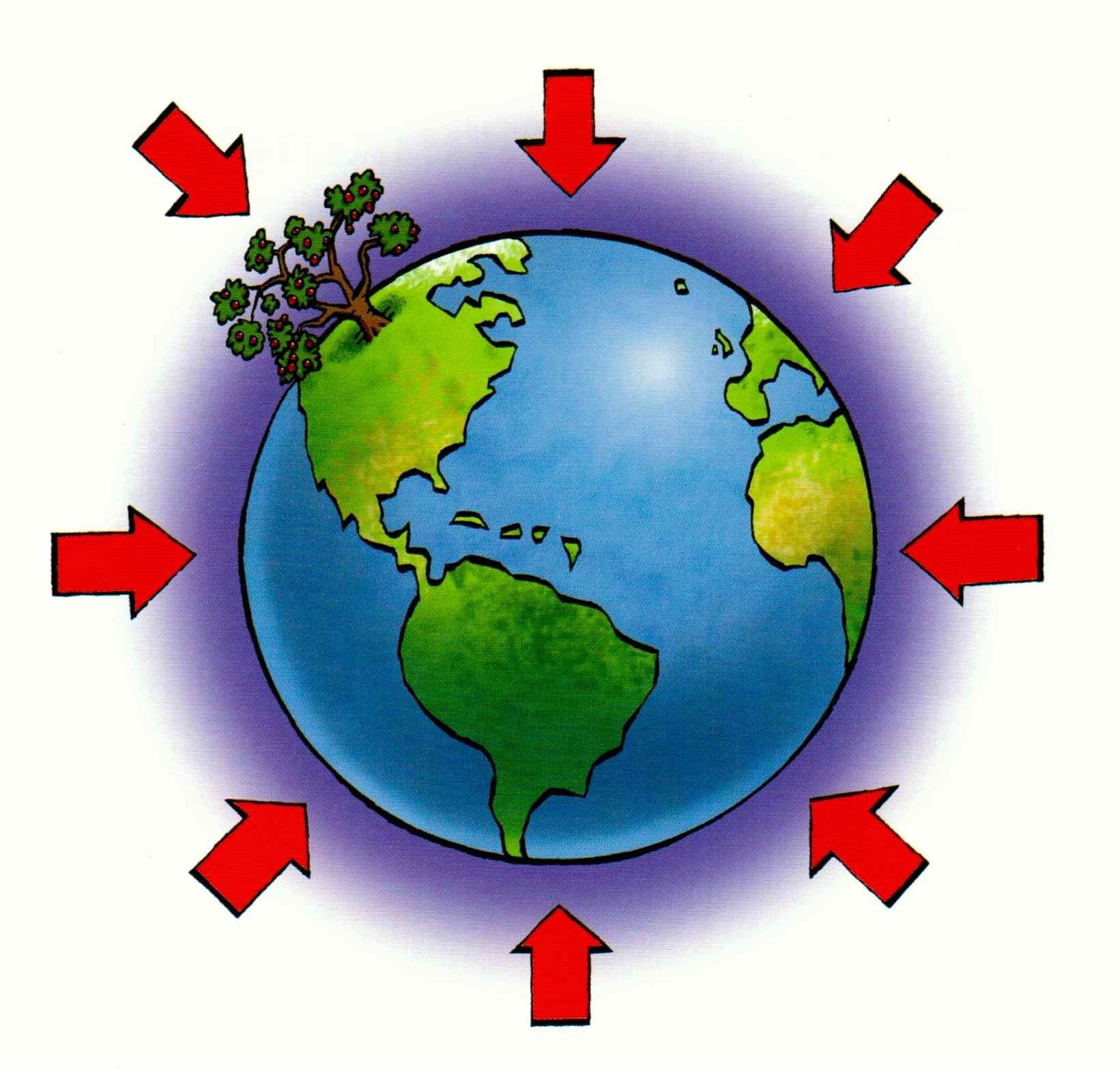
- Force that attracts two objects with mass. Interaction between MASS- ENERGY (Four Fundamental Forces, n.d.).
- Depends on the MASSES of the Objects, and DISTANCE between them.
- ALWAYS PRESENT (with more or less impact) because all particles have mass.
- FORCE CARRIERS: GRAVITON (no mass, hypothezided)
- GRAVITONS have no mass for gravity NOT to have no limit to its distance (Thacker, 1995).
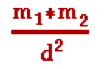
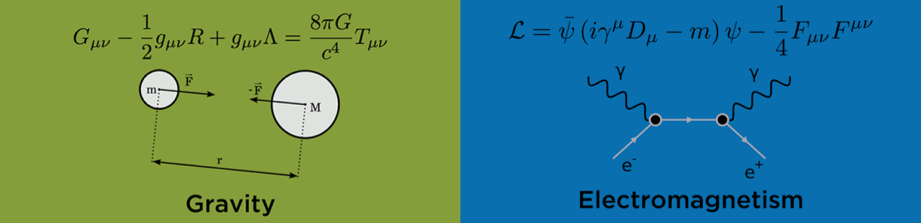
- GRAVITATIONAL FORCE=
- m1= mass of object 1, m2= mass of object 2 & d= the distance between object 1 and object 2
- An increase of *mass* adds to the force while an increase of *distance* (r) disminishes the force
- PROPORTIONAL to the product of the MASSES, but INVERSELY PROPORTIONAL to the distance between the objects.
- "proportional to the product of the masses"
- m1= mass of object 1, m2= mass of object 2 & d= the distance between object 1 and object 2
- FORCE RANGE= infinite (not limited distance)
- RELATIVE STRENGTH= 6*10^-39
- WEAKEST
- ATTRACTIVE FORCE
- EXAMPLES: 1) All objects fall because of the gravitational force exerted on them by Earth 2) The Moon and the artificial satellites orbit around the Earth. Basically, keeps the Solar System together (Four Fundamental Forces, n.d.).
ELECTROMAGNETIC FORCE
- Explains how changed particles react to electric and magnetic fields, as well as the fundamental links between them (Thacker, 1995).
- Involves ELECTRIC force and MAGNETIC force.
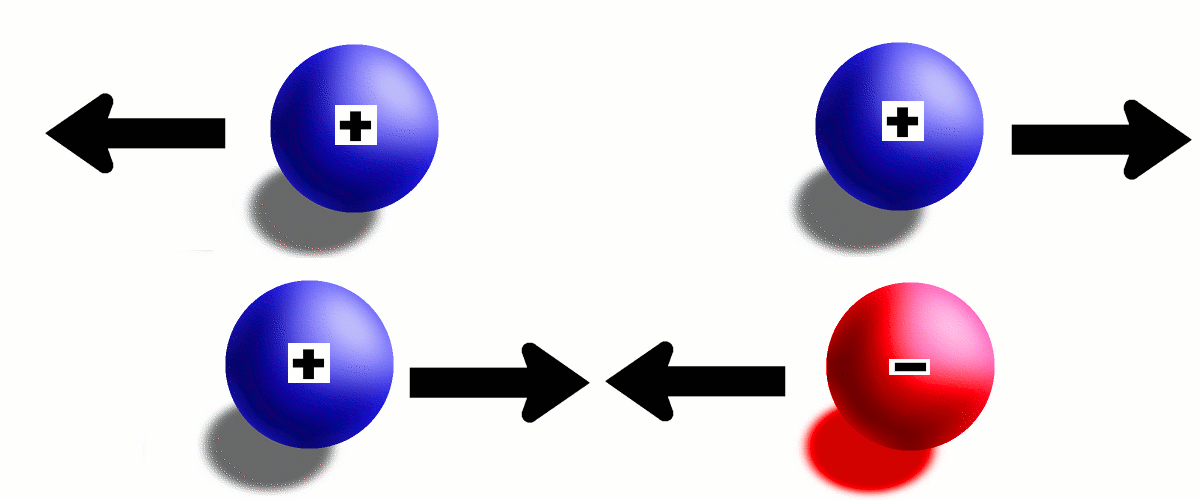
- Depends on the charge of the objects.
- In charge of transformation of atoms and molecules.
- Operates between particles with electric charge.
- Second STRONGEST.
- "The strength is PROPORTIONAL to the product of the electric charges of the particles, and INVERSELY PROPORTIONAL to the square of the distance between the particles´ distance" (Thacker, n.d.).
- RELATIVE STRENGTH= 1/137
- FORCE RANGE= infinte (not limited distance)
- ATTRACTIVE & REPULSIVE force.
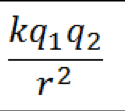
- ELECTROMAGNETIC FORCE=
- "proportional to the product of electric charges"
- k= Columbus constant (8.987 x 10^9), q1= electric charge of object 1, q2= electric charge of object 2 & r^2= square of the distances between the electric charged objects
- EXAMPLES: generating light (when protons and electrons interact, this force adds energy to the electrons forming PHOTONS) (Britannica, n.d.)
- Light from the Sun, the Earth´s magnetic field which protects us from radiation, magnetic levitation and Gamma radiation which causes the atomic nucleus to loose energy (Britannica, n.d.).
- FORCE CARRIERS: PHOTONS (no mass, no limited distance)
SIMILARITIES AND DIFFERENCES BETWEEN STRONG & WEAK FORCES
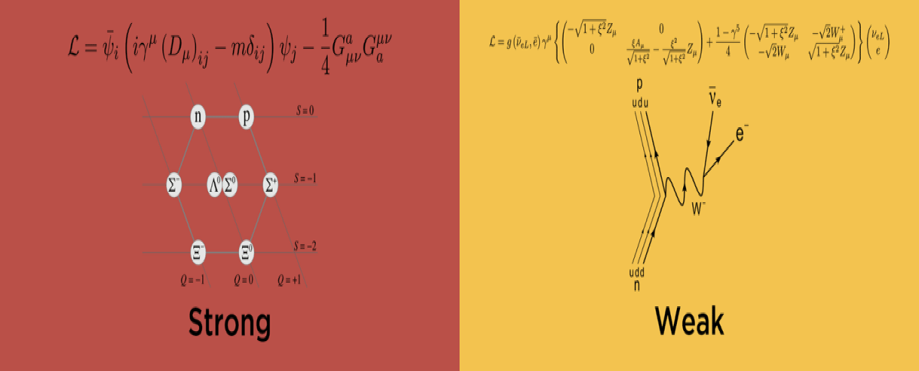
- DIFFERENCES: A decay with COLOR CHANGE and NO ELECTRIC CHARGE mediated by GLUONS is a STRONG INTERACTION, while a decay with NO COLOR CHANGE and ELECTRIC CHARGE mediated by W+ AND W- bosons is a WEAK INTERACTION.
- SIMILARITIES: Both have short ranges and work on the SUBATOMIC LEVELS
- FUN FACT: more energy decreases STRONG FORCE while less energy increases WEAK FORCE (Four Fundamental Forces, n.d.).
- DIFFERENCES: A decay with COLOR CHANGE and NO ELECTRIC CHARGE mediated by GLUONS is a STRONG INTERACTION, while a decay with NO COLOR CHANGE and ELECTRIC CHARGE mediated by W+ AND W- bosons is a WEAK INTERACTION.
Four Fundamental Forces. (n.d.). Similarities and Differences Between Strong/Weak Forces [Website]. Retrieved from https://sites.google.com/site/fourfundamentalforcesrhitabs/stuff-of-interest/anotherpost Four Fundamental Forces. (n.d.). Similarities and Differences Between Gravity and Electromagnetic Force [Website]. Retrieved from https://sites.google.com/site/fourfundamentalforcesrhitabs/stuff-of-interest/anotherpost Physics Edu. (n.d.). Nuclear Force [Website]. Retrieved from https://physics.tutorvista.com/modern-physics/nuclear-force.html Thacker, J. (1995). TheFour Forces [Website]. Retrieved from http://webhome.phy.duke.edu/~kolena/modern/forces.html#005 Barberio, E. (2014). What are Leptons? [Website]. Retrieved from https://phys.org/news/2014-01-leptons.html Hadrons. (n.d.). In Enclyclopedia Britannica. Retrieved from https://www.britannica.com/science/hadron Electromagnetic Force. (n.d.). In Encyclopedia Britannica. Retrieved from https://www.britannica.com/science/electromagn
SIMILARITIES AND DIFFERENCES BETWEEN GRAVITATIONAL & ELECTROMAGNETIC FORCE
- SIMILARITIES: Both are PROPORTIONAL to the product of either the masses of the objects (in the case of the Gravitational Force) or to the product of the electric charges of these (as it happens with Electromagnetic Force), but INVERSELY PROPORTIONAL to the distance (inverse square law) (Four Fundamental Forces, n.d.).
- DIFFERENCES: Gravitational force is an ATTRACTIVE FORCE while ELECTROMAGNETIC FORCE can be an attractive and/or repelling force). Also, Gravitational Force depends on the masses of both objects and distance, while Electromagnetic Force depends on the charges of the objects and their distance.
- SIMILARITIES: Both are PROPORTIONAL to the product of either the masses of the objects (in the case of the Gravitational Force) or to the product of the electric charges of these (as it happens with Electromagnetic Force), but INVERSELY PROPORTIONAL to the distance (inverse square law) (Four Fundamental Forces, n.d.).
RANGE OF FORCES
- GRAVITATIONAL FORCE< WEAK FORCE< ELECTROMAGNETIC FORCE< STRONG FORCE
Images and files in the map
Information
- Description
- Mind Map on FUNDAMENTAL FORCES, created by Ana Padilla on 11/08/2018.
- Created by
- Ana Padilla
- Views
- 7
- Rating