
Mind map
Sexual selection
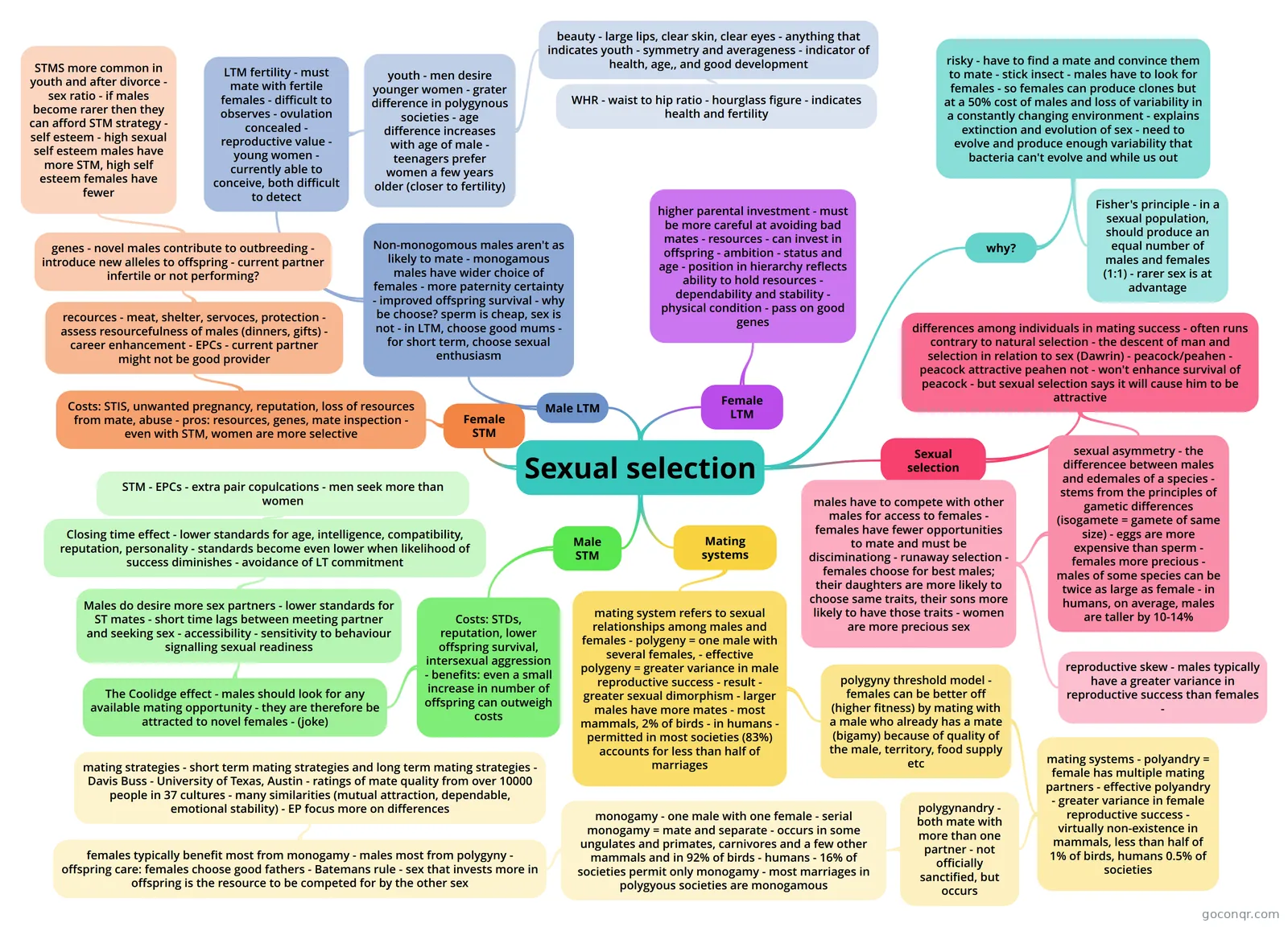
Mind map: sexual selection
Map content
Sexual selection
why?
- risky - have to find a mate and convince them to mate - stick insect - males have to look for females - so females can produce clones but at a 50% cost of males and loss of variability in a constantly changing environment - explains extinction and evolution of sex - need to evolve and produce enough variability that bacteria can't evolve and while us out
- Fisher's principle - in a sexual population, should produce an equal number of males and females (1:1) - rarer sex is at advantage
- risky - have to find a mate and convince them to mate - stick insect - males have to look for females - so females can produce clones but at a 50% cost of males and loss of variability in a constantly changing environment - explains extinction and evolution of sex - need to evolve and produce enough variability that bacteria can't evolve and while us out
Sexual selection
- differences among individuals in mating success - often runs contrary to natural selection - the descent of man and selection in relation to sex (Dawrin) - peacock/peahen - peacock attractive peahen not - won't enhance survival of peacock - but sexual selection says it will cause him to be attractive
- sexual asymmetry - the differencee between males and edemales of a species - stems from the principles of gametic differences (isogamete = gamete of same size) - eggs are more expensive than sperm - females more precious - males of some species can be twice as large as female - in humans, on average, males are taller by 10-14%
- males have to compete with other males for access to females - females have fewer opportunities to mate and must be disciminationg - runaway selection - females choose for best males; their daughters are more likely to choose same traits, their sons more likely to have those traits - women are more precious sex
- reproductive skew - males typically have a greater variance in reproductive success than females -
- males have to compete with other males for access to females - females have fewer opportunities to mate and must be disciminationg - runaway selection - females choose for best males; their daughters are more likely to choose same traits, their sons more likely to have those traits - women are more precious sex
- sexual asymmetry - the differencee between males and edemales of a species - stems from the principles of gametic differences (isogamete = gamete of same size) - eggs are more expensive than sperm - females more precious - males of some species can be twice as large as female - in humans, on average, males are taller by 10-14%
- differences among individuals in mating success - often runs contrary to natural selection - the descent of man and selection in relation to sex (Dawrin) - peacock/peahen - peacock attractive peahen not - won't enhance survival of peacock - but sexual selection says it will cause him to be attractive
Mating systems
- mating system refers to sexual relationships among males and females - polygeny = one male with several females, - effective polygeny = greater variance in male reproductive success - result - greater sexual dimorphism - larger males have more mates - most mammals, 2% of birds - in humans - permitted in most societies (83%) accounts for less than half of marriages
- polygyny threshold model - females can be better off (higher fitness) by mating with a male who already has a mate (bigamy) because of quality of the male, territory, food supply etc
- mating systems - polyandry = female has multiple mating partners - effective polyandry - greater variance in female reproductive success - virtually non-existence in mammals, less than half of 1% of birds, humans 0.5% of societies
- polygynandry - both mate with more than one partner - not officially sanctified, but occurs
- monogamy - one male with one female - serial monogamy = mate and separate - occurs in some ungulates and primates, carnivores and a few other mammals and in 92% of birds - humans - 16% of societies permit only monogamy - most marriages in polygyous societies are monogamous
- females typically benefit most from monogamy - males most from polygyny - offspring care: females choose good fathers - Batemans rule - sex that invests more in offspring is the resource to be competed for by the other sex
- mating strategies - short term mating strategies and long term mating strategies - Davis Buss - University of Texas, Austin - ratings of mate quality from over 10000 people in 37 cultures - many similarities (mutual attraction, dependable, emotional stability) - EP focus more on differences
- females typically benefit most from monogamy - males most from polygyny - offspring care: females choose good fathers - Batemans rule - sex that invests more in offspring is the resource to be competed for by the other sex
- monogamy - one male with one female - serial monogamy = mate and separate - occurs in some ungulates and primates, carnivores and a few other mammals and in 92% of birds - humans - 16% of societies permit only monogamy - most marriages in polygyous societies are monogamous
- polygynandry - both mate with more than one partner - not officially sanctified, but occurs
- mating systems - polyandry = female has multiple mating partners - effective polyandry - greater variance in female reproductive success - virtually non-existence in mammals, less than half of 1% of birds, humans 0.5% of societies
- polygyny threshold model - females can be better off (higher fitness) by mating with a male who already has a mate (bigamy) because of quality of the male, territory, food supply etc
- mating system refers to sexual relationships among males and females - polygeny = one male with several females, - effective polygeny = greater variance in male reproductive success - result - greater sexual dimorphism - larger males have more mates - most mammals, 2% of birds - in humans - permitted in most societies (83%) accounts for less than half of marriages
Male STM
- Costs: STDs, reputation, lower offspring survival, intersexual aggression - benefits: even a small increase in number of offspring can outweigh costs
- The Coolidge effect - males should look for any available mating opportunity - they are therefore be attracted to novel females - (joke)
- Males do desire more sex partners - lower standards for ST mates - short time lags between meeting partner and seeking sex - accessibility - sensitivity to behaviour signalling sexual readiness
- Closing time effect - lower standards for age, intelligence, compatibility, reputation, personality - standards become even lower when likelihood of success diminishes - avoidance of LT commitment
- STM - EPCs - extra pair copulcations - men seek more than women
- Closing time effect - lower standards for age, intelligence, compatibility, reputation, personality - standards become even lower when likelihood of success diminishes - avoidance of LT commitment
- Males do desire more sex partners - lower standards for ST mates - short time lags between meeting partner and seeking sex - accessibility - sensitivity to behaviour signalling sexual readiness
- The Coolidge effect - males should look for any available mating opportunity - they are therefore be attracted to novel females - (joke)
- Costs: STDs, reputation, lower offspring survival, intersexual aggression - benefits: even a small increase in number of offspring can outweigh costs
Female STM
- Costs: STIS, unwanted pregnancy, reputation, loss of resources from mate, abuse - pros: resources, genes, mate inspection - even with STM, women are more selective
- recources - meat, shelter, servoces, protection - assess resourcefulness of males (dinners, gifts) - career enhancement - EPCs - current partner might not be good provider
- genes - novel males contribute to outbreeding - introduce new alleles to offspring - current partner infertile or not performing?
- STMS more common in youth and after divorce - sex ratio - if males become rarer then they can afford STM strategy - self esteem - high sexual self esteem males have more STM, high self esteem females have fewer
- genes - novel males contribute to outbreeding - introduce new alleles to offspring - current partner infertile or not performing?
- recources - meat, shelter, servoces, protection - assess resourcefulness of males (dinners, gifts) - career enhancement - EPCs - current partner might not be good provider
- Costs: STIS, unwanted pregnancy, reputation, loss of resources from mate, abuse - pros: resources, genes, mate inspection - even with STM, women are more selective
Male LTM
- Non-monogomous males aren't as likely to mate - monogamous males have wider choice of females - more paternity certainty - improved offspring survival - why be choose? sperm is cheap, sex is not - in LTM, choose good mums - for short term, choose sexual enthusiasm
- LTM fertility - must mate with fertile females - difficult to observes - ovulation concealed - reproductive value - young women - currently able to conceive, both difficult to detect
- youth - men desire younger women - grater difference in polygynous societies - age difference increases with age of male - teenagers prefer women a few years older (closer to fertility)
- beauty - large lips, clear skin, clear eyes - anything that indicates youth - symmetry and averageness - indicator of health, age,, and good development
- WHR - waist to hip ratio - hourglass figure - indicates health and fertility
- beauty - large lips, clear skin, clear eyes - anything that indicates youth - symmetry and averageness - indicator of health, age,, and good development
- youth - men desire younger women - grater difference in polygynous societies - age difference increases with age of male - teenagers prefer women a few years older (closer to fertility)
- LTM fertility - must mate with fertile females - difficult to observes - ovulation concealed - reproductive value - young women - currently able to conceive, both difficult to detect
- Non-monogomous males aren't as likely to mate - monogamous males have wider choice of females - more paternity certainty - improved offspring survival - why be choose? sperm is cheap, sex is not - in LTM, choose good mums - for short term, choose sexual enthusiasm
Female LTM
- higher parental investment - must be more careful at avoiding bad mates - resources - can invest in offspring - ambition - status and age - position in hierarchy reflects ability to hold resources - dependability and stability - physical condition - pass on good genes
Information
- Description
- Degree Evolutionary Psychology Mind Map on Sexual selection, created by Abbey Wrigley on 21/01/2019.
- Created by
- Abbey Wrigley
- Views
- 0
- Rating