
Mind map
Design Thinking
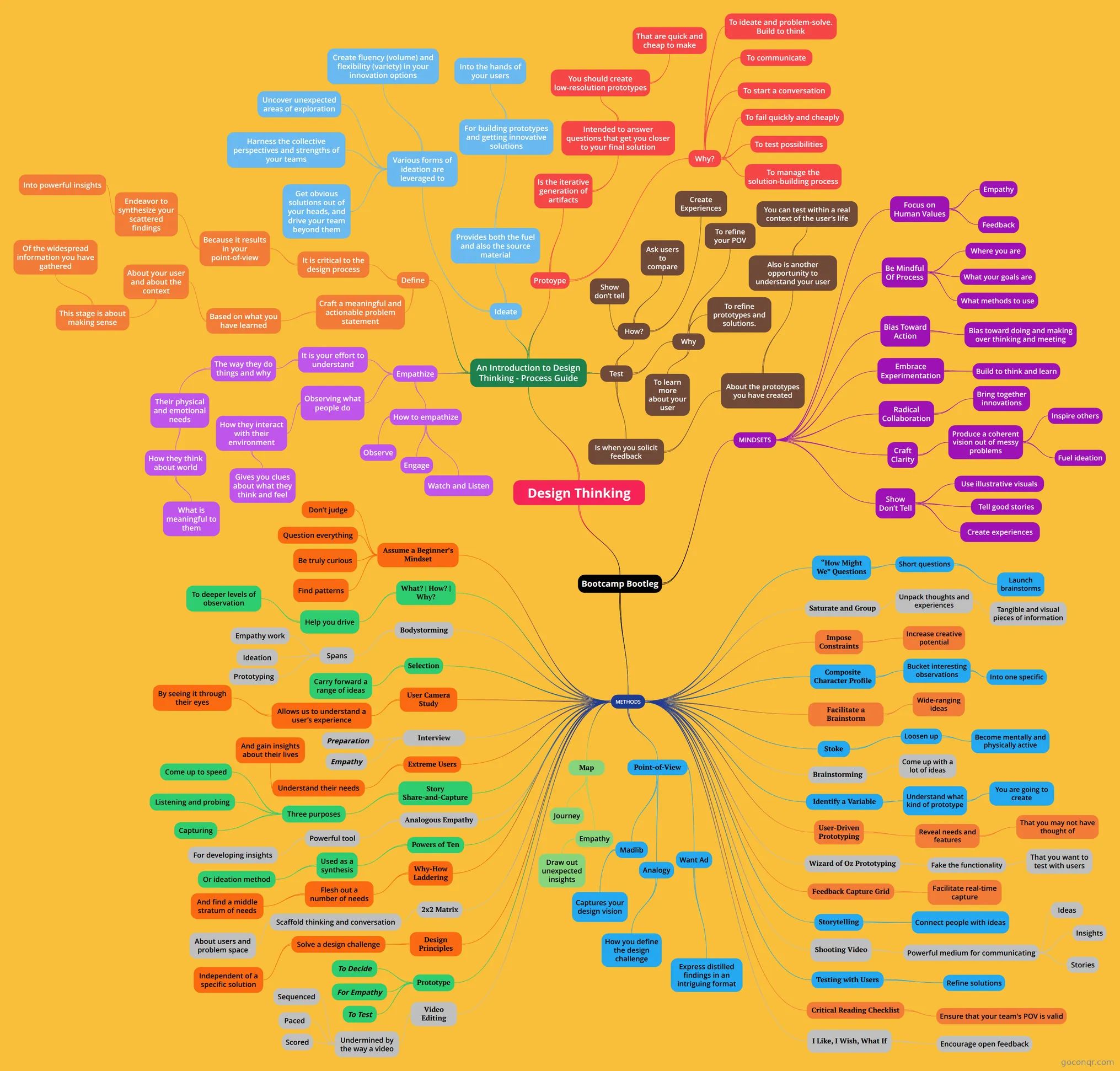
Mind map: Design thinking
Map content
Design Thinking
Bootcamp Bootleg
- MINDSETS
- Show Don’t Tell
- Create experiences
- Tell good stories
- Use illustrative visuals
- Focus on Human Values
- Empathy
- Feedback
- Craft Clarity
- Produce a coherent vision out of messy problems
- Inspire others
- Fuel ideation
- Produce a coherent vision out of messy problems
- Embrace Experimentation
- Build to think and learn
- Be Mindful Of Process
- Where you are
- What your goals are
- What methods to use
- Bias Toward Action
- Bias toward doing and making over thinking and meeting
- Radical Collaboration
- Bring together innovations
- Show Don’t Tell
- METHODS
- Assume a Beginner’s Mindset
- Don’t judge
- Question everything
- Be truly curious
- Find patterns
- What? | How? | Why?
- Help you drive
- To deeper levels of observation
- Help you drive
- User Camera Study
- Allows us to understand a user’s experience
- By seeing it through their eyes
- Allows us to understand a user’s experience
- Interview
- Preparation
- Empathy
- Extreme Users
- Understand their needs
- And gain insights about their lives
- Understand their needs
- Analogous Empathy
- Powerful tool
- For developing insights
- Powerful tool
- Story Share-and-Capture
- Three purposes
- Come up to speed
- Listening and probing
- Capturing
- Three purposes
- Saturate and Group
- Unpack thoughts and experiences
- Tangible and visual pieces of information
- Unpack thoughts and experiences
- Map
- Empathy
- Draw out unexpected insights
- Journey
- Empathy
- Composite Character Profile
- Bucket interesting observations
- Into one specific
- Bucket interesting observations
- Powers of Ten
- Used as a synthesis
- Or ideation method
- Used as a synthesis
- 2x2 Matrix
- Scaffold thinking and conversation
- About users and problem space
- Scaffold thinking and conversation
- Why-How Laddering
- Flesh out a number of needs
- And find a middle stratum of needs
- Flesh out a number of needs
- Point-of-View
- Madlib
- Captures your design vision
- Analogy
- How you define the design challenge
- Want Ad
- Express distilled findings in an intriguing format
- Madlib
- Critical Reading Checklist
- Ensure that your team's POV is valid
- Design Principles
- Solve a design challenge
- Independent of a specific solution
- Solve a design challenge
- “How Might We” Questions
- Short questions
- Launch brainstorms
- Short questions
- Stoke
- Loosen up
- Become mentally and physically active
- Loosen up
- Brainstorming
- Come up with a lot of ideas
- Facilitate a Brainstorm
- Wide-ranging ideas
- Selection
- Carry forward a range of ideas
- Bodystorming
- Spans
- Empathy work
- Ideation
- Prototyping
- Spans
- Impose Constraints
- Increase creative potential
- Prototype
- For Empathy
- To Test
- To Decide
- Testing with Users
- Refine solutions
- Identify a Variable
- Understand what kind of prototype
- You are going to create
- Understand what kind of prototype
- User-Driven Prototyping
- Reveal needs and features
- That you may not have thought of
- Reveal needs and features
- Wizard of Oz Prototyping
- Fake the functionality
- That you want to test with users
- Fake the functionality
- Feedback Capture Grid
- Facilitate real-time capture
- Storytelling
- Connect people with ideas
- Shooting Video
- Powerful medium for communicating
- Ideas
- Insights
- Stories
- Powerful medium for communicating
- Video Editing
- Undermined by the way a video
- Sequenced
- Paced
- Scored
- Undermined by the way a video
- I Like, I Wish, What If
- Encourage open feedback
- Assume a Beginner’s Mindset
- MINDSETS
An Introduction to Design Thinking - Process Guide
- Ideate
- Various forms of ideation are leveraged to
- Harness the collective perspectives and strengths of your teams
- Uncover unexpected areas of exploration
- Create fluency (volume) and flexibility (variety) in your innovation options
- Get obvious solutions out of your heads, and drive your team beyond them
- Provides both the fuel and also the source material
- For building prototypes and getting innovative solutions
- Into the hands of your users
- For building prototypes and getting innovative solutions
- Various forms of ideation are leveraged to
- Empathize
- It is your effort to understand
- The way they do things and why
- Their physical and emotional needs
- How they think about world
- What is meaningful to them
- How they think about world
- Their physical and emotional needs
- The way they do things and why
- Observing what people do
- How they interact with their environment
- Gives you clues about what they think and feel
- How they interact with their environment
- How to empathize
- Observe
- Engage
- Watch and Listen
- It is your effort to understand
- Protoype
- Why?
- To ideate and problem-solve. Build to think
- To communicate
- To start a conversation
- To fail quickly and cheaply
- To test possibilities
- To manage the solution-building process
- Is the iterative generation of artifacts
- Intended to answer questions that get you closer to your final solution
- You should create low-resolution prototypes
- That are quick and cheap to make
- You should create low-resolution prototypes
- Intended to answer questions that get you closer to your final solution
- Why?
- Test
- Is when you solicit feedback
- About the prototypes you have created
- Also is another opportunity to understand your user
- You can test within a real context of the user’s life
- Also is another opportunity to understand your user
- About the prototypes you have created
- How?
- Show don’t tell
- Create Experiences
- Ask users to compare
- Why
- To refine prototypes and solutions.
- To learn more about your user
- To refine your POV
- Is when you solicit feedback
- Define
- Craft a meaningful and actionable problem statement
- Based on what you have learned
- About your user and about the context
- This stage is about making sense
- Of the widespread information you have gathered
- This stage is about making sense
- About your user and about the context
- Based on what you have learned
- It is critical to the design process
- Because it results in your point-of-view
- Endeavor to synthesize your scattered findings
- Into powerful insights
- Endeavor to synthesize your scattered findings
- Because it results in your point-of-view
- Craft a meaningful and actionable problem statement
- Ideate
Information
- Description
- Informática Mind Map on Design Thinking, created by Kevin 19 on 14/10/2019.
- Created by
- Kevin 19
- Views
- 7
- Rating