
Mind map
Memory devices
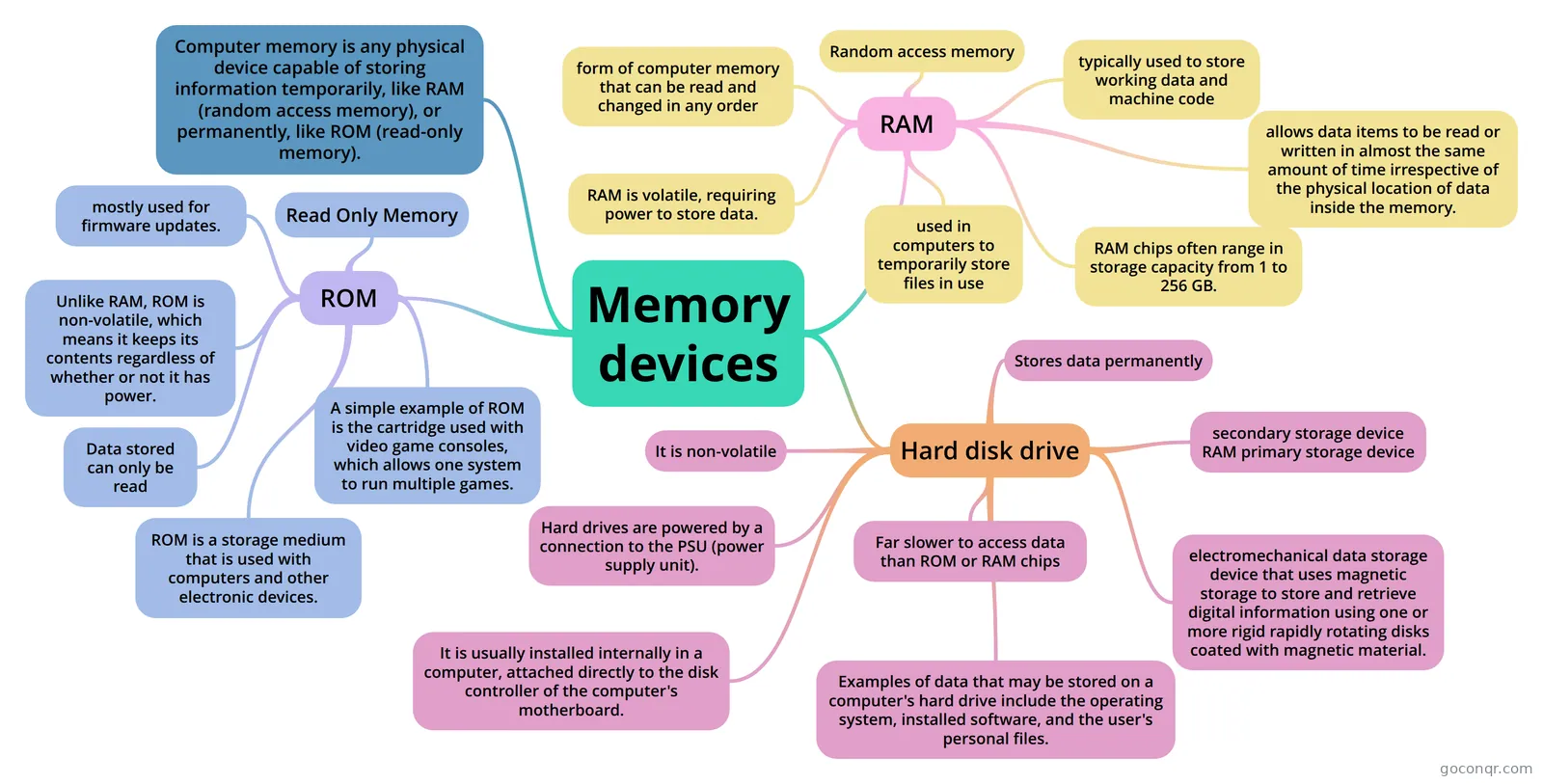
Mind map: Memory devices: RAM, ROM, and Hard disk drive
Map content
Memory devices
Computer memory is any physical device capable of storing information temporarily, like RAM (random access memory), or permanently, like ROM (read-only memory).
RAM
- Random access memory
- form of computer memory that can be read and changed in any order
- typically used to store working data and machine code
- allows data items to be read or written in almost the same amount of time irrespective of the physical location of data inside the memory.
- RAM is volatile, requiring power to store data.
- RAM chips often range in storage capacity from 1 to 256 GB.
- used in computers to temporarily store files in use
ROM
- Read Only Memory
- ROM is a storage medium that is used with computers and other electronic devices.
- Data stored can only be read
- mostly used for firmware updates.
- A simple example of ROM is the cartridge used with video game consoles, which allows one system to run multiple games.
- Unlike RAM, ROM is non-volatile, which means it keeps its contents regardless of whether or not it has power.
Hard disk drive
- It is non-volatile
- electromechanical data storage device that uses magnetic storage to store and retrieve digital information using one or more rigid rapidly rotating disks coated with magnetic material.
- Stores data permanently
- secondary storage device RAM primary storage device
- It is usually installed internally in a computer, attached directly to the disk controller of the computer's motherboard.
- Hard drives are powered by a connection to the PSU (power supply unit).
- Far slower to access data than ROM or RAM chips
- Examples of data that may be stored on a computer's hard drive include the operating system, installed software, and the user's personal files.