
Mind map
Acids, Bases and pH (Chapter 20)
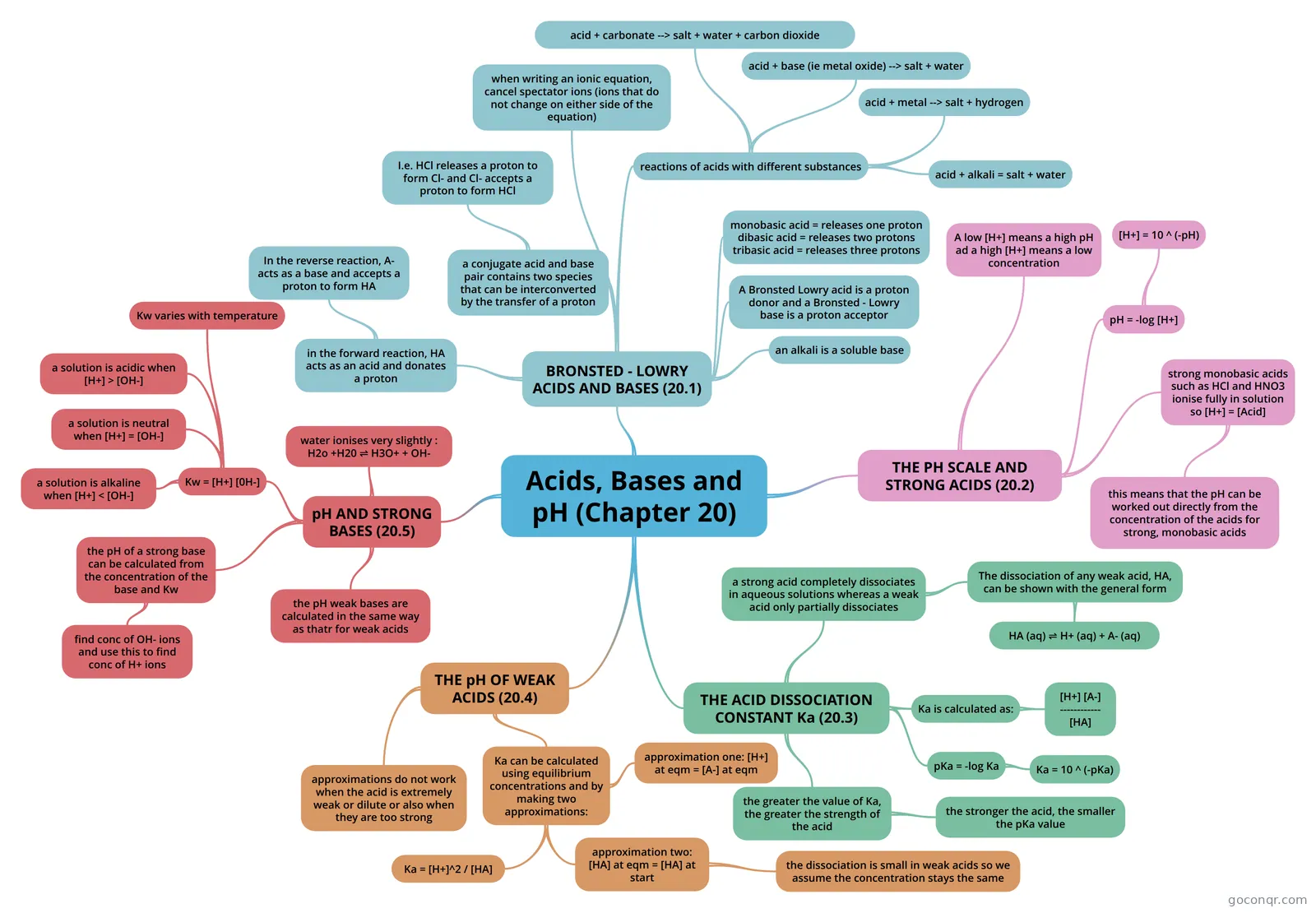
Mind map: Acids, bases and pH
Map content
Acids, Bases and pH (Chapter 20)
BRONSTED - LOWRY ACIDS AND BASES (20.1)
- an alkali is a soluble base
- A Bronsted Lowry acid is a proton donor and a Bronsted - Lowry base is a proton acceptor
- a conjugate acid and base pair contains two species that can be interconverted by the transfer of a proton
- I.e. HCl releases a proton to form Cl- and Cl- accepts a proton to form HCl
- monobasic acid = releases one proton dibasic acid = releases two protons tribasic acid = releases three protons
- in the forward reaction, HA acts as an acid and donates a proton
- In the reverse reaction, A- acts as a base and accepts a proton to form HA
- when writing an ionic equation, cancel spectator ions (ions that do not change on either side of the equation)
- reactions of acids with different substances
- acid + carbonate --> salt + water + carbon dioxide
- acid + base (ie metal oxide) --> salt + water
- acid + metal --> salt + hydrogen
- acid + alkali = salt + water
THE PH SCALE AND STRONG ACIDS (20.2)
- A low [H+] means a high pH ad a high [H+] means a low concentration
- pH = -log [H+]
- [H+] = 10 ^ (-pH)
- strong monobasic acids such as HCl and HNO3 ionise fully in solution so [H+] = [Acid]
- this means that the pH can be worked out directly from the concentration of the acids for strong, monobasic acids
THE ACID DISSOCIATION CONSTANT Ka (20.3)
- a strong acid completely dissociates in aqueous solutions whereas a weak acid only partially dissociates
- The dissociation of any weak acid, HA, can be shown with the general form
- HA (aq) ⇌ H+ (aq) + A- (aq)
- The dissociation of any weak acid, HA, can be shown with the general form
- Ka is calculated as:
- [H+] [A-] ------------ [HA]
- the greater the value of Ka, the greater the strength of the acid
- the stronger the acid, the smaller the pKa value
- pKa = -log Ka
- Ka = 10 ^ (-pKa)
- a strong acid completely dissociates in aqueous solutions whereas a weak acid only partially dissociates
THE pH OF WEAK ACIDS (20.4)
- Ka can be calculated using equilibrium concentrations and by making two approximations:
- approximation one: [H+] at eqm = [A-] at eqm
- approximation two: [HA] at eqm = [HA] at start
- the dissociation is small in weak acids so we assume the concentration stays the same
- Ka = [H+]^2 / [HA]
- approximations do not work when the acid is extremely weak or dilute or also when they are too strong
- Ka can be calculated using equilibrium concentrations and by making two approximations:
pH AND STRONG BASES (20.5)
- water ionises very slightly : H2o +H20 ⇌ H3O+ + OH-
- Kw = [H+] [0H-]
- Kw varies with temperature
- a solution is acidic when [H+] > [OH-]
- a solution is neutral when [H+] = [OH-]
- a solution is alkaline when [H+] < [OH-]
- the pH of a strong base can be calculated from the concentration of the base and Kw
- find conc of OH- ions and use this to find conc of H+ ions
- the pH weak bases are calculated in the same way as thatr for weak acids
Information
- Description
- A level Chemistry Mind Map on Acids, Bases and pH (Chapter 20), created by Taanya Bhatt on 29/01/2020.
- Created by
- Taanya Bhatt
- Views
- 0
- Rating
More on pH Scale and Calculations