
Mind map
Malaria
Map content
Malaria
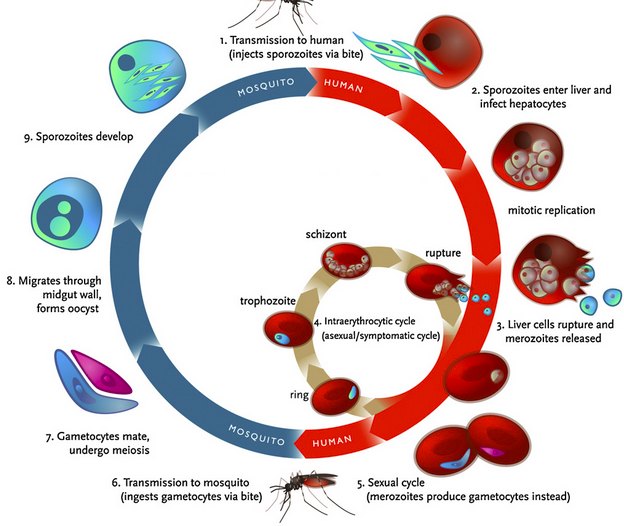
LIFE CYCLE
- Protozan parasites: Plasmodium
CLINICAL
- uncomplicated malaria
- severe flu-like illness
- fever
- malaria fevers are cyclical; synchronized with the bursting of merozoites into bloodstream
- chills + sweating
- head + body aches
- nausea + vomiting + diarrhead
- fever
- severe flu-like illness
- severe malaria
- impaired consciousness/cerebral malaria
- fits, prostration, coma
- severe anaemia
- respiratory distress
- multi organ failure
- renal failure
- pulmonary oedema
- death: 10-50% of cases
- fever
- impaired consciousness/cerebral malaria
- uncomplicated malaria
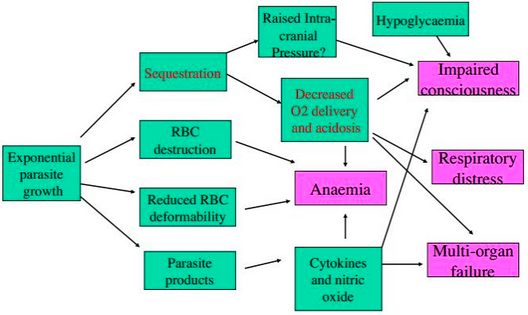
PATHOLOGY
EPIDEMIOLOGY
- Hypoendemic
- little transmission; sporatic, self-limiting outbreaks
- little public health importance
- poor development of immunity!
- disease affects all ages equally
- EX: China, Mexico
- Mesoendemic
- present in most areas; variable transmission intensity
- generally of ph importance
- development of immunity
- disease doesn't effect older generations
- EX: India, most of SE Asia
- Hyperendemic
- intense, widespread (but still seasonal transmission)
- often a ph problem
- development of good immunity
- disease mainly of children
- EX: African Saehl
- Holoendemic
- intense, widespread, seasonal variation is slight
- can be #1 ph problem
- good immunity
- disease mainly <5s
- EX: Humid, lowland tropical African
- Hypoendemic
CONTROL
- Prevention
- VC!
- IRS
- LLINS/ITNs
- ITNs provided 17% protective efficacy against mortality
- about 5.5 lives saved per 1,000 under nets
- treated nets can cut incidence in half
- VC!
- Treatment
- Drugs!
- parenteral
- Quinine, artesunate (better)
- orals
- artesunate, quinine, chloroquine...
- ACT: not affordable in African without subsidy
- parenteral
- Drugs!
- Diagnostics
- microscopy
- most accurate
- requires lab and trained staff
- rapid diagnostic tests
- point of care diagnostic!
- doesn't require lab or electricity; minimum training
- based on antigen capture
- no intensity result: just +/-
- 2 types: HRP-2 (persists after cure), LDH- negative 2 days after cure
- PCR-based assays
- serological tests
- microscopy
- Prevention
DDx fever
- Fever of unknown origin (FUO) in adults is defined as a temperature higher than 38.3 C (100.9 F) that lasts for more than three weeks with no obvious source despite appropriate investigation. The four categories of potential etiology of FUO are classic, nosocomial, immune deficient, and human immunodeficiency virus–related. The four subgroups of the differential diagnosis of FUO are infections, malignancies, autoimmune conditions, and miscellaneous. A thorough history, physical examination, and standard laboratory testing remain the basis of the initial evaluation of the patient with FUO. Newer diagnostic modalities, including updated serology, viral cultures, computed tomography, and magnetic resonance imaging, have important roles in the assessment of these patients.
- Night Sweats
Parasitic infectious disease transmitted by a mosquito and caused by Plasmodium, Species. The word Malaria, meaning ‘bad air’ in Italian, was so named because of the historical belief that the disease was caused by swamp vapors
Images and files in the map
Information
- Description
- Mind map of all aspects of malaria control.
- Created by
- Al Shayma Iedi
- Views
- 30
- Tags
- History
-
- Created by morgculver · May 23, 2015
- Copied by nora marwan · Feb 10, 2020
- Copied by rim almorsy · Feb 10, 2020
- Copied by Al Shayma Iedi · Feb 10, 2020
- Rating