
Mind map
Atopic Dermatitis Management
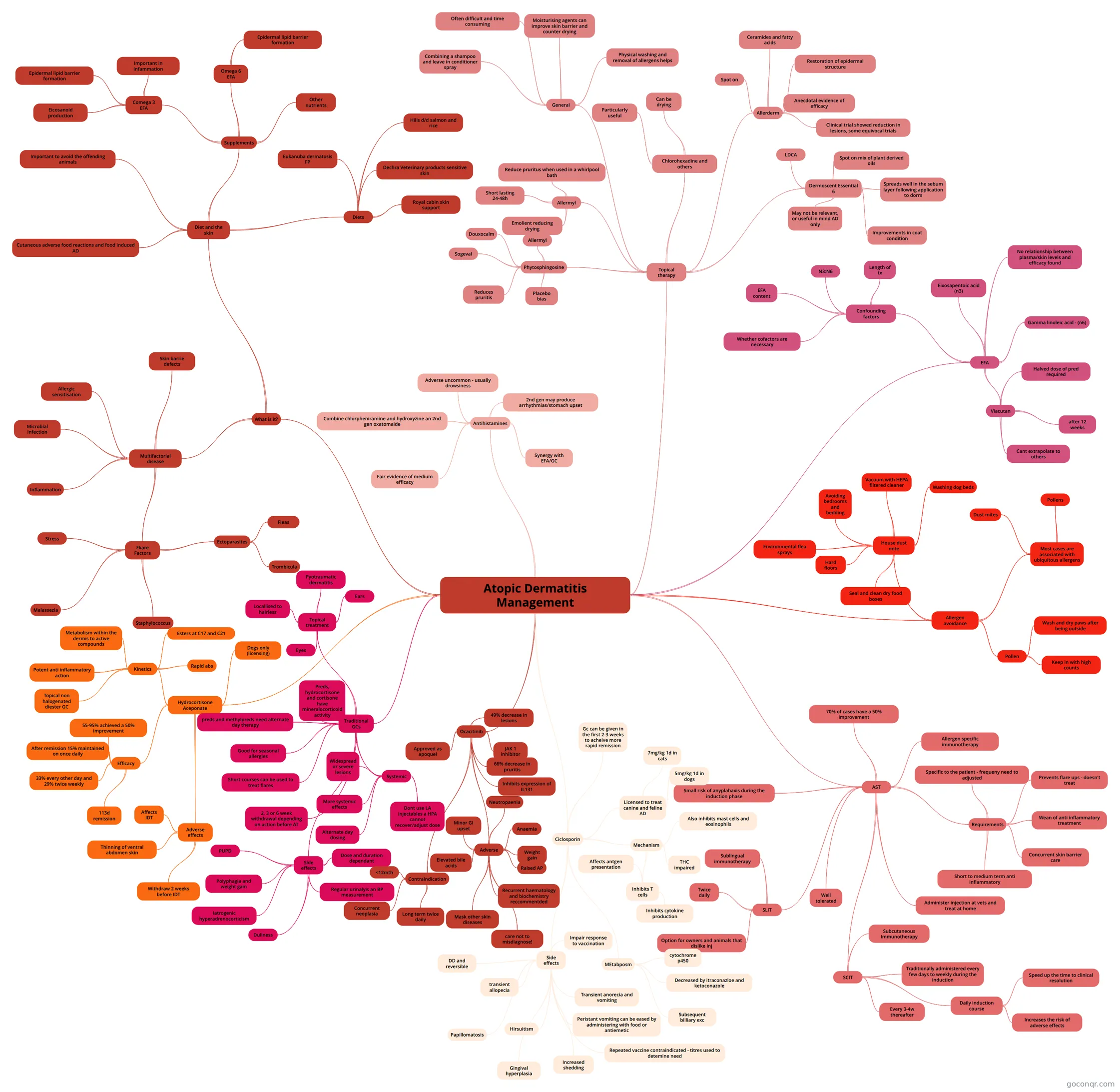
Mind map: Atopic dermatitis management
Map content
Atopic Dermatitis Management
What is it?
- Multifactorial disease
- Skin barrie defects
- Allergic sensitisation
- Inflammation
- Microbial infection
- Fkare Factors
- Ectoparasites
- Trombicula
- Fleas
- Staphylococcus
- Malassezia
- Stress
- Ectoparasites
- Diet and the skin
- Cutaneous adverse food reactions and food induced AD
- Important to avoid the offending animals
- Supplements
- Comega 3 EFA
- Important in infammation
- Epidermal lipid barrier formation
- Eicosanoid production
- Omega 6 EFA
- Epidermal lipid barrier formation
- Other nutrients
- Comega 3 EFA
- Diets
- Eukanuba dermatosis FP
- best
- Dechra Veterinary products sensitive skin
- Hills d/d salmon and rice
- Royal cabin skin support
- Eukanuba dermatosis FP
- Multifactorial disease
Topical therapy
- General
- Combining a shampoo and leave in conditioner spray
- Often difficult and time consuming
- Moisturising agents can improve skin barrier and counter drying
- Physical washing and removal of allergens helps
- Allermyl
- Reduce pruritus when used in a whirlpool bath
- Short lasting 24-48h
- Emolient reducing drying
- Phytosphingosine
- Douxocalm
- Sogeval
- Allermyl
- Reduces pruritis
- Placebo bias
- Chlorohexadine and others
- Particularly useful
- Can be drying
- Allerderm
- Spot on
- Ceramides and fatty acids
- Restoration of epidermal structure
- Anecdotal evidence of efficacy
- Clinical trial showed reduction in lesions, some equivocal trials
- Dermoscent Essential 6
- LDCA
- Spot on mix of plant derived oils
- Spreads well in the sebum layer following application to dorm
- Improvements in coat condition
- May not be relevant, or useful in mind AD only
- General
EFA
- Eixosapentoic acid (n3)
- Gamma linoleic acid - (n6)
- No relationship between plasma/skin levels and efficacy found
- Confounding factors
- N3:N6
- EFA content
- Length of tx
- Whether cofactors are necessary
- Viacutan
- Halved dose of pred required
- after 12 weeks
- Cant extrapolate to others
Allergen avoidance
- Most cases are associated with ubiquitous allergens
- Dust mites
- Pollens
- House dust mite
- Avoiding bedrooms and bedding
- Vacuum with HEPA filtered cleaner
- Hard floors
- Environmental flea sprays
- Washing dog beds
- Seal and clean dry food boxes
- Pollen
- Wash and dry paws after being outside
- Keep in with high counts
- Most cases are associated with ubiquitous allergens
AST
- Allergen specific immunotherapy
- 70% of cases have a 50% improvement
- Requirements
- Specific to the patient - frequeny need to adjusted
- Prevents flare ups - doesn't treat
- Concurrent skin barrier care
- Short to medium term anti inflammatory
- Wean of anti inflammatory treatment
- SCIT
- Subcutaneous Immunotherapy
- Traditionally administered every few days to weekly during the induction
- Every 3-4w thereafter
- Daily induction course
- Speed up the time to clinical resolution
- Increases the risk of adverse effects
- SLIT
- Sublingual immunotherapy
- Twice daily
- Option for owners and animals that dislike inj
- Small risk of anyplahaxis during the induction phase
- Administer injection at vets and treat at home
- Well tolerated
Ciclosporin
- Licensed to treat canine and feline AD
- 5mg/kg 1d in dogs
- 7mg/kg 1d in cats
- Mechanism
- Inhibits T cells
- T cells implicated in canine AD
- Affects antgen presentation
- Inhibits cytokine production
- Also inhibits mast cells and eosinophils
- THC impaired
- Inhibits T cells
- Gc can be given in the first 2-3 weeks to acheive more rapid remission
- Adverse effects don't seem to be additive
- MEtabposm
- cytochrome p450
- Subsequent billiary exc
- Decreased by itraconazloe and ketoconazole
- Side effects
- Transient anorecia and vomiting
- Peristant vomiting can be eased by administering with food or antiemetic
- Hirsuitism
- Increased shedding
- Gingival hyperplasia
- transient allopecia
- Papillomatosis
- DD and reversible
- Impair response to vaccination
- 2w either side
- Repeated vaccine contraindicated - titres used to detemine need
- Licensed to treat canine and feline AD
Hydrocortisone Aceponate
- Kinetics
- Topical non halogenated diester GC
- Esters at C17 and C21
- Rapid abs
- Potent anti inflammatory action
- Metabolism within the dermis to active compounds
- Efficacy
- 55-95% achieved a 50% improvement
- After remission 15% maintained on once daily
- 33% every other day and 29% twice weekly
- 113d remission
- Dogs only (licensing)
- Adverse effects
- Thinning of ventral abdomen skin
- Affects IDT
- Withdraw 2 weeks before IDT
- Kinetics
Traditional GCs
- preds and methylpreds need alternate day therapy
- Short courses can be used to treat flares
- Good for seasonal allergies
- Topical treatment
- Locallised to hairless
- Pyotraumatic dermatitis
- Ears
- Eyes
- Preds, hydrocortisone and cortisone have mineralocorticoid activity
- 2, 3 or 6 week withdrawal depending on action before AT
- Systemic
- Widespread or severe lesions
- More systemic effects
- Alternate day dosing
- Dont use LA injectables a HPA cannot recover/adjust dose
- Side effects
- PUPD
- use methylpreds and dexamethasone instead
- Polyphagia and weight gain
- Manage with low calorie diet
- Dullness
- Iatrogenic hyperadrenocorticism
- Dose and duration dependant
- Regular urinalyis an BP measurement
- PUPD
Antihistamines
- Fair evidence of medium efficacy
- Combine chlorpheniramine and hydroxyzine an 2nd gen oxatomaide
- Adverse uncommon - usually drowsiness
- 2nd gen may produce arrhythmias/stomach upset
- Synergy with EFA/GC
Ocacitinib
- Inhibits expression of IL131
- JAK 1 inhibitor
- Approved as apoquel
- 66% decrease in pruritis
- 49% decrease in lesions
- Contraindication
- <12mth
- Long term twice daily
- Concurrent neoplasia
- Adverse
- Minor GI upset
- Anaemia
- Raised AP
- Neutropaenia
- Elevated bile acids
- Weight gain
- Recurrent haematology and biochemistry reccommentded
- Mask other skin diseases
- care not to misdiagnose!
Information
- Description
- Degree - Professional Dog and Cat (Dermatology) Mind Map on Atopic Dermatitis Management, created by Charlotte Stephe on 26/02/2015.
- Created by
- Charlotte Stephe
- Views
- 2
- Rating
More on Pruritus and Allergic Skin Disease