
Mind map
Virtue Ethics
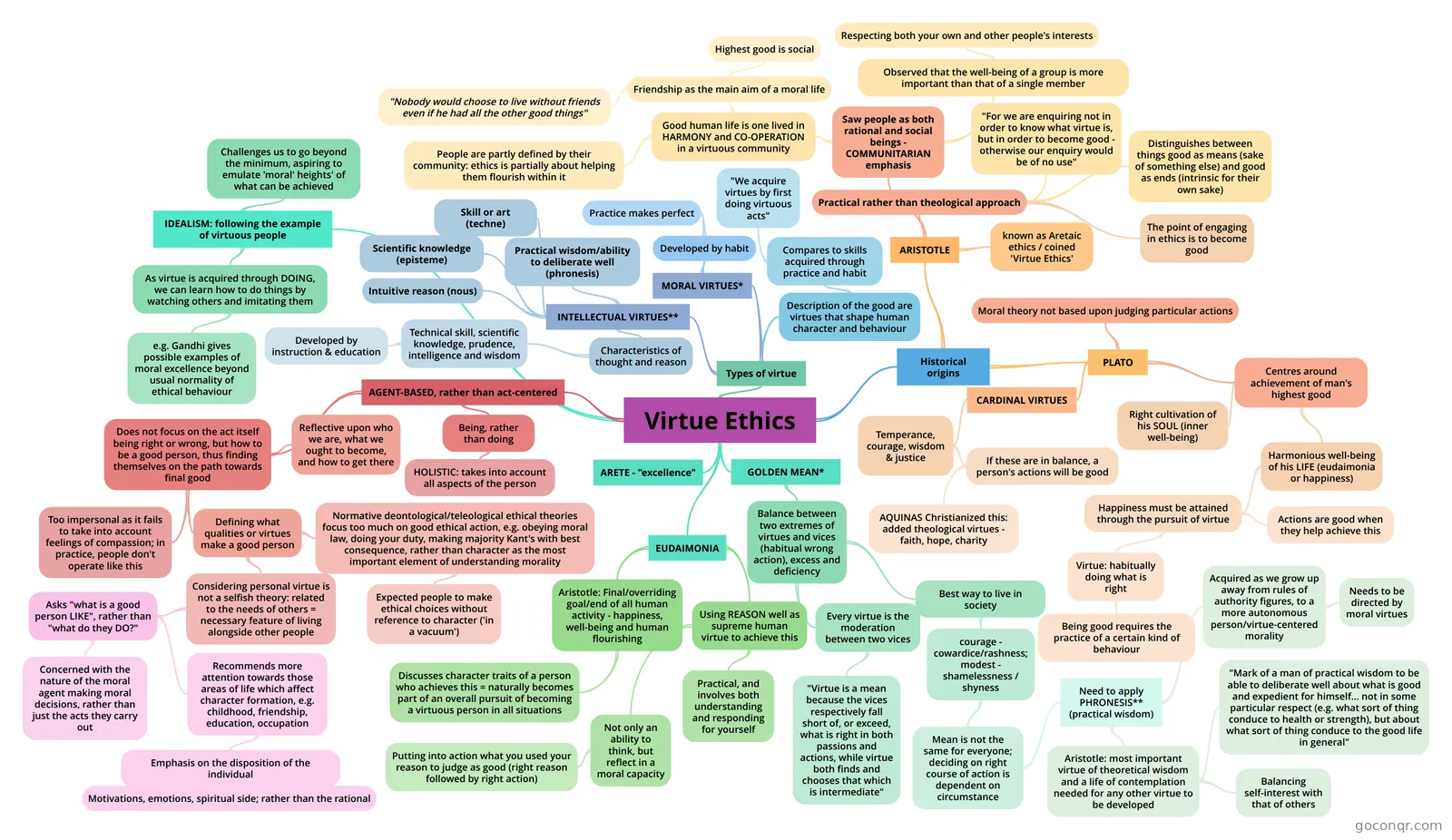
Mind map: Virtue ethics
Map content
Virtue Ethics
GOLDEN MEAN*
- Balance between two extremes of virtues and vices (habitual wrong action), excess and deficiency
- Best way to live in society
- courage - cowardice/rashness; modest - shamelessness / shyness
- Mean is not the same for everyone; deciding on right course of action is dependent on circumstance
- Need to apply PHRONESIS** (practical wisdom)
- Acquired as we grow up away from rules of authority figures, to a more autonomous person/virtue-centered morality
- Needs to be directed by moral virtues
- Aristotle: most important virtue of theoretical wisdom and a life of contemplation needed for any other virtue to be developed
- Balancing self-interest with that of others
- "Mark of a man of practical wisdom to be able to deliberate well about what is good and expedient for himself... not in some particular respect (e.g. what sort of thing conduce to health or strength), but about what sort of thing conduce to the good life in general"
- Acquired as we grow up away from rules of authority figures, to a more autonomous person/virtue-centered morality
- Need to apply PHRONESIS** (practical wisdom)
- Mean is not the same for everyone; deciding on right course of action is dependent on circumstance
- courage - cowardice/rashness; modest - shamelessness / shyness
- Every virtue is the moderation between two vices
- "Virtue is a mean because the vices respectively fall short of, or exceed, what is right in both passions and actions, while virtue both finds and chooses that which is intermediate"
- Best way to live in society
- Balance between two extremes of virtues and vices (habitual wrong action), excess and deficiency
Types of virtue
- INTELLECTUAL VIRTUES**
- Characteristics of thought and reason
- Technical skill, scientific knowledge, prudence, intelligence and wisdom
- Developed by instruction & education
- Technical skill, scientific knowledge, prudence, intelligence and wisdom
- Scientific knowledge (episteme)
- Intuitive reason (nous)
- Practical wisdom/ability to deliberate well (phronesis)
- Skill or art (techne)
- Characteristics of thought and reason
- MORAL VIRTUES*
- Developed by habit
- Practice makes perfect
- Developed by habit
- Description of the good are virtues that shape human character and behaviour
- Compares to skills acquired through practice and habit
- "We acquire virtues by first doing virtuous acts"
- Compares to skills acquired through practice and habit
- INTELLECTUAL VIRTUES**
Historical origins
- PLATO
- Moral theory not based upon judging particular actions
- Centres around achievement of man's highest good
- Right cultivation of his SOUL (inner well-being)
- Harmonious well-being of his LIFE (eudaimonia or happiness)
- Happiness must be attained through the pursuit of virtue
- Actions are good when they help achieve this
- Virtue: habitually doing what is right
- Being good requires the practice of a certain kind of behaviour
- Happiness must be attained through the pursuit of virtue
- CARDINAL VIRTUES
- Temperance, courage, wisdom & justice
- If these are in balance, a person's actions will be good
- AQUINAS Christianized this: added theological virtues - faith, hope, charity
- If these are in balance, a person's actions will be good
- Temperance, courage, wisdom & justice
- ARISTOTLE
- known as Aretaic ethics / coined 'Virtue Ethics'
- Practical rather than theological approach
- The point of engaging in ethics is to become good
- "For we are enquiring not in order to know what virtue is, but in order to become good - otherwise our enquiry would be of no use"
- Distinguishes between things good as means (sake of something else) and good as ends (intrinsic for their own sake)
- Saw people as both rational and social beings - COMMUNITARIAN emphasis
- Good human life is one lived in HARMONY and CO-OPERATION in a virtuous community
- People are partly defined by their community: ethics is partially about helping them flourish within it
- Friendship as the main aim of a moral life
- "Nobody would choose to live without friends even if he had all the other good things"
- Highest good is social
- Observed that the well-being of a group is more important than that of a single member
- Respecting both your own and other people's interests
- Good human life is one lived in HARMONY and CO-OPERATION in a virtuous community
- PLATO
AGENT-BASED, rather than act-centered
- Does not focus on the act itself being right or wrong, but how to be a good person, thus finding themselves on the path towards final good
- Reflective upon who we are, what we ought to become, and how to get there
- Defining what qualities or virtues make a good person
- Normative deontological/teleological ethical theories focus too much on good ethical action, e.g. obeying moral law, doing your duty, making majority Kant's with best consequence, rather than character as the most important element of understanding morality
- Expected people to make ethical choices without reference to character ('in a vacuum')
- Considering personal virtue is not a selfish theory: related to the needs of others = necessary feature of living alongside other people
- Asks "what is a good person LIKE", rather than "what do they DO?"
- Recommends more attention towards those areas of life which affect character formation, e.g. childhood, friendship, education, occupation
- Emphasis on the disposition of the individual
- Motivations, emotions, spiritual side; rather than the rational
- Emphasis on the disposition of the individual
- Concerned with the nature of the moral agent making moral decisions, rather than just the acts they carry out
- Recommends more attention towards those areas of life which affect character formation, e.g. childhood, friendship, education, occupation
- Asks "what is a good person LIKE", rather than "what do they DO?"
- Normative deontological/teleological ethical theories focus too much on good ethical action, e.g. obeying moral law, doing your duty, making majority Kant's with best consequence, rather than character as the most important element of understanding morality
- Too impersonal as it fails to take into account feelings of compassion; in practice, people don't operate like this
- Being, rather than doing
- HOLISTIC: takes into account all aspects of the person
- Does not focus on the act itself being right or wrong, but how to be a good person, thus finding themselves on the path towards final good
EUDAIMONIA
- Aristotle: Final/overriding goal/end of all human activity - happiness, well-being and human flourishing
- Discusses character traits of a person who achieves this = naturally becomes part of an overall pursuit of becoming a virtuous person in all situations
- Using REASON well as supreme human virtue to achieve this
- Not only an ability to think, but reflect in a moral capacity
- Putting into action what you used your reason to judge as good (right reason followed by right action)
- Practical, and involves both understanding and responding for yourself
- Not only an ability to think, but reflect in a moral capacity
- Aristotle: Final/overriding goal/end of all human activity - happiness, well-being and human flourishing
ARETE - "excellence"
IDEALISM: following the example of virtuous people
- As virtue is acquired through DOING, we can learn how to do things by watching others and imitating them
- e.g. Gandhi gives possible examples of moral excellence beyond usual normality of ethical behaviour
- Challenges us to go beyond the minimum, aspiring to emulate 'moral' heights' of what can be achieved
- As virtue is acquired through DOING, we can learn how to do things by watching others and imitating them
Information
- Description
- Mind Map on Virtue Ethics, created by May Yuen on 28/02/2015.
- Created by
- May Yuen
- Views
- 1
- Rating