
Mind map
Changing UK Economy
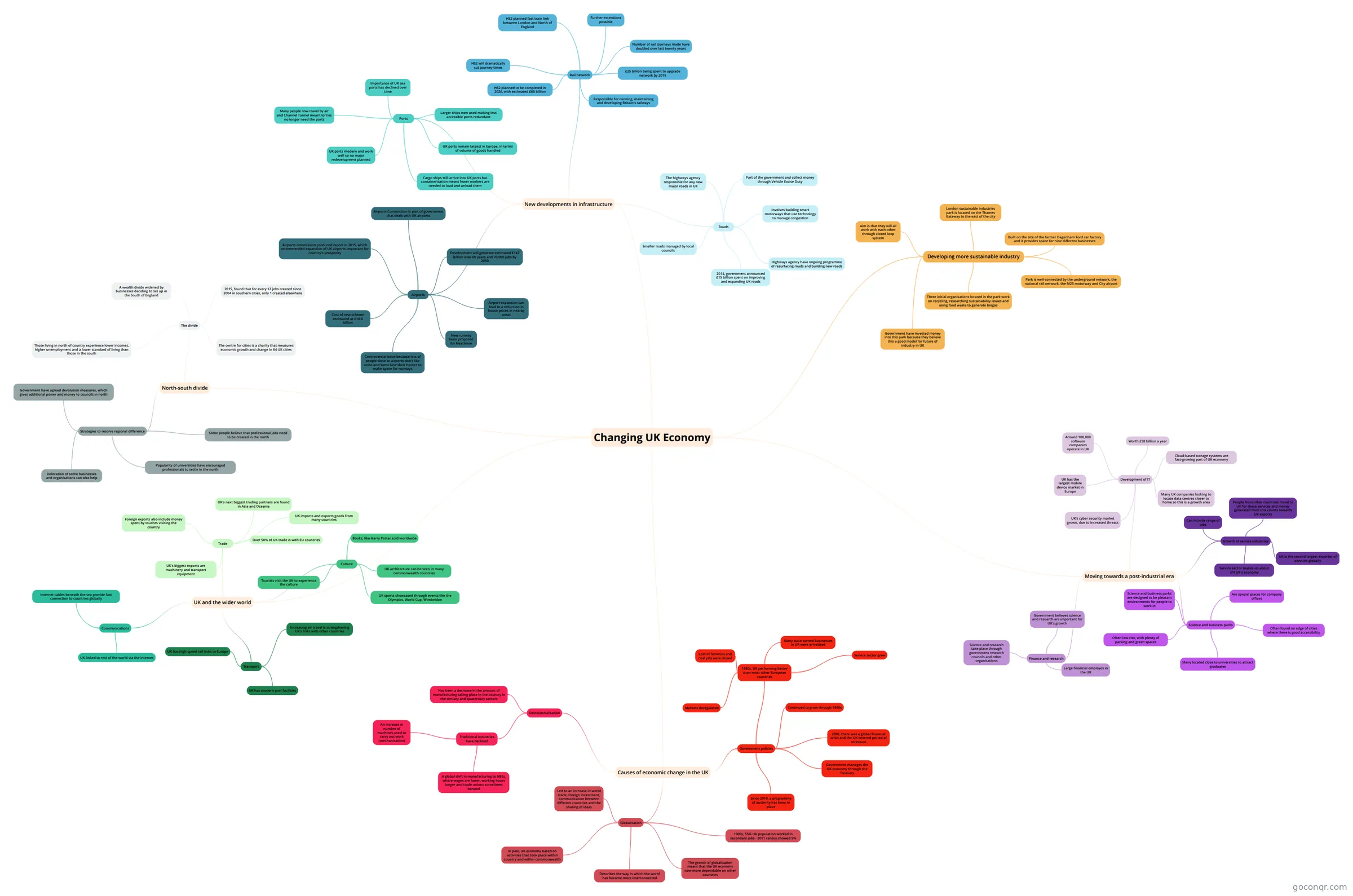
Mind map: Changing UK economy
Map content
Changing UK Economy
Causes of economic change in the UK
- Globalisation
- Describes the way in which the world has become more interconnected
- Led to an increase in world trade, foreign investment, communication between different countries and the sharing of ideas
- In past, UK economy based on activities that took place within country and within commonwealth
- The growth of globalisation meant that the UK economy now more dependable on other countries
- 1900s, 55% UK population worked in secondary jobs - 2011 census showed 9%
- Government policies
- Government manages the UK economy through the Treasury
- 1980s, UK performing better than most other European countries
- Many state-owned businesses in UK were privatised
- Markets deregulated
- Lots of factories and coal pits were closed
- Service sector grew
- Continued to grow through 1990s
- 2008, there was a global financial crisis and the UK entered period of recession
- Since 2010, a programme of austerity has been in place
- Deindustrialisation
- Has been a decrease in the amount of manufacturing taking place in the country in the tertiary and quaternary sectors
- Traditional industries have declined
- A global shift in manufacturing to NEEs, where wages are lower, working hours longer and trade unions sometimes banned
- An increase in number of machines used to carry out work (mechanisation)
- Globalisation
Moving towards a post-industrial era
- Development of IT
- Worth £58 billion a year
- Around 100,000 software companies operate in UK
- UK has the largest mobile device market in Europe
- Cloud-based storage systems are fast-growing part of UK economy
- Many UK companies looking to locate data centres closer to home so this is a growth area
- UK's cyber security market grown, due to increased threats
- Growth of service industries
- Service sector makes up about 3/4 UK's economy
- Can include range of jobs
- People from other countries travel to UK for these services and money generated from this counts towards UK exports
- UK is the second largest exporter of services globally
- Finance and research
- Large financial employes in the UK
- Government believes science and research are important for UK's growth
- Science and research take place through government research councils and other organisations
- Science and business parks
- Are special places for company offices
- Often found on edge of cities where there is good accessibility
- Many located close to universities to attract graduates
- Science and business parks are designed to be pleasant environments for people to work in
- Often low-rise, with plenty of parking and green spaces
- Development of IT
Developing more sustainable industry
- London sustainable industries park is located on the Thames Gateway to the east of the city
- Built on the site of the farmer Dagenham Ford car factory and it provides space for nine different businesses
- Park is well-connected by the underground network, the national rail network, the M25 motorway and City airport
- Three initial organisations located in the park work on recycling, researching sustainability issues and using food waste to generate biogas
- Aim is that they will all work with each other through closed loop system
- Government have invested money into this park because they believe this a good model for future of industry in UK
New developments in infrastructure
- Roads
- The highways agency responsible for any new major roads in UK
- Part of the government and collect money through Vehicle Excise Duty
- Smaller roads managed by local councils
- Highways agency have ongoing programme of resurfacing roads and building new roads
- 2014, government announced £15 billion spent on improving and expanding UK roads
- Involves building smart motorways that use technology to manage congestion
- Rail network
- Responsible for running, maintaining and developing Britain's railways
- Number of rail journeys made have doubled over last twenty years
- £25 billion being spent to upgrade network by 2019
- HS2 planned fast train link between London and North of England
- HS2 planned to be completed in 2026, with estimated £88 billion
- HS2 will dramatically cut journey times
- Further extensions possible
- Ports
- Importance of UK sea ports has declined over time
- Many people now travel by air and Channel Tunnel meant lorries no longer need the ports
- Cargo ships still arrive into UK ports but containerisation meant fewer workers are needed to load and unload them
- Larger ships now used making less accessible ports redundant
- UK ports remain largest in Europe, in terms of volume of goods handled
- UK ports modern and work well so no major redevelopment planned
- Airports
- Airports Commission is part of government that deals with UK airports
- Airports commission produced report in 2015, which recommended expansion of UK airports important for country's prosperity
- Controversial issue because lots of people close to airports don't like noise and some lose their homes to make space for runways
- Airport expansion can lead to a reduction in house prices in nearby areas
- New runway been proposed for Heathrow
- Development will generate estimated £147 billion over 60 years and 70,000 jobs by 2050
- Cost of new scheme estimated at £18.6 billion
- Roads
North-south divide
- The divide
- A wealth divide widened by businesses deciding to set up in the South of England
- Those living in north of country experience lower incomes, higher unemployment and a lower standard of living than those in the south
- The centre for cities is a charity that measures economic growth and change in 64 UK cities
- 2015, found that for every 12 jobs created since 2004 in southern cities, only 1 created elsewhere
- Strategies to resolve regional difference
- Government have agreed devolution measures, which gives additional power and money to councils in north
- Some people believe that professional jobs need to be created in the north
- Popularity of universities have encouraged professionals to settle in the north
- Relocation of some businesses and organisations can also help
- The divide
UK and the wider world
- Trade
- UK imports and exports goods from many countries
- Over 50% of UK trade is with EU countries
- UK's next biggest trading partners are found in Asia and Oceania
- Foreign exports also include money spent by tourists visiting the country
- UK's biggest exports are machinery and transport equipment
- Culture
- Books, like Harry Potter sold worldwide
- UK sports showcased through events like the Olympics, World Cup, Wimbeldon
- UK architecture can be seen in many commonwealth countries
- Tourists visit the UK to experience the culture
- Transport
- Increasing air travel is strengthening UK's links with other countries
- UK has modern port facilities
- UK has high speed rail links to Europe
- Communications
- UK linked to rest of the world via the internet
- Internet cables beneath the sea provide fast connection to countries globally
- Trade
Information
- Description
- GCSE Geography Mind Map on Changing UK Economy, created by Shannon Evans on 01/06/2020.
- Created by
- Shannon Evans
- Views
- 19
- Rating
More on The Changing UK Economy