
Mind map
Biology B2 - Evolution, Extinction and Speciation
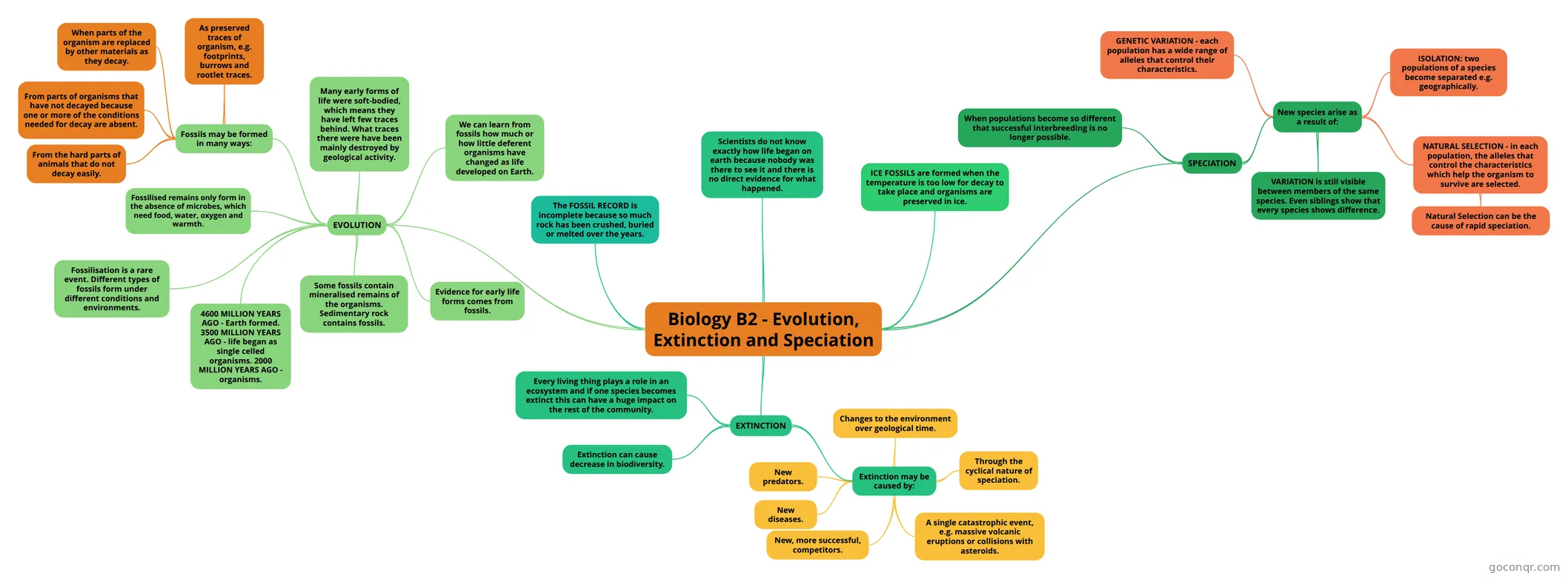
Mind map: Evolution, Extinction, and Speciation
Map content
Biology B2 - Evolution, Extinction and Speciation
EVOLUTION
- Evidence for early life forms comes from fossils.
- Some fossils contain mineralised remains of the organisms. Sedimentary rock contains fossils.
- Fossilisation is a rare event. Different types of fossils form under different conditions and environments.
- Fossilised remains only form in the absence of microbes, which need food, water, oxygen and warmth.
- Fossils may be formed in many ways:
- From the hard parts of animals that do not decay easily.
- From parts of organisms that have not decayed because one or more of the conditions needed for decay are absent.
- When parts of the organism are replaced by other materials as they decay.
- As preserved traces of organism, e.g. footprints, burrows and rootlet traces.
- Many early forms of life were soft-bodied, which means they have left few traces behind. What traces there were have been mainly destroyed by geological activity.
- We can learn from fossils how much or how little deferent organisms have changed as life developed on Earth.
- 4600 MILLION YEARS AGO - Earth formed. 3500 MILLION YEARS AGO - life began as single celled organisms. 2000 MILLION YEARS AGO - organisms.
EXTINCTION
- Every living thing plays a role in an ecosystem and if one species becomes extinct this can have a huge impact on the rest of the community.
- Extinction can cause decrease in biodiversity.
- Extinction may be caused by:
- Changes to the environment over geological time.
- New predators.
- New diseases.
- New, more successful, competitors.
- A single catastrophic event, e.g. massive volcanic eruptions or collisions with asteroids.
- Through the cyclical nature of speciation.
SPECIATION
- When populations become so different that successful interbreeding is no longer possible.
- New species arise as a result of:
- GENETIC VARIATION - each population has a wide range of alleles that control their characteristics.
- ISOLATION: two populations of a species become separated e.g. geographically.
- NATURAL SELECTION - in each population, the alleles that control the characteristics which help the organism to survive are selected.
- Natural Selection can be the cause of rapid speciation.
- VARIATION is still visible between members of the same species. Even siblings show that every species shows difference.
ICE FOSSILS are formed when the temperature is too low for decay to take place and organisms are preserved in ice.
The FOSSIL RECORD is incomplete because so much rock has been crushed, buried or melted over the years.
Scientists do not know exactly how life began on earth because nobody was there to see it and there is no direct evidence for what happened.
Information
- Description
- AS - Level Science Mind Map on Biology B2 - Evolution, Extinction and Speciation, created by Hannah Robinson on 06/05/2015.
- Created by
- Hannah Robinson
- Views
- 1
- Rating