
Mind map
Follower
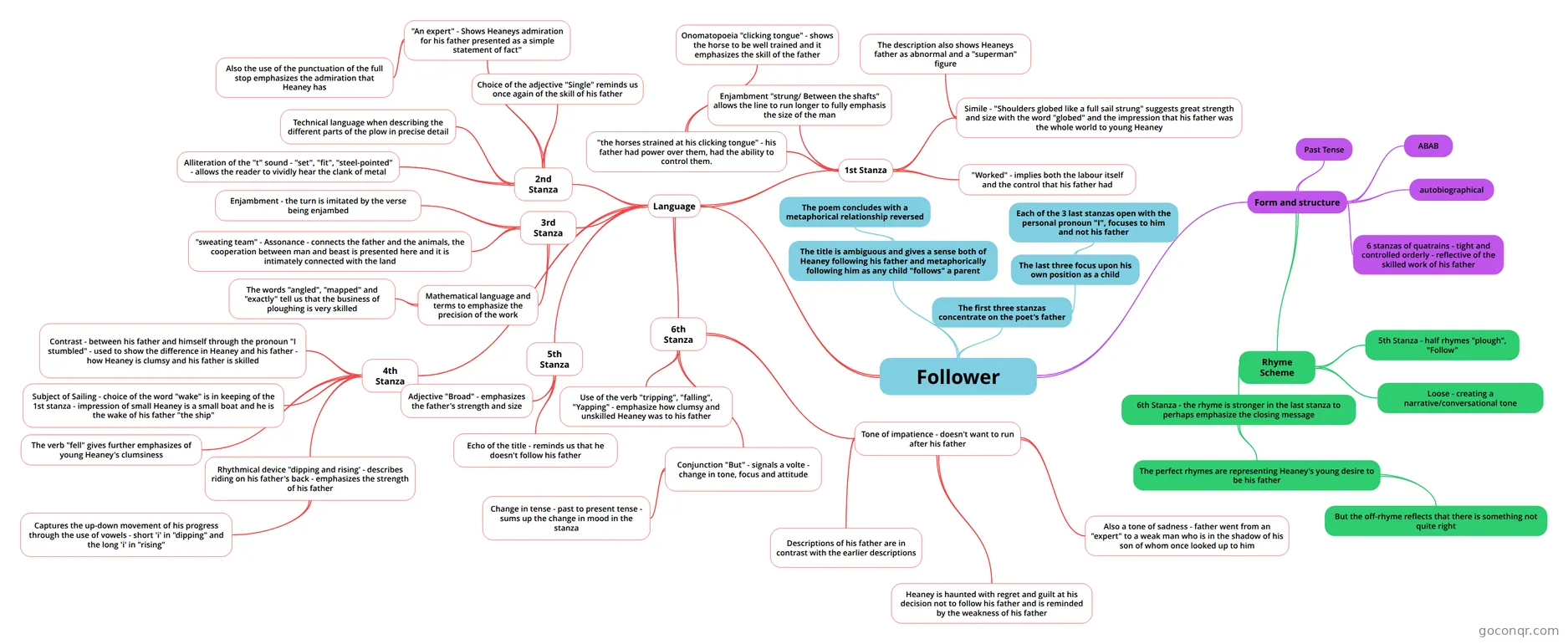
Mind map: Follower by Seamus Heaney
Map content
Follower
The title is ambiguous and gives a sense both of Heaney following his father and metaphorically following him as any child "follows" a parent
- The poem concludes with a metaphorical relationship reversed
Form and structure
- 6 stanzas of quatrains - tight and controlled orderly - reflective of the skilled work of his father
- autobiographical
- Past Tense
- Rhyme Scheme
- 5th Stanza - half rhymes "plough", "Follow"
- 6th Stanza - the rhyme is stronger in the last stanza to perhaps emphasize the closing message
- The perfect rhymes are representing Heaney's young desire to be his father
- But the off-rhyme reflects that there is something not quite right
- The perfect rhymes are representing Heaney's young desire to be his father
- Loose - creating a narrative/conversational tone
- ABAB
Language
- 1st Stanza
- "Worked" - implies both the labour itself and the control that his father had
- Simile - "Shoulders globed like a full sail strung" suggests great strength and size with the word "globed" and the impression that his father was the whole world to young Heaney
- The description also shows Heaneys father as abnormal and a "superman" figure
- Enjambment "strung/ Between the shafts" allows the line to run longer to fully emphasis the size of the man
- "the horses strained at his clicking tongue" - his father had power over them, had the ability to control them.
- Onomatopoeia "clicking tongue" - shows the horse to be well trained and it emphasizes the skill of the father
- 2nd Stanza
- "An expert" - Shows Heaneys admiration for his father presented as a simple statement of fact"
- Also the use of the punctuation of the full stop emphasizes the admiration that Heaney has
- Technical language when describing the different parts of the plow in precise detail
- Alliteration of the "t" sound - "set", "fit", "steel-pointed" - allows the reader to vividly hear the clank of metal
- Choice of the adjective "Single" reminds us once again of the skill of his father
- "An expert" - Shows Heaneys admiration for his father presented as a simple statement of fact"
- 3rd Stanza
- "sweating team" - Assonance - connects the father and the animals, the cooperation between man and beast is presented here and it is intimately connected with the land
- Enjambment - the turn is imitated by the verse being enjambed
- Mathematical language and terms to emphasize the precision of the work
- The words "angled", "mapped" and "exactly" tell us that the business of ploughing is very skilled
- 4th Stanza
- Contrast - between his father and himself through the pronoun "I stumbled" - used to show the difference in Heaney and his father - how Heaney is clumsy and his father is skilled
- Subject of Sailing - choice of the word "wake" is in keeping of the 1st stanza - impression of small Heaney is a small boat and he is the wake of his father "the ship"
- The verb "fell" gives further emphasizes of young Heaney's clumsiness
- Rhythmical device "dipping and rising' - describes riding on his father's back - emphasizes the strength of his father
- Captures the up-down movement of his progress through the use of vowels - short 'i' in "dipping" and the long 'i' in "rising"
- 5th Stanza
- Echo of the title - reminds us that he doesn't follow his father
- Adjective "Broad" - emphasizes the father's strength and size
- 6th Stanza
- Use of the verb "tripping", "falling", "Yapping" - emphasize how clumsy and unskilled Heaney was to his father
- Conjunction "But" - signals a volte - change in tone, focus and attitude
- Change in tense - past to present tense - sums up the change in mood in the stanza
- Tone of impatience - doesn't want to run after his father
- Descriptions of his father are in contrast with the earlier descriptions
- Also a tone of sadness - father went from an "expert" to a weak man who is in the shadow of his son of whom once looked up to him
- Heaney is haunted with regret and guilt at his decision not to follow his father and is reminded by the weakness of his father
- 1st Stanza
The first three stanzas concentrate on the poet's father
- The last three focus upon his own position as a child
- Each of the 3 last stanzas open with the personal pronoun "I", focuses to him and not his father
- The last three focus upon his own position as a child
Information
- Description
- Mind Map on Follower, created by Tracy O'Hagan on 20/05/2015.
- Created by
- Tracy O'Hagan
- Views
- 58
- Rating