
Mind map
Constructivism/Identity
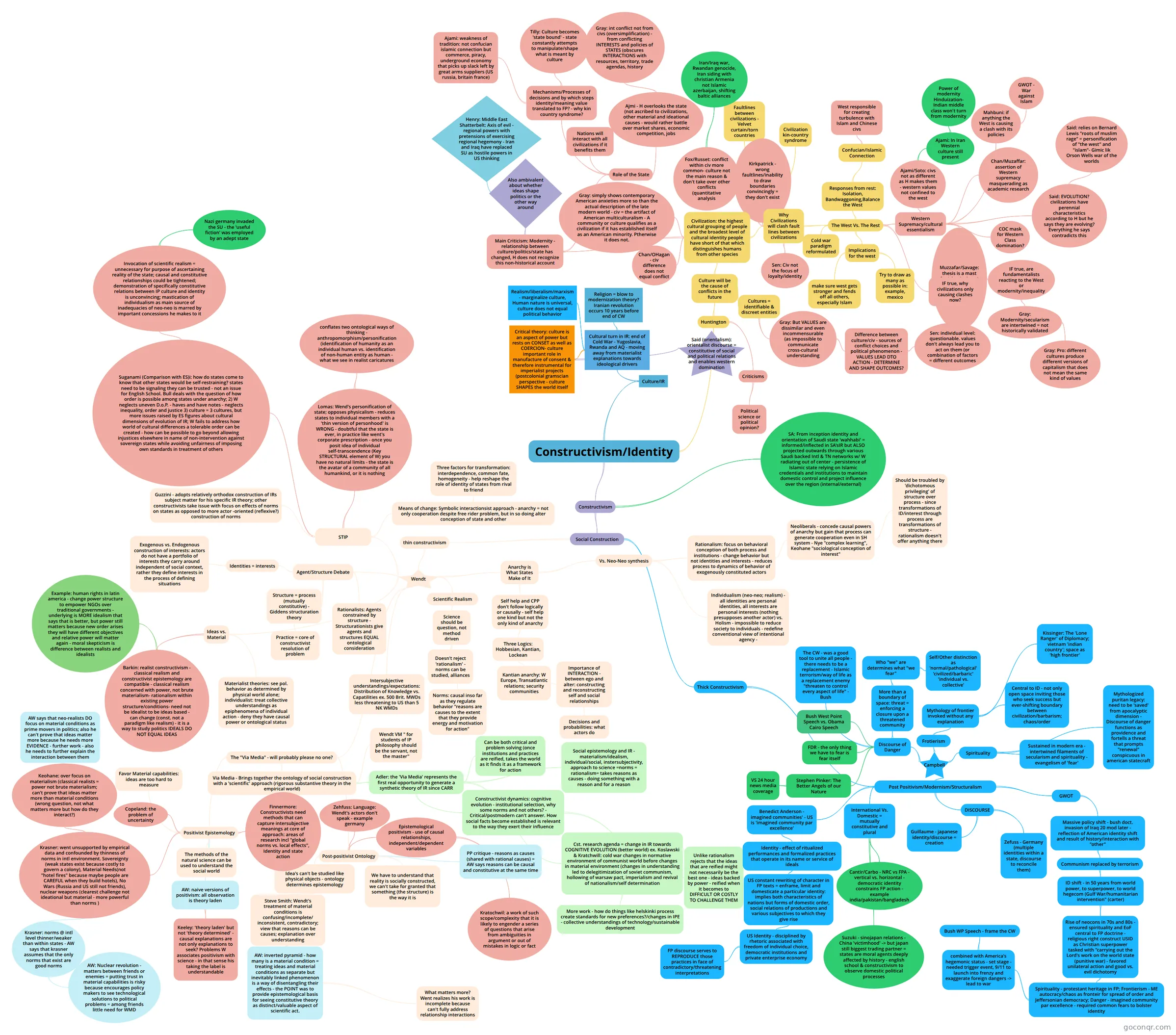
Mind map: Constructivism and identity in IR
Map content
Constructivism/Identity
Constructivism
- Social Construction
- thin constructivism
- Wendt
- Anarchy is What States Make of It
- Self help and CPP don't follow logically or causally - self help one kind but not the only kind of anarchy
- Three Logics: Hobbesian, Kantian, Lockean
- Kantian anarchy: W Europe, Transatlantic relations; security communities
- Importance of INTERACTION - between ego and alter: constructing and reconstructing self and social relationships
- Decisions and probabilities: what actors do
- Importance of INTERACTION - between ego and alter: constructing and reconstructing self and social relationships
- Kantian anarchy: W Europe, Transatlantic relations; security communities
- Three Logics: Hobbesian, Kantian, Lockean
- Vs. Neo-Neo synthesis
- Individualism (neo-neo; realism) - all identities are personal identities, all interests are personal interests (nothing presupposes another actor) vs. Holism - impossible to reduce society to individuals - redefine conventional view of intentional agency -
- Rationalism: focus on behavioral conception of both process and institutions - change behavior but not identities and interests - reduces process to dynamics of behavior of exogenously constituted actors
- Neoliberals - concede causal powers of anarchy but gain that process can generate cooperation even in SH system - Nye "complex learning", Keohane "sociological conception of interest"
- Should be troubled by 'dichotomous privileging' of structure over process - since transformations of ID/interest through process are transformations of structure - rationalism doesn't offer anything there
- Neoliberals - concede causal powers of anarchy but gain that process can generate cooperation even in SH system - Nye "complex learning", Keohane "sociological conception of interest"
- Self help and CPP don't follow logically or causally - self help one kind but not the only kind of anarchy
- The "Via Media" - will probably please no one?
- Positivist Epistemology
- The methods of the natural science can be used to understand the social world
- Copeland: the problem of uncertainty
- Favor Material capabilities: ideas are too hard to measure
- Krasner: went unsupported by empirical data and confounded by thinness of norms in intl environment. Sovereignty (weak states exist because costly to govern a colony), Material Needs(not "hotel fires" because maybe people are CAREFUL when they build hotels), No Wars (Russia and US still not friends), nuclear weapons (clearest challenge not ideational but material - more powerful than norms )
- Keohane: over focus on materialism (classical realists = power not brute materialism; can't prove that ideas matter more than material conditions (wrong question, not what matters more but how do they interact?)
- AW says that neo-realists DO focus on material conditions as prime movers in politics; also he can't prove that ideas matter more because he needs more EVIDENCE - further work - also he needs to further explain the interaction between them
- Krasner: norms @ intl level thinner/weaker than within states - AW says that krasner assumes that the only norms that exist are good norms
- AW: Nuclear revolution - matters between friends or enemies = putting trust in material capabilities is risky because encourages policy makers to see technological solutions to political problems = among friends little need for WMD
- Keohane: over focus on materialism (classical realists = power not brute materialism; can't prove that ideas matter more than material conditions (wrong question, not what matters more but how do they interact?)
- AW: naive versions of positivism: all observation is theory laden
- Keeley: 'theory laden' but not 'theory determined' - causal explanations are not only explanations to seek? Problems W associates positivism with science - in that sense his taking the label is understandable
- Finnermore: Constructivists need methods that can capture intersubjective meanings at core of approach: areas of research incl "global norms vs. local effects", Identity and state action
- Post-positivist Ontology
- We have to understand that reality is socially constructed, we can't take for granted that something (the structure) is the way it is
- Zehfuss: Language: Wendt's actors don't speak - example germany
- Epistemological positivism - use of causal relationships, independent/dependent variables
- Kratochwil: a work of such scope/complexity that it is likely to engender a series of questions that arise from ambiguities in argument or out of mistakes in logic or fact
- Idea's can't be studied like physical objects - ontology determines epistemology
- Steve Smith: Wendt's treatment of material conditions is confusing/incomplete/ inconsistent, contradictory; view that reasons can be causes; explanation over understanding
- AW: inverted pyramid - how many is a material condition = treating ideas and material conditions as separate but inevitably linked phenomenon is a way of disentangling their effects - the POINT was to provide epistemological basis for seeing constitutive theory as distinct/valuable aspect of scientific act.
- What matters more? Went realizes his work is incomplete because can't fully address relationship interactions
- AW: inverted pyramid - how many is a material condition = treating ideas and material conditions as separate but inevitably linked phenomenon is a way of disentangling their effects - the POINT was to provide epistemological basis for seeing constitutive theory as distinct/valuable aspect of scientific act.
- Steve Smith: Wendt's treatment of material conditions is confusing/incomplete/ inconsistent, contradictory; view that reasons can be causes; explanation over understanding
- PP critique - reasons as causes (shared with rational causes) = AW says reasons can be causal and constitutive at the same time
- Via Media - Brings together the ontology of social construction with a 'scientific' approach (rigorous substantive theory in the empirical world)
- Adler: the 'Via Media' represents the first real opportunity to generate a synthetic theory of IR since CARR
- Can be both critical and problem solving (once institutions and practices are reified, takes the world as it finds it as a framework for action
- Social epistemology and IR - materialism/idealism, individual/social, instersubjectivity, approach to science =norms = rationalism= takes reasons as causes - doing something with a reason and for a reason
- Constructivist dynamics: cognitive evolution - institutional selection, why some norms and not others? - Critical/postmodern can't answer. How social facts become established is relevant to the way they exert their influence
- Unlike rationalism rejects that the ideas that are reified might not necessarily be the best one - ideas backed by power - reified when it becomes to DIFFICULT OR COSTLY TO CHALLENGE THEM
- Cst. research agenda = change in IR towards COGNITIVE EVOLUTION (better world) ex. Koslawski & Kratchwill: cold war changes in normative environment of communist world before changes in material environment (changes in understanding led to delegitimization of soviet communism, hollowing of warsaw pact, imperialism and revival of nationalism/self determination
- More work - how do things like helskinki process create standards for new preferences?/changes in IPE - collective understandings of technology/sustainable development
- Wendt VM " for students of IP philosophy should be the servant, not the master"
- Adler: the 'Via Media' represents the first real opportunity to generate a synthetic theory of IR since CARR
- Positivist Epistemology
- Scientific Realism
- Science should be question, not method driven
- Norms: causal inso far as they regulate behavior "reasons are causes to the extent that they provide energy and motivation for action"
- Doesn't reject 'rationalism' - norms can be studied, alliances
- Science should be question, not method driven
- Agent/Structure Debate
- Identities = interests
- Exogenous vs. Endogenous construction of interests: actors do not have a portfolio of interests they carry around independent of social context, rather they define interests in the process of defining situations
- Structure = process (mutually constitutive) - Giddens structuration theory
- Practice = core of constructivist resolution of problem
- Rationalists: Agents constrained by structure - Structurationists give agents and structures EQUAL ontological consideration
- Identities = interests
- Intersubjective understandings/expectations: Distribution of Knowledge vs. Capatilities ex. 500 Brit. MWDs less threatening to US than 5 NK WMDs
- Ideas vs. Material
- Barkin: realist constructivism - classical realism and constructivist epistemology are compatible - classical realism concerned with power, not brute materialism- rationalism within existing power structure/conditions- need not be idealist to be ideas based - can change (const. not a paradigm like realism) - it is a way to study politics IDEALS DO NOT EQUAL IDEAS
- Example: human rights in latin america - change power structure to empower NGOs over traditional governments - underlying is MORE idealism that says that is better, but power still matters because new order arises they will have different objectives and relative power will matter again - moral skepticism is difference between realists and idealists
- Materialist theories: see pol. behavior as determined by physical world alone; individualist: treat collective understandings as epiphenomena of individual action - deny they have causal power or ontological status
- Barkin: realist constructivism - classical realism and constructivist epistemology are compatible - classical realism concerned with power, not brute materialism- rationalism within existing power structure/conditions- need not be idealist to be ideas based - can change (const. not a paradigm like realism) - it is a way to study politics IDEALS DO NOT EQUAL IDEAS
- STIP
- Guzzini - adopts relatively orthodox construction of IRs subject matter for his specific IR theory; other constructivists take issue with focus on effects of norms on states as opposed to more actor -oriented (reflexive?) construction of norms
- Means of change: Symbolic interactionsist approach - anarchy = not only cooperation despite free rider problem, but in so doing alter conception of state and other
- Three factors for transformation: interdependence, common fate, homogeneity - help reshape the role of identity of states from rival to friend
- Suganami (Comparison with ES)i: how do states come to know that other states would be self-restraining? states need to be signaling they can be trusted - not an issue for English School. Bull deals with the question of how order is possible among states under anarchy; 2) W neglects uneven D.o.P. - haves and have notes - neglects inequality, order and justice 3) culture = 3 cultures, but more issues raised by ES figures about cultural dimensions of evolution of IR; W fails to address how world of cultural differences a tolerable order can be created - how can be possible to go beyond allowing injustices elsewhere in name of non-intervention against sovereign states while avoiding unfairness of imposing own standards in treatment of others
- Invocation of scientific realism = unnecessary for purpose of ascertaining reality of the state; causal and constitutive relationships could be tightened; demonstration of specifically constitutive relations between IP culture and identity is unconvincing; mastication of individualism as main source of inadequacies of neo-neo is marred by important concessions he makes to it
- Nazi germany invaded the SU - the 'useful fiction' was employed by an adept state
- Invocation of scientific realism = unnecessary for purpose of ascertaining reality of the state; causal and constitutive relationships could be tightened; demonstration of specifically constitutive relations between IP culture and identity is unconvincing; mastication of individualism as main source of inadequacies of neo-neo is marred by important concessions he makes to it
- Lomas: Wend's personification of state; opposes physicalism - reduces states to individual members with a 'thin version of personhood' is WRONG - doubtful that the state is ever, in practice like went's corporate prescription - once you posit idea of individual self-transcendence (Key STRUCTURAL element of W) you have no natural limits - the state is the avatar of a community of all humankind, or it is nothing
- conflates two ontological ways of thinking - anthropomorphism/personification (identification of humanity as an individual human vs. identification of non-human entity as human - what we see in realist caricatures
- Anarchy is What States Make of It
- Wendt
- Thick Constructivism
- Post Positivism/Modernism/Structuralism
- Campbell
- Discourse of Danger
- Bush West Point Speech vs. Obama Cairo Speech
- FDR - the only thing we have to fear is fear itself
- Stephen Pinker: The Better Angels of our Nature
- VS 24 hour news media coverage
- The CW - was a good tool to unite all people - there needs to be a replacement - Islamic terrorism/way of life as a replacement enemy "threaten to control every aspect of life" - Bush
- More than a boundary of space: threat = enforcing a closure upon a threatened community
- Who "we" are determines what "we fear"
- Self/Other distinction as 'normal/pathological' 'civilized/barbaric' 'individual vs. collective'
- Who "we" are determines what "we fear"
- Frotierism
- Mythology of frontier invoked without any explanation
- Kissinger: The 'Lone Ranger' of Diplomacy; vietnam 'indian country'; space as 'high frontier'
- Central to ID - not only open space inviting those who seek success but ever-shifting boundary between civilization/barbarism; chaos/order
- Mythology of frontier invoked without any explanation
- Spirituality
- Mythologized puritan legacy: need to be 'saved' from apocalyptic dimension - Discourse of danger functions as providence and fortells a threat that prompts "renewal" conspicuous in american statecraft
- Sustained in modern era - intertwined filaments of secularism and spirituality - evangelism of 'fear'
- Discourse of Danger
- DISCOURSE
- Guillaume - japanese identity/discourse = creation
- Zefuss - Germany (multiple identities within a state, discourse to reconcile them)
- Benedict Anderson - imagined communities' - US is 'imagined community par excellence'
- Identity - effect of ritualized performances and formalized practices that operate in its name or service of ideals
- US constant rewriting of character in FP texts = enframe, limit and domesticate a particular identity: implies both characteristics of nations but forms of domestic order, social relations of productions and various subjectives to which they give rise
- US Identity - disciplined by rhetoric associated with freedom of individual choice, democratic institutions and private enterprise economy
- FP discourse serves to REPRODUCE those practices in face of contradictory/threatening interpretations
- US Identity - disciplined by rhetoric associated with freedom of individual choice, democratic institutions and private enterprise economy
- US constant rewriting of character in FP texts = enframe, limit and domesticate a particular identity: implies both characteristics of nations but forms of domestic order, social relations of productions and various subjectives to which they give rise
- Identity - effect of ritualized performances and formalized practices that operate in its name or service of ideals
- GWOT
- Massive policy shift - bush doct. invasion of Iraq 20 mod later - reflection of American identity shift and result of history/interaction with "other"
- Communism replaced by terrorism
- ID shift - in 50 years from world power, to superpower, to world hegecom (Gulf War/humanitarian intervention" (carter)
- Rise of neocons in 70s and 80s - ensured spirituality and EoF central to FP doctrine - religious right construct USID as Christian superpower tasked with "carrying out the Lord's work on the world state (punitive war) - favored unilateral action and good vs. evil dichotomy
- Spirituality - protestant heritage in FP; Frontierism - ME autocracy/chaos as fronteir for spread of order and Jeffersonian democracy; Danger - imagined community par excellence - required common fears to bolster identity
- combined with America's hegemonic status - set stage - needed trigger event, 9/11 to launch into frenzy and exaggerate foreign dangers -> lead to war
- Bush WP Speech - frame the CW
- combined with America's hegemonic status - set stage - needed trigger event, 9/11 to launch into frenzy and exaggerate foreign dangers -> lead to war
- Spirituality - protestant heritage in FP; Frontierism - ME autocracy/chaos as fronteir for spread of order and Jeffersonian democracy; Danger - imagined community par excellence - required common fears to bolster identity
- Rise of neocons in 70s and 80s - ensured spirituality and EoF central to FP doctrine - religious right construct USID as Christian superpower tasked with "carrying out the Lord's work on the world state (punitive war) - favored unilateral action and good vs. evil dichotomy
- ID shift - in 50 years from world power, to superpower, to world hegecom (Gulf War/humanitarian intervention" (carter)
- Communism replaced by terrorism
- Massive policy shift - bush doct. invasion of Iraq 20 mod later - reflection of American identity shift and result of history/interaction with "other"
- International Vs. Domestic = mutually constitutive and plural
- Cantir/Carbo - NRC vs FPA - vertical vs. horizontal - democratic identity constrains FP action - example india/pakistan/bangladesh
- Suzuki - sinojapan relations - China 'victimhood' -> but japan still biggest trading partner = states are moral agents deeply affected by history - english school & constructivism to observe domestic political processes
- Campbell
- Post Positivism/Modernism/Structuralism
- thin constructivism
- SA: From inception identity and orientation of Saudi state 'wahhabi' = informed/inflected in SA'sIR but ALSO projected outwards through various Saudi backed Intl & TN networks w/ W radiating out of center - persistence of Islamic state relying on Islamic credentials and institutions to maintain domestic control and project influence over the region (internal/external)
- Social Construction
Huntington
- Culture will be the cause of conflicts in the future
- Civilization: the highest cultural grouping of people and the broadest level of cultural identity people have short of that which distinguishes humans from other species
- Why Civilizations will clash fault lines between civilizations
- The West Vs. The Rest
- Responses from rest: Isolation, Bandwaggoning,Balance the West
- Confucian/Islamic Connection
- West responsible for creating turbulence with Islam and Chinese civs
- Confucian/Islamic Connection
- Implications for the west
- make sure west gets stronger and fends off all others, especially Islam
- Try to draw as many as possible in: example, mexico
- Cold war paradigm reformulated
- Western Supremacy/cultural essentialism
- Said: EVOLUTION? civilizations have perennial characteristics according to H but he says they are evolving? Everything he says contradicts this
- Said: relies on Bernard Lewis "roots of muslim rage" = personification of "the west" and "islam"- Gimic lik Orson Wells war of the worlds
- Ajami/Soto: civs not as different as H makes them - western values not confined to the west
- Ajami: In Iran Western culture still present
- Power of modernity Hinduization- Indian middle class won't turn from modernity
- Ajami: In Iran Western culture still present
- COC mask for Western Class domination?
- Muzzafar/Savage: thesis is a mast for Islamic threat for West after Cold War
- IF true, are fundamentalists reacting to the West or modernity/inequality
- Gray: Modernity/secularism are intertwined = not historically validated
- Gray: Pro: different cultures produce different versions of capitalism that does not mean the same kind of values
- Gray: Modernity/secularism are intertwined = not historically validated
- IF true, are fundamentalists reacting to the West or modernity/inequality
- Chan/Muzaffar: assertion of Western supremacy masquerading as academic research
- Mahbuni: if anything the West is causing a clash with its policies
- GWOT - War against Islam
- Said: EVOLUTION? civilizations have perennial characteristics according to H but he says they are evolving? Everything he says contradicts this
- IF true, why civilizations only causing clashes now?
- Responses from rest: Isolation, Bandwaggoning,Balance the West
- Faultlines between civilizations - Velvet curtain/torn countries
- Civilization kin-country syndrome
- Kirkpatrick - wrong faultlines/inability to draw boundaries convincingly = they don't exist
- Sen: Civ not the focus of loyalty/identity
- Fox/Russet: conflict within civ more common- culture not the main reason & don't take over other conflicts (quantitative analysis
- Iran/Iraq war, Rwandan genocide, Iran siding with christian Armenia not Islamic azerbaijan, shifting baltic alliances
- The West Vs. The Rest
- Chan/OHagan - civ difference does not equal conflict
- Main Criticism: Modernity - relationship between culture/politics/state has changed, H does not recognize this non-historical account
- Also ambivalent about whether ideas shape politics or the other way around
- Henry: Middle East Shatterbelt: Axis of evil - regional powers with pretensions of exercising regional hegemony - Iran and Iraq have replaced SU as hostile powers in US thinking
- Role of the State
- Ajmi - H overlooks the state (not ascribed to civilizations, other material and ideational causes - would rather battle over market shares, economic competition, jobs
- Gray: int conflict not from civs (oversimplification) - from conflicting INTERESTS and policies of STATES (obscures INTERACTIONS with resources, territory, trade agendas, history
- Mechanisms/Processes of decisions and by which steps identity/meaning value translated to FP? - why kin country syndrome?
- Tilly: Culture becomes 'state bound' - state constantly attempts to manipulate/shape what is meant by culture
- Ajami: weakness of tradition: not confucian islamic connection but commerce, piracy, underground economy that picks up slack left by great arms suppliers (US russia, britain france)
- Nations will interact with all civilizations if it benefits them
- Ajmi - H overlooks the state (not ascribed to civilizations, other material and ideational causes - would rather battle over market shares, economic competition, jobs
- Also ambivalent about whether ideas shape politics or the other way around
- Gray: simply shows contemporary American anxieties more so than the actual description of the late modern world - civ = the artifact of American multiculturalism - A community or culture qualifies as a civilization if it has established itself as an American minority. Ptherwise it does not.
- Why Civilizations will clash fault lines between civilizations
- Cultures = identifiable & discreet entities
- Gray: But VALUES are dissimilar and even incommensurable (as impossible to communicate cross-cultural understanding
- Difference between culture/civ - sources of conflict choices and political phenomenon - VALUES LEAD DTO ACTION - DETERMINE AND SHAPE OUTCOMES?
- Sen: individual level: questionable. values don't always lead you to act on them (or combination of factors = different outcomes
- Difference between culture/civ - sources of conflict choices and political phenomenon - VALUES LEAD DTO ACTION - DETERMINE AND SHAPE OUTCOMES?
- Gray: But VALUES are dissimilar and even incommensurable (as impossible to communicate cross-cultural understanding
- Civilization: the highest cultural grouping of people and the broadest level of cultural identity people have short of that which distinguishes humans from other species
- Criticisms
- Political science or political opinion?
- Culture will be the cause of conflicts in the future
Culture/IR
- Cultural turn in IR: end of Cold War - Yugoslavia, Rwanda and AQ - moving away from materialist explanations towards ideological drivers
- Religion = blow to modernization theory? Iranian revolution occurs 10 years before end of CW
- Realism/liberalism/marxism - marginalize culture, Human nature is universal, culture does not equal political behavior
- Critical theory: culture is an aspect of power but rests on CONSET as well as COERCION- culture important role in manufacture of consent & therefore instrumental for imperialist projects (postcolonial gramscian perspective - culture SHAPES the world itself
- Said (orientalism): orientalist discourse = constitutive of social and political relations and enables western domination
- Cultural turn in IR: end of Cold War - Yugoslavia, Rwanda and AQ - moving away from materialist explanations towards ideological drivers
Information
- Description
- IR Mind Map on Constructivism/Identity, created by Rachel Gabriel on 25/05/2015.
- Created by
- Rachel Gabriel
- Views
- 2
- History
-
- Created by Rachel Gabriel · May 25, 2015
- Copied by Rachel Gabriel · May 25, 2015
- Rating
More on Constructivism in International Relations