
Mind map
form and analysis
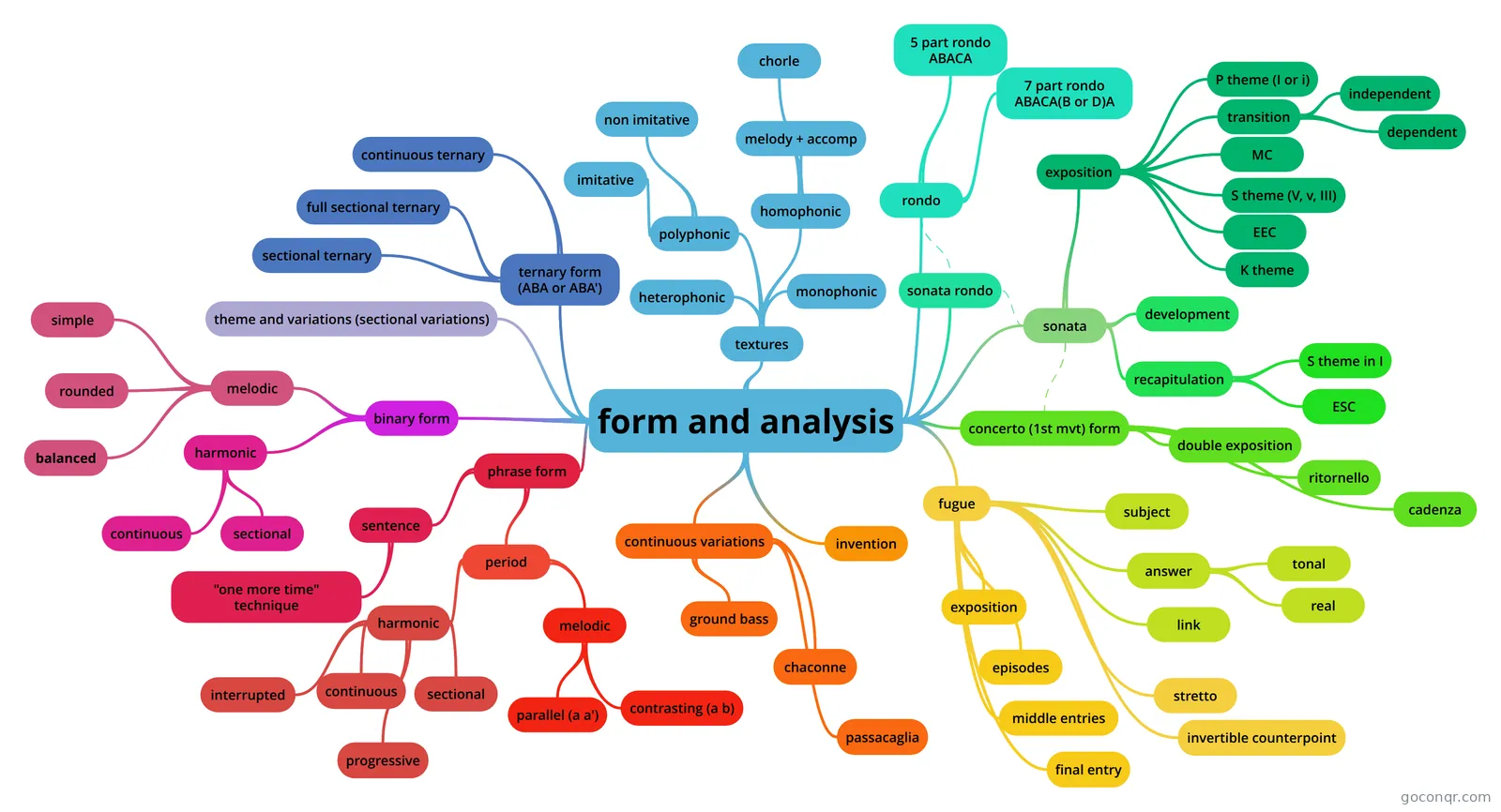
Mind map: form and analysis
Map content
form and analysis
theme and variations (sectional variations)
rondo
- alternating refrain and digressions B- often in V, v or III C- less consistent key common for each section to be its own binary form
- 5 part rondo ABACA
- 7 part rondo ABACA(B or D)A
ternary form (ABA or ABA')
- - may include transitions or retransitions (may be difficult to distinguish between continuous or sectional w/ transitions) - B sections more distinct than in rounded binary - often printed with D.C. al fine - compound ternary form
- sectional ternary
- AB | A - A section moves away from its own tonic, while B section ends in its tonic A | BA - A section ends in its own tonic, B section moves more continuously to A's reprise
- full sectional ternary
- each of the three sections ends on the tonic of the key it began in
- continuous ternary
- each of the three sections ends on a different key than the theme's tonic
sonata
- exposition
- P theme (I or i)
- often presentational, strong
- transition
- energized surface texture, "breaking out"
- independent
- a new theme
- dependent
- uses previous theme, ie; dissolving restatement
- MC
- strong HC in the new key
- S theme (V, v, III)
- tends to be more gentle, piano, lyrical
- EEC
- first satisfactory PAC in new key
- K theme
- confirmation, lots of V I motion
- P theme (I or i)
- development
- recapitulation
- generally gets "off track" somewhere in transition- the point at which it gets back on track is called the crux
- ESC
- S theme in I
- exposition
fugue
- an imitative counterpoint for a fixed number of voices that are based upon a short theme first, subject is stated in each of the lines, then brought back in a variety of waysthe fugue is a procedure, NOT a form, so fugues may exhibit a variety of forms
- subject
- the short theme on which the contrapuntal lines are based
- answer
- a statement of the subject in the dominant at the first exposition
- real
- an exact transposition
- tonal
- not an exact transposition
- exposition
- each voice in turn states the theme (either a subject or an answer)
- link
- short passages used to connect subjects and answers
- episodes
- a portion of a fugue in which the subject is not stated- often develops motives from the subject or countersubject
- middle entries
- may be varied rhythmically or intervallicly (inversion, retrograde, augmentation, diminution, other changes)
- stretto
- when statements of the subject overlap may use the whole subject or the first part of the subject
- invertible counterpoint
- when 2 or more melodic lines exchange places
- final entry
- the last time the subject enters- not necessarily the end of the fugue
binary form
- A and B often repeat B material is often a monte (mountain- ascending sequence), ponte (bridge) or fonte (foundtain- descending sequence)
- melodic
- simple
- none of the A section returns at the end of the B section
- rounded
- part of the A section comes back at the end of the B section
- balanced
- part of A section comes back at the end of the B section, transposed (typically from V to I)
- simple
- harmonic
- continuous
- A sec
- sectional
- A section is harmonically closed: ends on a PAC in I
- continuous
continuous variations
- no formal break between theme and its variations these three terms were more distinct in 17th century, began being used interchangably in 18th century
- ground bass
- bassline stays constant
- chaconne
- harmonic pattern stays (does NOT have to be the exact same chords)
- passacaglia
- repeated melody (usually begins in bass and moves up through voices)
sonata rondo
- has some elements of both
invention
- bach's inventions... "shows methods of arriving at good musical ideas and of developing them satisfactorily" not all use imitation
concerto (1st mvt) form
- sonata form with some differences
- double exposition
- the orchestra has an exposition, then the soloist does creates a conflict for composers, as there can only be 1 recap
- ritornello
- at the end of the exposition, orch returns- has to at least dip into the new key a little
- cadenza
- somewhere towards the end of the recap-
phrase form
- also: compound period, nested sentence phrase overlap
- period
- **no formal breaks between a theme and its variations
- harmonic
- interrupted
- a section ends with a HC, next section re-begins on I
- sectional
- a section harmonically closed: ends with an IAC in I
- progressive
- ends with a PAC in a different key
- continuous
- a ends with a HC, next section does NOT begin on I
- interrupted
- melodic
- parallel (a a')
- contrasting (a b)
- sentence
- short idea, repetition of short idea, extension of short idea ending with a cadence often 1:1:2 proportions
- "one more time" technique
textures
- polyphonic
- multiple voices of equal importance
- imitative
- 2 or more independent voices which converse with statements of an identical or very similar idea
- non imitative
- monophonic
- only 1 voice
- homophonic
- multiple voices of differing levels of importance
- melody + accomp
- accomp is often: chordal: block chords, rhythmic punctuation, broken chords: arpeggiated, alberti bass (1535), can have ornamental tones, waltz
- chorle
- heterophonic
- important voice doubled in multiple instruments (less common in western music)
- polyphonic
Information
- Description
- music Mind Map on form and analysis, created by Meredith Wickless on 08/12/2022.
- Created by
- Meredith Wickless
- Views
- 0
- Rating