
Mind map
Pollution Controls
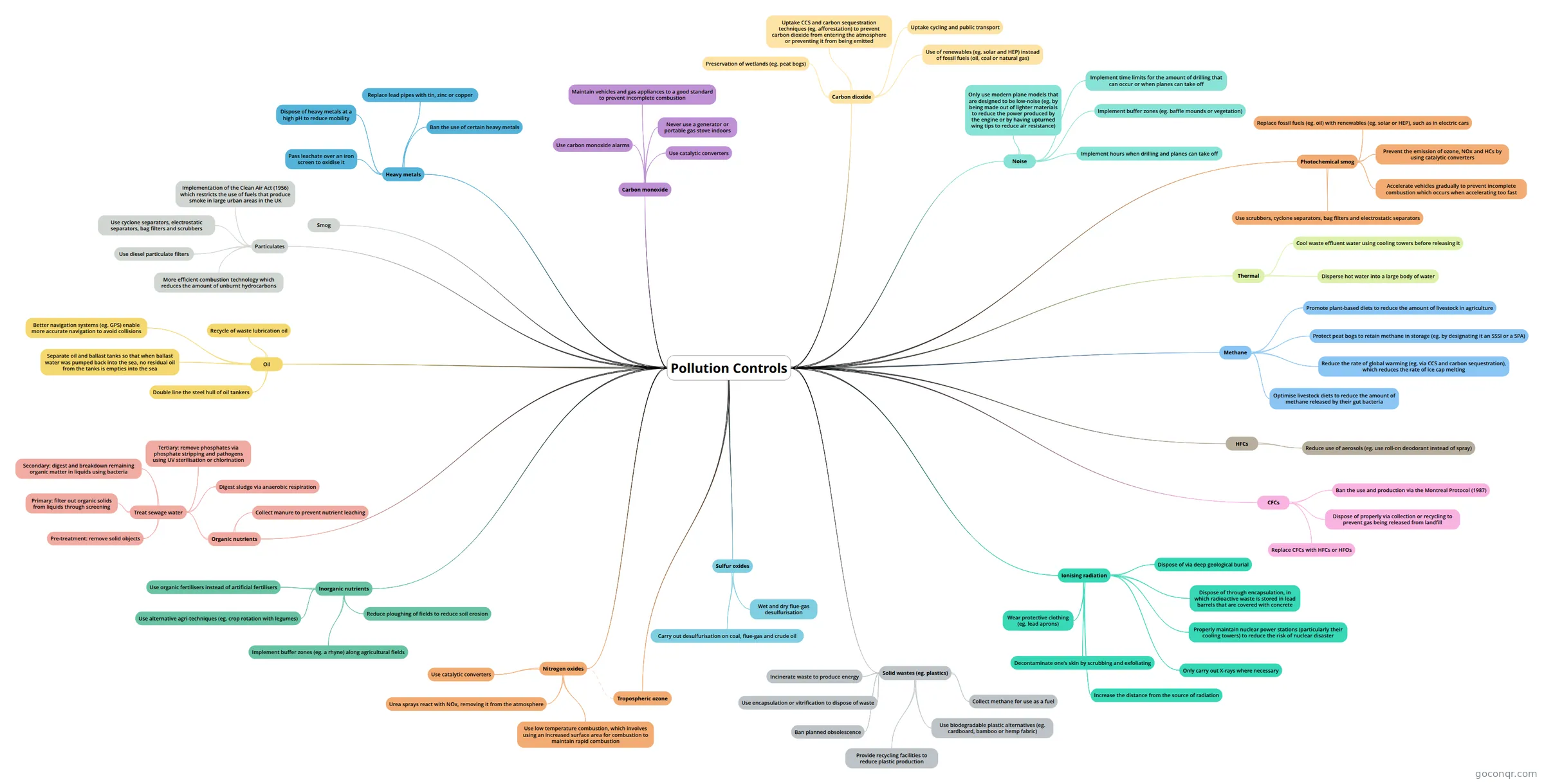
Mind map: Pollution controls
Map content
Pollution Controls
Carbon dioxide
- Use of renewables (eg. solar and HEP) instead of fossil fuels (oil, coal or natural gas)
- Uptake CCS and carbon sequestration techniques (eg. afforestation) to prevent carbon dioxide from entering the atmosphere or preventing it from being emitted
- Uptake cycling and public transport
- Preservation of wetlands (eg. peat bogs)
Methane
- Promote plant-based diets to reduce the amount of livestock in agriculture
- Protect peat bogs to retain methane in storage (eg. by designating it an SSSI or a SPA)
- Reduce the rate of global warming (eg. via CCS and carbon sequestration), which reduces the rate of ice cap melting
- Optimise livestock diets to reduce the amount of methane released by their gut bacteria
Nitrogen oxides
- Use low temperature combustion, which involves using an increased surface area for combustion to maintain rapid combustion
- Urea sprays react with NOx, removing it from the atmosphere
- Use catalytic converters
Sulfur oxides
- Carry out desulfurisation on coal, flue-gas and crude oil
- Wet and dry flue-gas desulfurisation
Smog
Particulates
- Use diesel particulate filters
- Use cyclone separators, electrostatic separators, bag filters and scrubbers
- Implementation of the Clean Air Act (1956) which restricts the use of fuels that produce smoke in large urban areas in the UK
- More efficient combustion technology which reduces the amount of unburnt hydrocarbons
Photochemical smog
- Replace fossil fuels (eg. oil) with renewables (eg. solar or HEP), such as in electric cars
- Prevent the emission of ozone, NOx and HCs by using catalytic converters
- Accelerate vehicles gradually to prevent incomplete combustion which occurs when accelerating too fast
- Use scrubbers, cyclone separators, bag filters and electrostatic separators
Tropospheric ozone
Organic nutrients
- Treat sewage water
- Pre-treatment: remove solid objects
- Primary: filter out organic solids from liquids through screening
- Secondary: digest and breakdown remaining organic matter in liquids using bacteria
- Tertiary: remove phosphates via phosphate stripping and pathogens using UV sterilisation or chlorination
- Digest sludge via anaerobic respiration
- Collect manure to prevent nutrient leaching
- Treat sewage water
Inorganic nutrients
- Use organic fertilisers instead of artificial fertilisers
- Use alternative agri-techniques (eg. crop rotation with legumes)
- Implement buffer zones (eg. a rhyne) along agricultural fields
- Reduce ploughing of fields to reduce soil erosion
Oil
- Double line the steel hull of oil tankers
- Recycle of waste lubrication oil
- Better navigation systems (eg. GPS) enable more accurate navigation to avoid collisions
- Separate oil and ballast tanks so that when ballast water was pumped back into the sea, no residual oil from the tanks is empties into the sea
Heavy metals
- Pass leachate over an iron screen to oxidise it
- Dispose of heavy metals at a high pH to reduce mobility
- Replace lead pipes with tin, zinc or copper
- Ban the use of certain heavy metals
Noise
- Implement time limits for the amount of drilling that can occur or when planes can take off
- Implement buffer zones (eg. baffle mounds or vegetation)
- Only use modern plane models that are designed to be low-noise (eg. by being made out of lighter materials to reduce the power produced by the engine or by having upturned wing tips to reduce air resistance)
- Implement hours when drilling and planes can take off
Thermal
- Cool waste effluent water using cooling towers before releasing it
- Disperse hot water into a large body of water
CFCs
- Ban the use and production via the Montreal Protocol (1987)
- Dispose of properly via collection or recycling to prevent gas being released from landfill
- Replace CFCs with HFCs or HFOs
HFCs
- Reduce use of aerosols (eg. use roll-on deodorant instead of spray)
Solid wastes (eg. plastics)
- Use biodegradable plastic alternatives (eg. cardboard, bamboo or hemp fabric)
- Provide recycling facilities to reduce plastic production
- Collect methane for use as a fuel
- Use encapsulation or vitrification to dispose of waste
- Incinerate waste to produce energy
- Ban planned obsolescence
Carbon monoxide
- Use carbon monoxide alarms
- Maintain vehicles and gas appliances to a good standard to prevent incomplete combustion
- Never use a generator or portable gas stove indoors
- Use catalytic converters
Ionising radiation
- Dispose of through encapsulation, in which radioactive waste is stored in lead barrels that are covered with concrete
- Dispose of via deep geological burial
- Properly maintain nuclear power stations (particularly their cooling towers) to reduce the risk of nuclear disaster
- Wear protective clothing (eg. lead aprons)
- Only carry out X-rays where necessary
- Increase the distance from the source of radiation
- Decontaminate one's skin by scrubbing and exfoliating
Information
- Description
- A level Environmental Studies Mind Map on Pollution Controls, created by Am Hawk on 14/05/2024.
- Created by
- Am Hawk
- Views
- 1
- Rating