
Mind map
ENGLISH
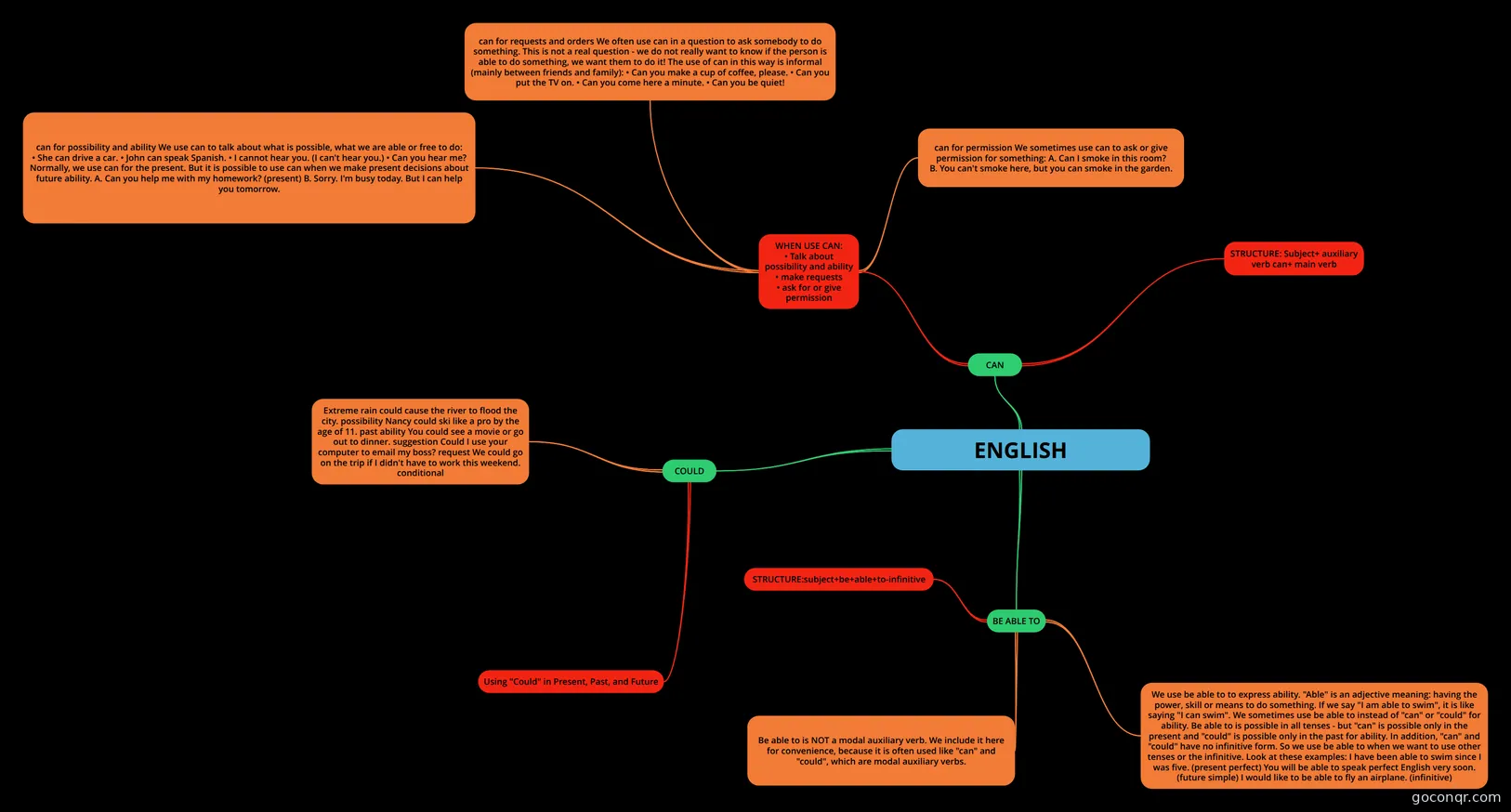
Mind map: can could and be able to
Map content
ENGLISH
CAN
- WHEN USE CAN: • Talk about possibility and ability • make requests • ask for or give permission
- can for possibility and ability We use can to talk about what is possible, what we are able or free to do: • She can drive a car. • John can speak Spanish. • I cannot hear you. (I can't hear you.) • Can you hear me? Normally, we use can for the present. But it is possible to use can when we make present decisions about future ability. A. Can you help me with my homework? (present) B. Sorry. I'm busy today. But I can help you tomorrow.
- can for requests and orders We often use can in a question to ask somebody to do something. This is not a real question - we do not really want to know if the person is able to do something, we want them to do it! The use of can in this way is informal (mainly between friends and family): • Can you make a cup of coffee, please. • Can you put the TV on. • Can you come here a minute. • Can you be quiet!
- can for permission We sometimes use can to ask or give permission for something: A. Can I smoke in this room? B. You can't smoke here, but you can smoke in the garden.
- STRUCTURE: Subject+ auxiliary verb can+ main verb
- WHEN USE CAN: • Talk about possibility and ability • make requests • ask for or give permission
COULD
- Using "Could" in Present, Past, and Future
- Extreme rain could cause the river to flood the city. possibility Nancy could ski like a pro by the age of 11. past ability You could see a movie or go out to dinner. suggestion Could I use your computer to email my boss? request We could go on the trip if I didn't have to work this weekend. conditional
BE ABLE TO
- STRUCTURE:subject+be+able+to-infinitive
- Be able to is NOT a modal auxiliary verb. We include it here for convenience, because it is often used like "can" and "could", which are modal auxiliary verbs.
- We use be able to to express ability. "Able" is an adjective meaning: having the power, skill or means to do something. If we say "I am able to swim", it is like saying "I can swim". We sometimes use be able to instead of "can" or "could" for ability. Be able to is possible in all tenses - but "can" is possible only in the present and "could" is possible only in the past for ability. In addition, "can" and "could" have no infinitive form. So we use be able to when we want to use other tenses or the infinitive. Look at these examples: I have been able to swim since I was five. (present perfect) You will be able to speak perfect English very soon. (future simple) I would like to be able to fly an airplane. (infinitive)
Information
- Description
- Mind Map on ENGLISH, created by Álvaro Minguito, Rodríguez on 25/01/2016.
- Created by
- Álvaro Minguito, Rodríguez
- Views
- 1
- Rating