
Mind map
6.3 Intermolecular Forces
Map content
6.3 Intermolecular Forces
Covalent bonding is strong and holds the atoms in a amolecule together. INTERMOLECULAR forces are weak interactions between dipoles of different molecules. Intermolecular forces fall into three main categories...
- ... Induced dipole-dipole interactions / London Forces
- 1-10 kJmol-1
- ... Permanent dipole-dipole interactions
- 3-25 kJmol-1
- ... Hydrogen Bonding
- 10-40kJmol-1
- ... Induced dipole-dipole interactions / London Forces
Intermolecular forces are responsible for physical properties such as melting/boiling points, where as covalent bonds determine the identity and chemical reactions of molecules
Induced dipole-dipole interactions (London Forces)
- Weak intermolecular forces
- exist between ALL molecules
- They act between induced dipoles in different molecules
- What is an induced dipole?
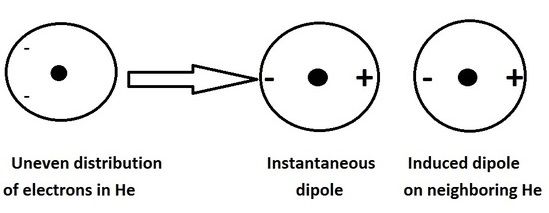
- Electrons are mobile and so their movement produces a changing dipole in a molecule
- At any instant, an instantaneous dipole will exist, but its position is constantly shifting
- The instantaneous dipole INDUCES a dipole on a neighbouring molecule
- The induced dipole induces further dipoles on neighbourin gmolecules, which then attract one another
- The instantaneous dipole INDUCES a dipole on a neighbouring molecule
- At any instant, an instantaneous dipole will exist, but its position is constantly shifting
- Induced dipole-dipoles are temporary
- The strength of induced dipole-dipole interactions
- The more electrons in each molecule, the larger the instantaneous and induced dipole, this means the induced dipole-dipole interactions are greater and the attractive forced between the molecules are stronger.
- Larger numbers of electrons means larger induced dipoles, so, more energy is needed to overcome the intermolecular forces, increasing the BOILING POINT
- The more electrons in each molecule, the larger the instantaneous and induced dipole, this means the induced dipole-dipole interactions are greater and the attractive forced between the molecules are stronger.
- Electrons are mobile and so their movement produces a changing dipole in a molecule
- What is an induced dipole?
Permanent Dipole-Dipole Interactions
- act between the permanent dipole in different polar molecules
- Comparing Hydrogen Chloride and Fluorine
- Molecule
- F - F
- none
- yes
- no
- 9 x 2 = 18
- -220
- 9 x 2 = 18
- no
- yes
- H-Cl
- H s+ -- Cl s-
- yes
- yes
- 1+17 = 18
- -85
- 1+17 = 18
- yes
- yes
- - Fluorine molecules are non-polar and only have London Forces between molecules
- - Hydrogen chloride molecules are polar and have London forces AND permanent dipole-dipole interactions between molecules
- - Extra energy is needed to break the additional permanent dipole-dipole interactions between hydrogen chloride molecules
- - Therefore the boiling point of Hydrogen Chloride is higher than Fluorine
- - Extra energy is needed to break the additional permanent dipole-dipole interactions between hydrogen chloride molecules
- - Hydrogen chloride molecules are polar and have London forces AND permanent dipole-dipole interactions between molecules
- H s+ -- Cl s-
- none
- F - F
- Dipole
- London Forces
- Permanent Dipole-dipole interactions
- Number of Electrons
- Boiling point/ degrees C
- Molecule
Simple Molecular Substances
- A simple molecular substance is made up of simple molecules - small units containing a definite number of atoms with a definite molecular formula, such as neon, Ne, hydrogen, H2, water H2O and carbon dioxide CO2
- In the solid state = form regular structure called a simple molecular lattice
- molecules held in place by weak intermolecular forces
- atoms within each molecule are bonded together strongly by covalent bonds
- In the solid state = form regular structure called a simple molecular lattice
- Properties of simple molecular substances
- Low melting and boiling point
- At room temperature, simple molecular substances may exist as solids, liquids or gases. All SMS can be solidified into simple molecular lattices be reducing the temperature
- In a simple molecular lattice, the weak intermolecular forces can be broken even by the energy present at low temperatures
- SMS have LOW melting and boiling points
- When a SM lattice is broken apart during melting
- only the weak intermolecular forces break
- the covalent bonds are strong and DO NOT break
- At room temperature, simple molecular substances may exist as solids, liquids or gases. All SMS can be solidified into simple molecular lattices be reducing the temperature
- Solubility
- Covalent substances with simple molecular structures fall into two categories, polar and non-polar
- Solubility of non-polar simple molecular substances
- When a simple molecular compound is added to a non-polar solvent, such as hexane, intermolecular forces form between the molecules and the solvent
- The interactions weaken the intermolecular forces in the simple molecular lattice. The intermolecular forces break and the compound dissolves
- Therefore, non-polar SMS tend to be soluble in non-polar solvents
- When a SMS is added to a polar solvent, there is little interaction between the molecules in the lattice and the solvent molecules
- The intermolecular bonding within the polar solvent is too strong to be broken
- Therefore SMS tend to be insoluble in polar solvents
- The intermolecular bonding within the polar solvent is too strong to be broken
- When a SMS is added to a polar solvent, there is little interaction between the molecules in the lattice and the solvent molecules
- Therefore, non-polar SMS tend to be soluble in non-polar solvents
- The interactions weaken the intermolecular forces in the simple molecular lattice. The intermolecular forces break and the compound dissolves
- When a simple molecular compound is added to a non-polar solvent, such as hexane, intermolecular forces form between the molecules and the solvent
- Solubility of polar SMS
- Polar covalent substances may dissolve in polar solvents as the polar solute molecules and the polar solvent molecules can attract each other
- Process is similar to dissolving an ionic compound
- Solubility depends on the strength of the dipole and can be hard to predict. Some compounds such as ethanol, C2H5OH, contain both polar (the O-H) and non-polar (the C chain) parts in their structure and can dissolve in both polar and non-polar solvents
- Process is similar to dissolving an ionic compound
- Polar covalent substances may dissolve in polar solvents as the polar solute molecules and the polar solvent molecules can attract each other
- Solubility of non-polar simple molecular substances
- Covalent substances with simple molecular structures fall into two categories, polar and non-polar
- Electrical Conductivity
- No mobile charged particles in SMS
- With no charged particles that can move, there is nothing to complete and electrical circuit
- Therefore SMS are non-conductors of electricity
- Low melting and boiling point
- A simple molecular substance is made up of simple molecules - small units containing a definite number of atoms with a definite molecular formula, such as neon, Ne, hydrogen, H2, water H2O and carbon dioxide CO2
Images and files in the map
Information
- Description
- AS - Level Chemistry (6 - Shapes of Molecules and Intermolecular Forces) Mind Map on 6.3 Intermolecular Forces, created by Bee Brittain on 17/04/2016.
- Created by
- Bee Brittain
- Views
- 278
- Tags
- Rating