
Mind map
Chapter 16,17,19 Con.
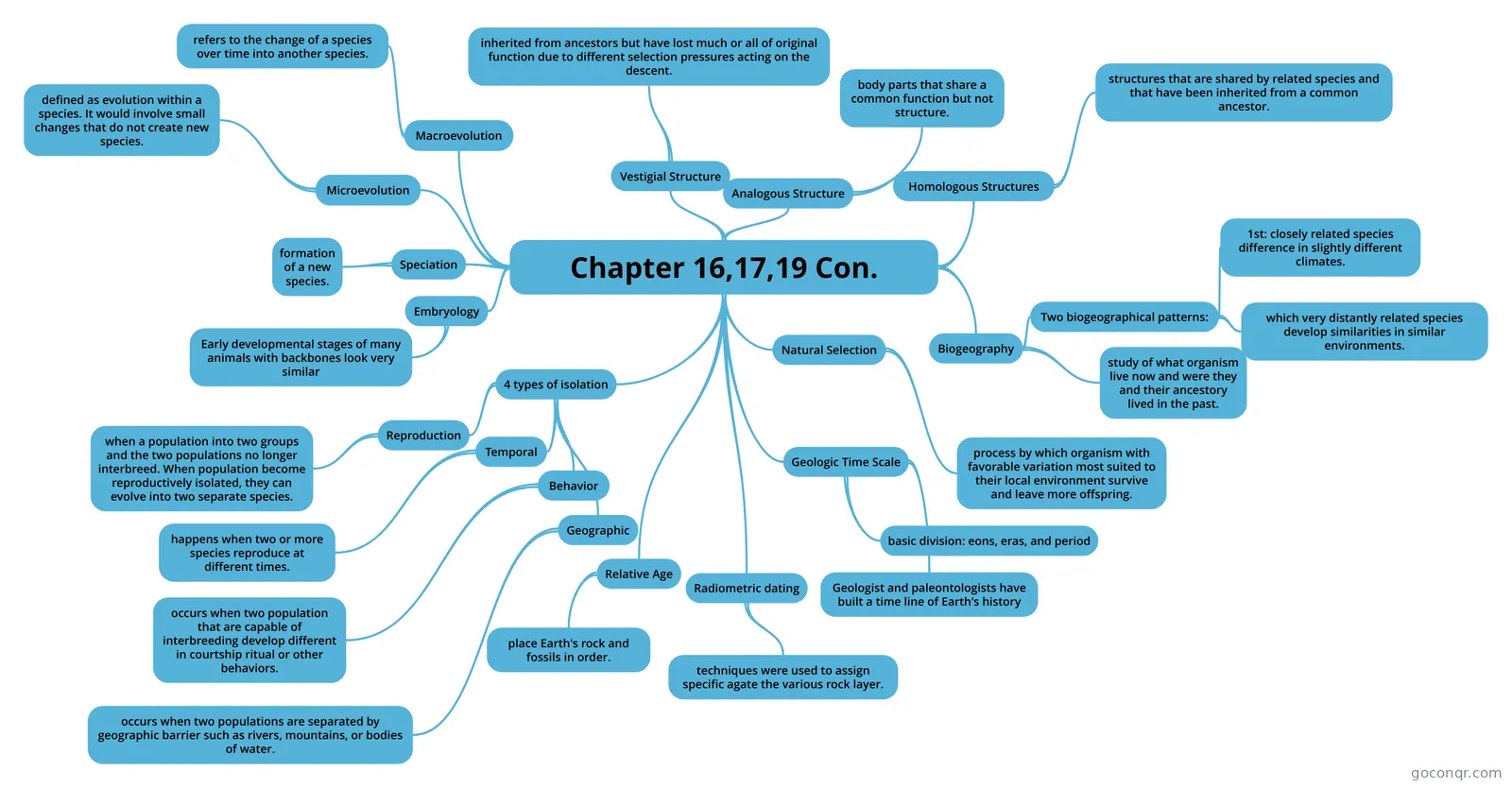
Mind map: Natural selection and evolution evidence
Map content
Chapter 16,17,19 Con.
Natural Selection
- process by which organism with favorable variation most suited to their local environment survive and leave more offspring.
Biogeography
- study of what organism live now and were they and their ancestory lived in the past.
- Two biogeographical patterns:
- 1st: closely related species difference in slightly different climates.
- which very distantly related species develop similarities in similar environments.
Homologous Structures
- structures that are shared by related species and that have been inherited from a common ancestor.
Analogous Structure
- body parts that share a common function but not structure.
Vestigial Structure
- inherited from ancestors but have lost much or all of original function due to different selection pressures acting on the descent.
Embryology
- Early developmental stages of many animals with backbones look very similar
Speciation
- formation of a new species.
4 types of isolation
- Reproduction
- when a population into two groups and the two populations no longer interbreed. When population become reproductively isolated, they can evolve into two separate species.
- Temporal
- happens when two or more species reproduce at different times.
- Behavior
- occurs when two population that are capable of interbreeding develop different in courtship ritual or other behaviors.
- Geographic
- occurs when two populations are separated by geographic barrier such as rivers, mountains, or bodies of water.
- Reproduction
Geologic Time Scale
- Geologist and paleontologists have built a time line of Earth's history
- basic division: eons, eras, and period
Relative Age
- place Earth's rock and fossils in order.
Radiometric dating
- techniques were used to assign specific agate the various rock layer.
Microevolution
- defined as evolution within a species. It would involve small changes that do not create new species.
Macroevolution
- refers to the change of a species over time into another species.