
Mind map
C2
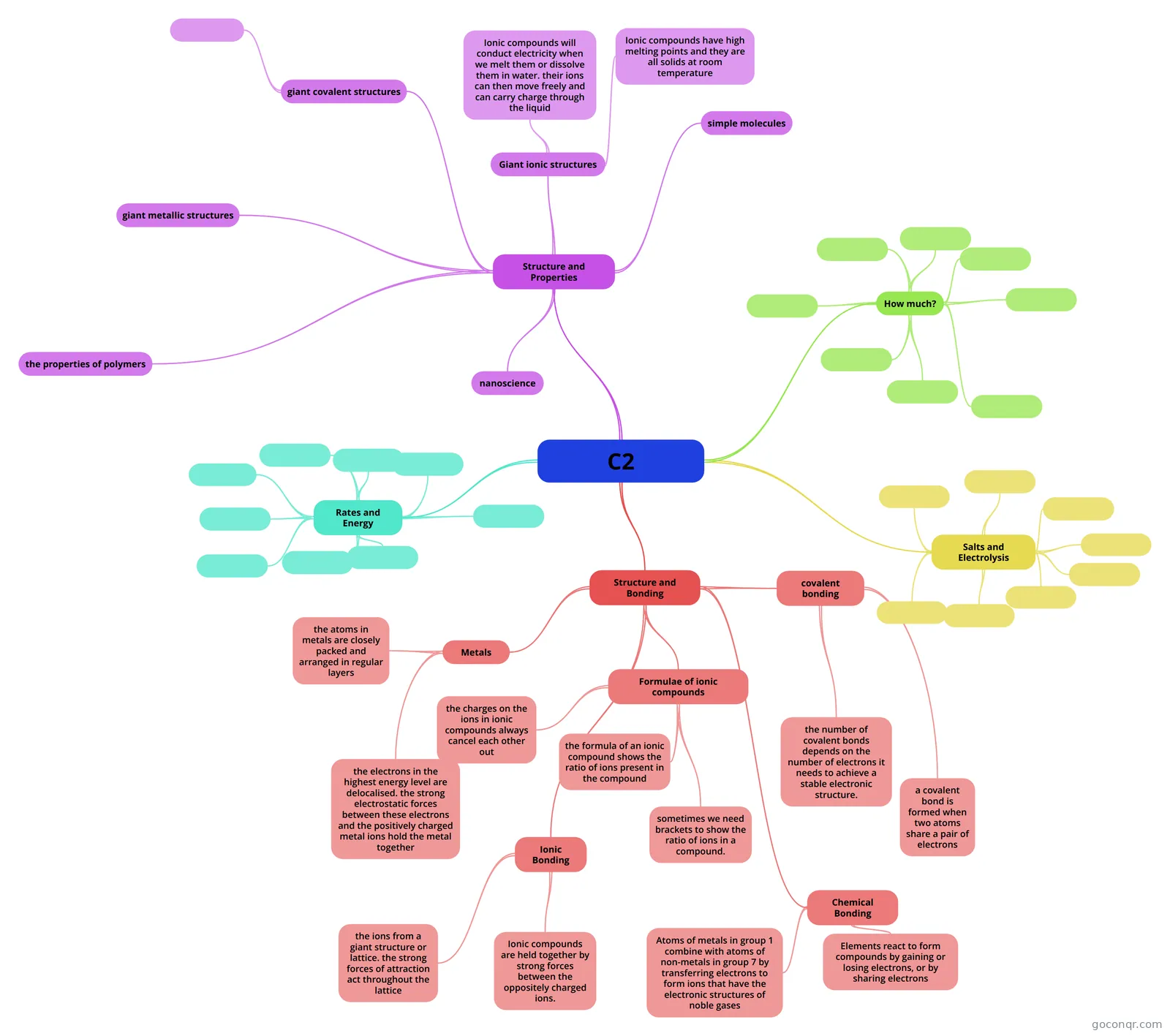
Mind map: C2 chemistry
Map content
C2
Structure and Bonding
- Chemical Bonding
- Elements react to form compounds by gaining or losing electrons, or by sharing electrons
- Atoms of metals in group 1 combine with atoms of non-metals in group 7 by transferring electrons to form ions that have the electronic structures of noble gases
- Ionic Bonding
- Ionic compounds are held together by strong forces between the oppositely charged ions.
- the ions from a giant structure or lattice. the strong forces of attraction act throughout the lattice
- Formulae of ionic compounds
- the charges on the ions in ionic compounds always cancel each other out
- the formula of an ionic compound shows the ratio of ions present in the compound
- sometimes we need brackets to show the ratio of ions in a compound.
- covalent bonding
- a covalent bond is formed when two atoms share a pair of electrons
- the number of covalent bonds depends on the number of electrons it needs to achieve a stable electronic structure.
- Metals
- the atoms in metals are closely packed and arranged in regular layers
- the electrons in the highest energy level are delocalised. the strong electrostatic forces between these electrons and the positively charged metal ions hold the metal together
- Chemical Bonding
Structure and Properties
- Giant ionic structures
- Ionic compounds have high melting points and they are all solids at room temperature
- Ionic compounds will conduct electricity when we melt them or dissolve them in water. their ions can then move freely and can carry charge through the liquid
- giant metallic structures
- simple molecules
- nanoscience
- the properties of polymers
- giant covalent structures
- Giant ionic structures
How much?
Rates and Energy
Salts and Electrolysis
Information
- Description
- GCSE chemistry (C2) Mind Map on C2, created by wavehunter on 22/03/2014.
- Created by
- wavehunter
- Views
- 94
- Tags
- Rating