
Mind map
Law & Morality
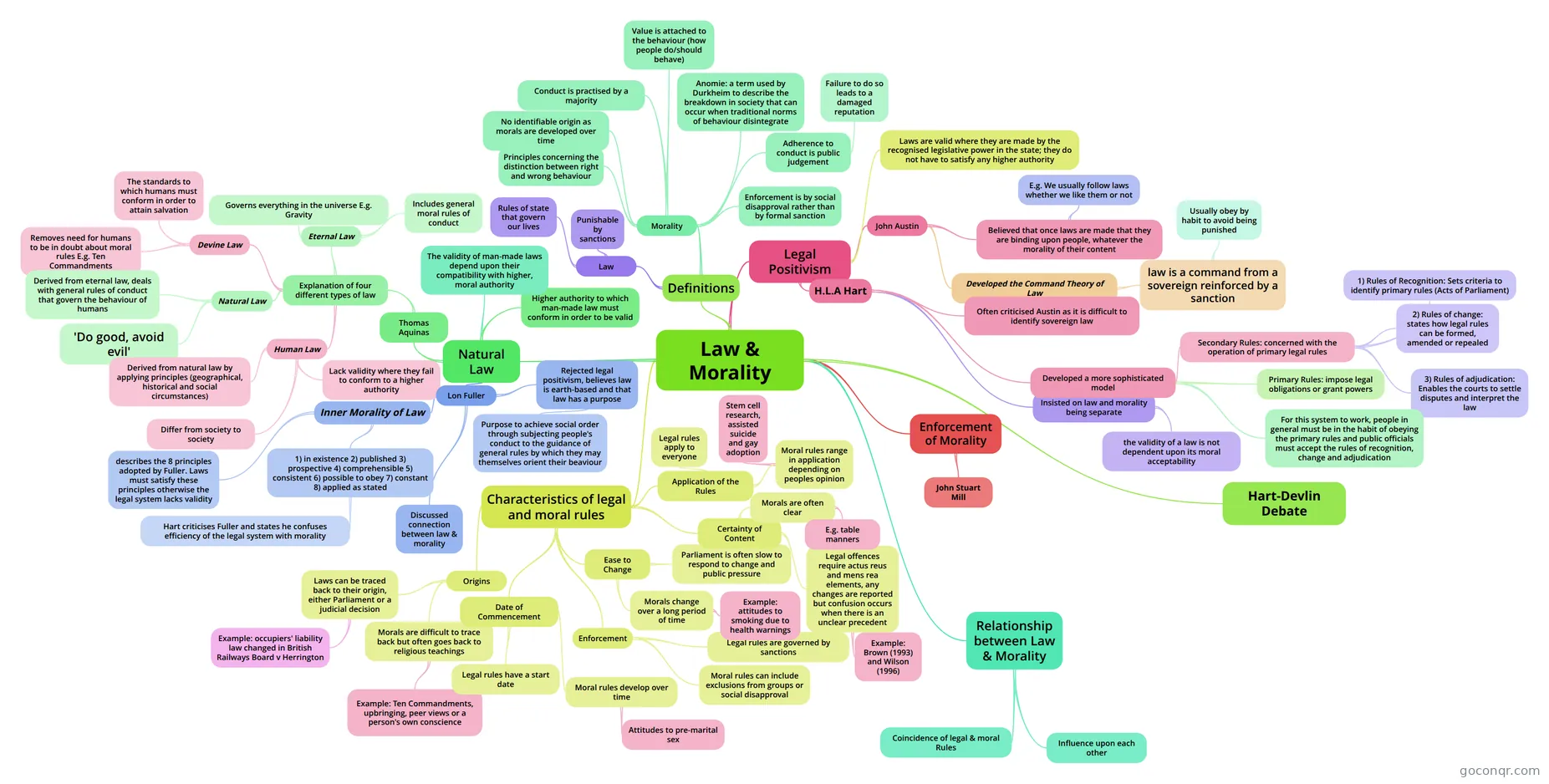
Mind map: law and morality
Map content
Law & Morality
Definitions
- Law
- Rules of state that govern our lives
- Punishable by sanctions
- Morality
- Principles concerning the distinction between right and wrong behaviour
- No identifiable origin as morals are developed over time
- Conduct is practised by a majority
- Value is attached to the behaviour (how people do/should behave)
- Adherence to conduct is public judgement
- Failure to do so leads to a damaged reputation
- Enforcement is by social disapproval rather than by formal sanction
- Anomie: a term used by Durkheim to describe the breakdown in society that can occur when traditional norms of behaviour disintegrate
- Law
Legal Positivism
- Laws are valid where they are made by the recognised legislative power in the state; they do not have to satisfy any higher authority
- John Austin
- Believed that once laws are made that they are binding upon people, whatever the morality of their content
- E.g. We usually follow laws whether we like them or not
- Developed the Command Theory of Law
- law is a command from a sovereign reinforced by a sanction
- Usually obey by habit to avoid being punished
- law is a command from a sovereign reinforced by a sanction
- Believed that once laws are made that they are binding upon people, whatever the morality of their content
- H.L.A Hart
- Often criticised Austin as it is difficult to identify sovereign law
- Insisted on law and morality being separate
- the validity of a law is not dependent upon its moral acceptability
- Developed a more sophisticated model
- Primary Rules: impose legal obligations or grant powers
- Secondary Rules: concerned with the operation of primary legal rules
- 1) Rules of Recognition: Sets criteria to identify primary rules (Acts of Parliament)
- 2) Rules of change: states how legal rules can be formed, amended or repealed
- 3) Rules of adjudication: Enables the courts to settle disputes and interpret the law
- For this system to work, people in general must be in the habit of obeying the primary rules and public officials must accept the rules of recognition, change and adjudication
Natural Law
- Higher authority to which man-made law must conform in order to be valid
- The validity of man-made laws depend upon their compatibility with higher, moral authority
- Thomas Aquinas
- Explanation of four different types of law
- Eternal Law
- Governs everything in the universe E.g. Gravity
- Includes general moral rules of conduct
- Devine Law
- The standards to which humans must conform in order to attain salvation
- Removes need for humans to be in doubt about moral rules E.g. Ten Commandments
- Natural Law
- Derived from eternal law, deals with general rules of conduct that govern the behaviour of humans
- 'Do good, avoid evil'
- Human Law
- Derived from natural law by applying principles (geographical, historical and social circumstances)
- Differ from society to society
- Lack validity where they fail to conform to a higher authority
- Eternal Law
- Explanation of four different types of law
- Lon Fuller
- Discussed connection between law & morality
- Rejected legal positivism, believes law is earth-based and that law has a purpose
- Purpose to achieve social order through subjecting people's conduct to the guidance of general rules by which they may themselves orient their beaviour
- Inner Morality of Law
- describes the 8 principles adopted by Fuller. Laws must satisfy these principles otherwise the legal system lacks validity
- 1) in existence 2) published 3) prospective 4) comprehensible 5) consistent 6) possible to obey 7) constant 8) applied as stated
- Hart criticises Fuller and states he confuses efficiency of the legal system with morality
Characteristics of legal and moral rules
- Origins
- Laws can be traced back to their origin, either Parliament or a judicial decision
- Example: occupiers' liability law changed in British Railways Board v Herrington
- Morals are difficult to trace back but often goes back to religious teachings
- Example: Ten Commandments, upbringing, peer views or a person's own conscience
- Laws can be traced back to their origin, either Parliament or a judicial decision
- Date of Commencement
- Legal rules have a start date
- Moral rules develop over time
- Attitudes to pre-marital sex
- Enforcement
- Legal rules are governed by sanctions
- Moral rules can include exclusions from groups or social disapproval
- Ease to Change
- Parliament is often slow to respond to change and public pressure
- Morals change over a long period of time
- Example: attitudes to smoking due to health warnings
- Certainty of Content
- Legal offences require actus reus and mens rea elements, any changes are reported but confusion occurs when there is an unclear precedent
- Example: Brown (1993) and Wilson (1996)
- Morals are often clear
- E.g. table manners
- Legal offences require actus reus and mens rea elements, any changes are reported but confusion occurs when there is an unclear precedent
- Application of the Rules
- Legal rules apply to everyone
- Moral rules range in application depending on peoples opinion
- Stem cell research, assisted suicide and gay adoption
- Origins
Hart-Devlin Debate
Relationship between Law & Morality
- Coincidence of legal & moral Rules
- Influence upon each other
Enforcement of Morality
- John Stuart Mill
Information
- Description
- a level Law Mind Map on Law & Morality, created by hannii_lou on 24/03/2014.
- Created by
- hannii_lou
- Views
- 242
- Tags
- Rating