
Mind map
Behaviourism Vs Cognitivism
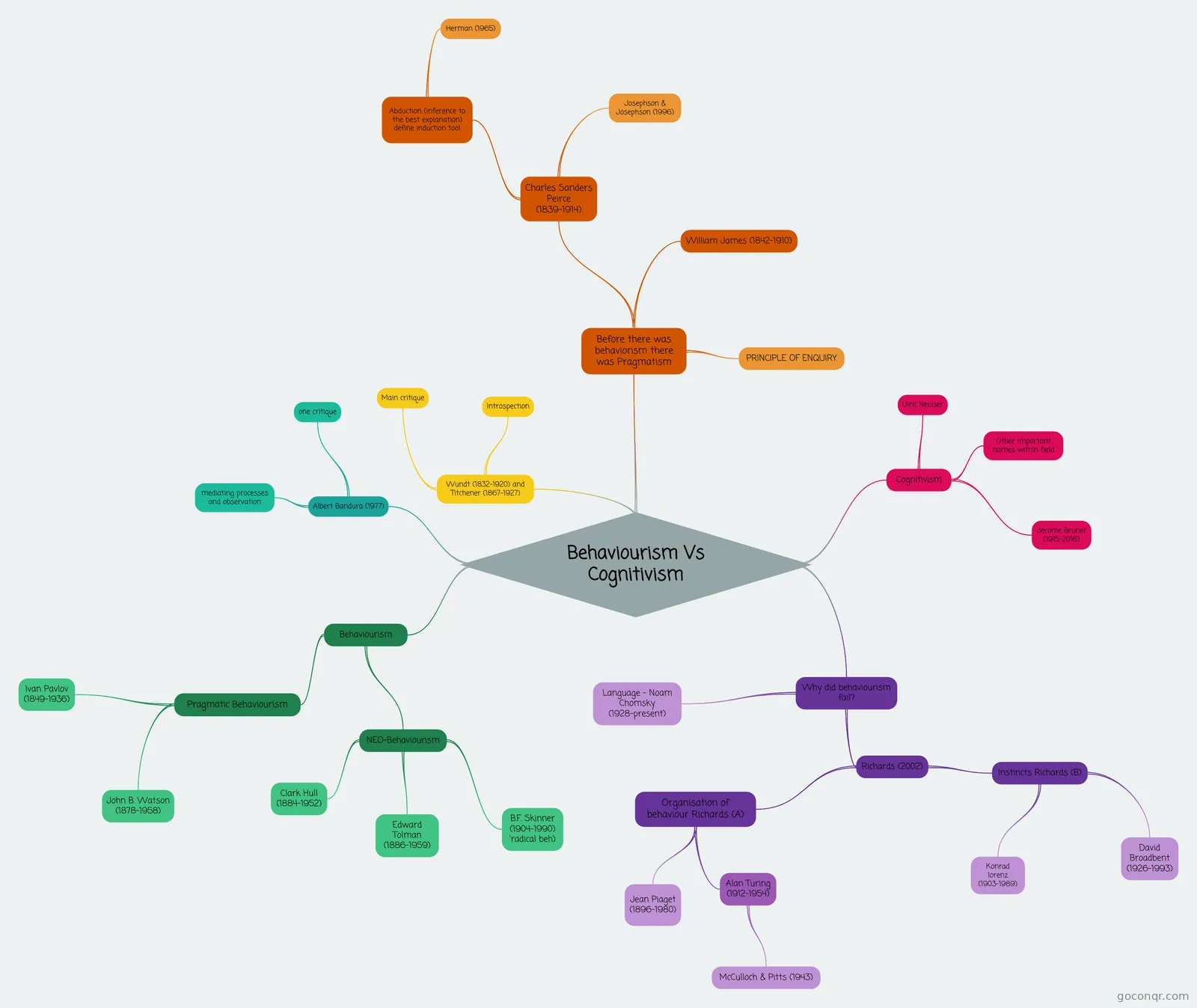
Mind map: Behaviourism vs cognitivism
Map content
Behaviourism Vs Cognitivism
Behaviourism
- NEO-Behaviourism
- Tolman, Hull, & Skinner are all associated with Neo behaviourism. More self-consciously trying to formalise the laws of behaviour using physical observations. *Sought to explain more complex forms of behaviour~ Extends behaviourism to include un-observable behaviour as-well as observable behaviour e.g. involving stimulus-organism-response (SOR).
- Clark Hull (1884-1952)
- Of the 3 neo-behaviourists, H was most ambitious about constructing formal theory of behaviour. He believed he had found the fundamental law of learning or habit-formation. According to the law: a stimulus could only produce a response as long as it was associated with the stimulus that usually caused the response. As long as the unconventional stimulus was similar enough to the original stimulus. Pavolv had noted this (with his dogs when they salivated at bell) BUT Hull theorised that learning was continuous- when animal was trained to respond to certain positive stimuli (or avoid negative), all aspects of that stimulus were gradually associated with that response. THUS animal learns in INCRAMENTAL way rather than all-or-nothing bursts. - These laws of behaviour explained how all learning took place without resorting to immaterial notions like soul or free will. - Hull designed variety of machines that worked on principles of conditioning reflexes, in order to demonstrate that learning was a wholly mechanistic process, he even expressed his laws of behaviour in mathematical terms filling his (1943) ‘Principles of Behaviour: An introduction to behaviour theory’ with complex equations. - Emphasized need to consider NOT just stimulus & response, but also intervening organismic variables: - Reaction Potential the belief that the link between stimulus-response r/ship could be anything that might affect how an organism responds i.e. learning, fatigue, disease, injury, motivation etc~
- response to Tolman's work, agrees on importance of drive but sought to disprove his theories. Actually demonstrated that learning is not as flexible as believed- constructed mathematical equations of behaviour that he claims S-R learning follows.
- Edward Tolman (1886-1959)
- Focused experimental work on rats learning their way through mazes, he differed from behaviourist predecessors by taking more holistic approach to behaviour than they had. Rather than talking in terms of isolated stimuli and responses, Tolman emphasized their integration with the environment in his (1932) ‘Purpose Behavior in Animals and Men’.
- stresses the importance of the relationships between stimuli (not just between S-R) and recognised that there were other variables in the environment that could affect S-R. Also importantly found that rats could create cognitive-maps(learn behaviourist shortest route, when this route is blocked they choose second-shortest route!) of mazes even without reinforcement.
- the rats appeared to be making decisions about where to go in the maze i.e. would pause and seem to make a decision to move in certain direction~ this observation caused Tolman to design further experiments investigating Latent learning & found that rats can learn even without a reward! so learning may not simply be S-R but goal-directed, it might just so happen that the goal of many animals is to receive food- compared to escaping a maze.
- B.F. Skinner (1904-1990) 'radical beh)
- Rejected Hull’s attempts at formal theory building; It is suggested that Skinner founded a branch of ‘radical behaviourism’ which stated that the goal of psychology should be to predict and control behaviour (back to Watsonian values). Skinner, like Watson, also recognised the role of internal mental events, and while he agreed such private events CANNOT be used to explain behaviour he proposed they should be explained in the analysis of behaviour. - Another important distinction between radical and methodological behaviourism concerns extent to which environmental factors influence behaviour. Watson’s (1913) methodological asserts the mind is blank at birth. In contrast, radical behaviourism accepts the view that organisms are born with INNATE behaviours, & thus recognises the role of genes & biological components in behaviour.
- everything we do is determined by our previous experiences and behaviours = EXTREME DETERMINISM. It is not necessary to consider thought processes/learning, only patterns of reinforcement/punishment as learning of behaviours~ extreme--> it is possible to socially engineer a perfect society! It is possible to choose a person's future and raise them accordingly.
- Pragmatic Behaviourism
- Ivan Pavlov (1849-1936)
- His main contribution to psychology includes introducing classical conditioning terms (unconditioned stimulus/response, conditioned stimulus/response). Depicts that all living things learn to behave by building associations, if we can understand the relationships involved we can manipulate the stimuli to produce certain behaviours i.e. does a louder bell cause heavier salivation.
- John B. Watson (1878-1958)
- American psychologist who established the school of behaviourism (essentially) in 1913 when he wrote an article entitled ‘Psychology as the behaviourist views it’, which set out a number of underlying assumptions regarding the methodology of behaviourism: - All behaviour is learnt from the environment through stimulus-response therefore the mind is born a blank slate. There is little fundamental (qualitative) difference between learning in humans and that in animals (Phylogenetic continuity).- Psychology should be seen as a science! Human psychology failed to make good claims as a natural science due to being too reliant on introspection, by ignoring consciousness it stops psychology being so forcibly introspective thus removing the barrier between psychology and the other sciences. - Behaviourism is primarily concerned with observable behaviour (as opposed to internal events like thinking/ emotion) = purely experimental branch of psychology focused on predicting + controlling behaviour. Behaviourism does not concern with ‘consciousness’.
- Ivan Pavlov (1849-1936)
- NEO-Behaviourism
Why did behaviourism fail?
- Language - Noam Chomsky (1928-present)
- No behaviourist account of language acquisition using stimulus/response would be able to account for language's flexibility and creativity. Chomsky theorised a critical period of language acquisition in which children are biologically ready to learn language (by adopting/interpreting from environment). Though it is possible for someone who has missed the critical period to learn the basics of a language, feral/previously deaf children have demonstrated a poor ability to grasp complex features of language such as grammar/syntax, thus suggesting that behaviourism (that does not consider a biological/innate aspect of learning) cannot explain language acquisition to a high-standard without admitting that some kind of innate ability must be involved (something not acquired through S-R).
- Skinner wrote 'Verbal Behaviour' in 1957, a book which made radical behaviourist claims about child developmental psychology. In this book, Skinner argued that children's language acquisition takes place in a purely mechanistic manner through operant conditioning.
- Richards (2002)
- Organisation of behaviour Richards (A)
- discusses that by the 1950’s it was apparent that behaviourism could not account for higher-order behaviours such as piano playing or language learning. Building these complex behaviours by creating laborious chains of associations would take more time than anyone has available. This flaw in the behaviourist movement was made increasingly apparent during the cognitivism shift when computer programmers were able to design computers to do very complex actions, this gave early cognitivists ideas about how such outcomes might be neurologically implemented. These new developments gave cognitivists a superiority over behaviourism in dealing with the organisation of complex behaviours.
- Alan Turing (1912-1954)
- In Turing’s time, behaviourism was the dominant psychological framework with a exclusive focus on observable behaviour, which meant that a psychologist’s job was to explain how stimuli evoked responses from an organism, and how behaviour is modified by its consequences. Looking inside the mind for answers of behaviour was not considered relevant because you cannot directly observe ‘the mind’.
- During his short life he contributed to many academic fields: mathematics, cryptanalysis, logic, philosophy, and psychology etc. In 1935 he created abstract computing machines (Turing machines) and was seen as most influential within psychology for the Turing test concept (deals with question of whether computers can think): involves a computer and 2 humans (one as a foil and one is an interrogator), interrogator attempts to determine, by asking questions, which one of the others is a computer. A number of people play the interrogator/foil and if none of them can correctly identify then it is questioned whether the conclusion can be drawn that the computer can 'think'? It was predicted long before Turing (back to Socrates in fact) who once stated that if machine (obviously not with the foresight of a modern machine) looked moved and talked similar to a human we would still be able to distinguish between it and a human because it would not be able to produce all possible responses in a conversation. If we are unable to produce a conscious ‘thinking’ machine, Richards (2002) states that behaviour then must not simply be down to rules (as believed by behaviourists) but something more complex and flexible~. So behaviourism focuses primarily on measuring observable behaviours and other external patterns to attempt to predict what behaviours would be in the future, they ignored all potential internal factors I.e. mental processes. Artificial intelligence developed through the fall of behaviourism because scientists began to question if actually machines could be programmed to behave like a human much like we may be hard-wired to behave a certain way biologically e.g. grammar/language acquisition and learning.
- McCulloch & Pitts (1943)
- So after Alan Turing proposed a formal model of computation for his Turing machinery in 1936, M&P(1943) proposed that neurones (MCP neurones) were simple logic devices such that mental processes could be explained by computations performed by the brain. MCP neurones were proposed to be very simple devices that worked with simple strings of coded information, they had a fixed firing threshold, and they simultaneously weigh up all of the excitatory/inhibitory synapse inputs/outputs This idea had a significant impact for the later envelop men's of artificial intelligence in computing.
- Jean Piaget (1896-1980)
- (pre dating the cognitive revolution) For example argues the behaviourist view that we build knowledge from a series of connections to form set rules of logic and our behaviour, he says instead we construct flexible schemas of knowledge by interacting with the environment. New interactions can thus change the schema~ By assuming that complex representations could be created, modified, extended and essentially discarded he radically changed the way we think about child development and human cognition.
- Instincts Richards (B)
- Discusses that many of the behaviourists rely on the ‘white rat’ as a convenient behaving organism for studying behaviour because it adapts to its environment however this logic contains a logical error. The white rat is so adaptable to its environment because it is biologically a highly adaptive animal. To invoke findings of the White rat as evidence of the primary role of the environment in determining behaviour is therefore a fallacy because other animals (e.g. Humans) are not that biologically adaptable to the environment. Further scrutiny is even the White rat and pigeons are limited in the behaviours capable of adapting through S-R, conditioning ecliptic behaviour (food rewards correct pecking) is easy but to try and condition wing-preening would be far less likely to work. ~ the rat can also learn that ‘brown water’=poisoned, and clear water = fine, even after one trial. This quick-learning is not explainable by a theory that does not consider innate factors.
- David Broadbent (1926-1993)
- Konrad lorenz (1903-1989)
- Scientists such as Lorenz~ demonstrate that behaviourism is not sufficient to explain behaviours that are not apparent evaluations of S-R. Lorenz' most famous work involved the observation of gosling imprinting behaviours. (Gosling attach to nearest living being as primary care giver)~ shows that behaviourism is not a sufficient model without considering innate properties~ I.e. The imprinting behaviour is innate because the gosling would not have had enough time to compute that lack of caregiver = bad outcome, to know that hey need to attach/follow/imitate/trust etc.
- Organisation of behaviour Richards (A)
- Language - Noam Chomsky (1928-present)
Before there was behaviorism there was Pragmatism
- concerns the 'truth of concepts'. How do we choose the meaning of a concept over another? And are there implications of choosing certain definitions?
- PRINCIPLE OF ENQUIRY
- William James (1842-1910)
- James’ pragmatism- ‘true’ ideas are those we can fully understand & validate, false ideas are those we cannot, so truth is made in action & through its consequences. Similar to Pierce however still recognises that individuals can associate practicality to different ideas i.e. recognises that a ghost might actually be ‘true’ to an individual because the belief may have meaning even if it is not ‘true’. - James’ pragmatism can be practically applied as a technique to assess & solve disputes about conflicting theories (thus can still direct science~). Example given by James: human catches sight of squirrel by moving rapidly around the tree, but no matter how fast he cannot see squirrel because it moves so fast around tree in opposite direction. Resulting metaphysical problem is: Does the man go round the squirrel or not? Can only solve the problem by pointing out that which answer is correct depends on what is practically meant by ‘going around’.
- suggested that there are two 'types of mind' (approaches): tough minded and tender mind. Tough minds are: materialist, atheist, empirical, a-posteriori (learning through justifications using empirical evidence). Tender minds are: idealist, religious, a-priori (learning through mind). This distinction has plagued philosophy, pragmatists need to look at practical consequences to solve problems, and sometimes it is better to be tough OR tender there is no right answer here. James' popular example given is SQUIRREL, so depends on practical definition to solve~
- Charles Sanders Peirce (1839-1914)
- If we do not conceive the object of our conceptions to have any practical bearings, then it clearly does not have meaning. In other words the truth of a concept is based on the limits of its own practical application. This allows us to see what difference the truth of certain concepts would make to our lives. Electricity for example is a 'truth', because we can see its practical impact on our everyday lives, ghosts on the other hand do not. This knowledge further allows us to decide where the best focus for our scientific investigations and belief-settling inquiry lies. Concept is meaningless if it has no practical effect on the way we live our lives. Electricity for example…
- Josephson & Josephson (1996)
- Argues abductive reasoning relies on fallible justifications of explanations. Abductive inferences depend on evaluation of all possible hypotheses, or atleast a large enough set of them that guarantees it includes the true one. If we think there is a significant chance that there is a better explanation, even one we haven't thought of, that we cannot think of, or that is completely unavailable to us, then we should not make the inference and normally would not. Abductive reasoning therefore tries to use the claim "it is likely to be true because I couldn't think of a better one". - In one sense the best explanation is the 'true' one but having no independent access to the truth, the 'reasoner' can only assert judgements of 'best' based on their limited considerations. - Abductions can often display 'emergent certainty'= conclusion of an abduction can have, and be more deserving of, more certainty than any of its premises. - However despite their fallibility abductions are knowledge producing inferences because after investigation and proving to be correct the abductive logical argument is now very strong. Doubt cannot be completely eliminated but by the aid of abductive inferences, knowledge is possible.
- Abduction (inference to the best explanation) define induction too!
- CSP introduced this type of inference to modern logic- is underpinning logic of pragmatism (which is the ‘logic of abduction’), involves concluding an explanation that best explains the (often incomplete) observation. Abduction demonstrates that just because an inference is based on statistical data it is not enough to classify it as an inductive one. ‘Observed many grey elephants and no non-grey ones, and infer from this that all elephants are grey because that best explains why you have observed so many grey ones and non-grey ones. Abductive inferences are ‘ampliative’ (conclusion goes way beyond what is logically contained in the premises~
- Herman (1965)
- gave insightful analysis to everyday abductive reasoning- argues when we infer that a witness if telling the truth, we are: inferring that he says what he does because he believes it Inferring he believes what he does because he actually did witness the situation which he describes Confidence in testimony based on our conclusions about the most plausible explanation for that testimony. Our confidence fails if we come to think that there is some other plausible explanation for his testimony e.g. He stands to gain from our believing him.
Wundt (1832-1920) and Titchener (1867-1927)
- Structuralism is considered to be one of the first established schools of psychology. Wundt (1832-1920), a German physician, initially introduced the foundational concepts of structuralism, but Titchener (1867-1927) pioneered the school and established psychology as a separate subject. Essentially structuralism involves a process of introspection (examination of a person's own thoughts and feelings) to gain a unique access to a person's mental state and thought-processes. Titchener believed that introspection could be used to identify all of the individual structures of the mind to identify all of the building blocks of a person's consciousness, and thus understanding how it functions and thus attempting to explain our behaviours (aim of psychology)~
- Introspection
- literally means 'looking within', to try and describe a person's memory, perceptions, cognitive processes, and/or motivations.
- Wundt claimed that his introspection was purely objective and scientific, referring to it as a method whereby pts made comments about stimuli they had been presented with an experimental sense. However, the behaviourists felt that such a method was insufficiently objective and in his behaviourist manifesto Watson (1913) claimed that introspective methods prevented psychology from being recognised as a science.
- Main critique
- maincritique was its focus on introspection as method to gain understanding of conscious experience. Critics argue that self-analysis yielded different results depending on who was using it and what they were seeking. Some critics also pointed out that introspective techniques actually resulted in retrospection - the memory of a sensation rather than the sensation itself.
- Behaviourists fully rejected even the idea of the conscious experience as a worthy topic in psychology, since they believed that the subject matter of scientific psychology should be strictly operationalised in an objective and measurable way. Because the notion of a mind could not be objectively measured, it was not worth further inquiry.
Cognitivism
- response to behaviourism which neglected to explain cognition~ Behaviourists acknowledged the existence of thinking BUT identified it as a behaviour rather than a process. Cognitivists argue that thinking is so essential to psychology that it should become its own field~
- Jerome Bruner (1915-2016)
- American psychologist who made significant contributions to human cognitive psychology and cognitive learning theory in educational psychology. In 1947 Bruner published his study 'Value and Need as Organising Factors in Perception' in which children of different secio-economic backgrounds were asked to estimate the size of coins or wooden disks the size of American pennies, nickels, dimes, quarters and half-dollars. Results showed that the value and need the children associated with the coins (based on SES) caused them to significantly overestimate the size of the coins, especially when compared to their more accurate estimations of the same size disks.
- These experiments and many other that followed make up 'New Look' psychology, which challenges psychologists to study not just an organism's response to a stimulus, but also its internal interpretation.
- Other important names within field
- Ulric Neisser
- is credited with formally having coined the term 'cognitive psychology' in 1967. Neisser's definition of "cognition" illustrates the then-progressive concept of cognitive processes i.e. refers to all processes by which the sensory input is transformed, reduced, elaborated, stored, recovered, and used.
Albert Bandura (1977)
- agreed with the behaviourist learning theories of classical and operant conditioning. However, he added two important ideas:
- - The social learning theory approach takes more thought processes into account and acknowledges the role they play in deciding if a behaviour is to be carried out or not. This approach can explain some quite complex behaviours however it cannot adequately account for how we develop a whole range of behaviour including thoughts and feelings. We have a lot of cog-control over our behaviour and just because we have experiences of violence does not mean we have to reproduce such behaviour.
- mediating processes and observation
- SLT is often described as the bridge between behaviourism and cognitivism because it considers how fully mental (cognitive) factors are involved in learning~ Unlike Skinner and other behaviourists Bandura (1977) considers that humans are active information processors and think about the relationship between their behaviour and its consequences. Observational learning could not occur unless cognitive processes were at work.
- one critique
- - One criticism of SLT arise from its commitment to the environment as the chief influence on behaviour. It is limiting to describe behaviour solely in terms of either nature or nurture, and attempts to underestimate the complexity of human behaviour. It is more likely that behaviour is due to an interaction between biology and environment~
Information
- Description
- - Second year mind maps (Conceptual) Mind Map on Behaviourism Vs Cognitivism, created by Rachael Jones on 24/12/2016.
- Created by
- Rachael Jones
- Views
- 8
- Rating