
Mind map
Statutory Interpretation - Methods of Interpretating Statutes
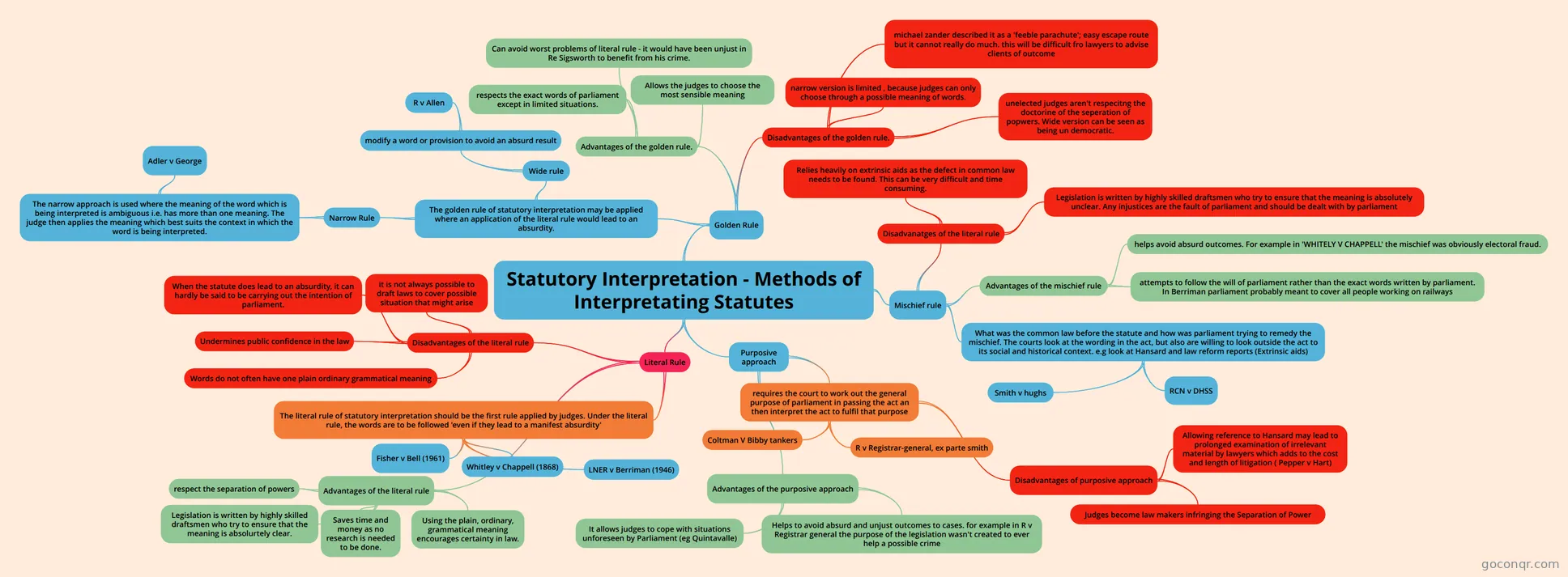
Mind map: Statutory interpretation methods
Map content
Statutory Interpretation - Methods of Interpretating Statutes
Literal Rule
- The literal rule of statutory interpretation should be the first rule applied by judges. Under the literal rule, the words are to be followed 'even if they lead to a manifest absurdity'
- Fisher v Bell (1961)
- Statute made it a criminal offence to 'offer' such flick knives for sale. His conviction was quashed as goods on display in shops are not 'offers' in the technical sense but an invitation to treat.
- Whitley v Chappell (1868)
- Dead person was not in the literal meaning of entitled to vote.
- LNER v Berriman (1946)
- 'repairing and relaying' d was in fact maintaining.
- Fisher v Bell (1961)
- Advantages of the literal rule
- respect the separation of powers
- Using the plain, ordinary, grammatical meaning encourages certainty in law.
- Legislation is written by highly skilled draftsmen who try to ensure that the meaning is absolurtely clear.
- Saves time and money as no research is needed to be done.
- Disadvantages of the literal rule
- Undermines public confidence in the law
- it is not always possible to draft laws to cover possible situation that might arise
- Words do not often have one plain ordinary grammatical meaning
- When the statute does lead to an absurdity, it can hardly be said to be carrying out the intention of parliament.
- The literal rule of statutory interpretation should be the first rule applied by judges. Under the literal rule, the words are to be followed 'even if they lead to a manifest absurdity'
Mischief rule
- What was the common law before the statute and how was parliament trying to remedy the mischief. The courts look at the wording in the act, but also are willing to look outside the act to its social and historical context. e.g look at Hansard and law reform reports (Extrinsic aids)
- Smith v hughs
- prostitute 'soliciting in a street or public place'. Attracting customers from a balcony; court held that they had been rightly convicted as the mischief the statute was trying to remedy was being able to walk along the streets without being harassed.
- RCN v DHSS
- Lawful abortion could be carried out by a 'registered medical practitioner'. Clearly covers doctors, but what about nurses? due to medical advances abortion could be carried out by using drugs instead of surgical abortions. The mischief was to stop illegal abortions where no medical care was available.
- Smith v hughs
- Advantages of the mischief rule
- attempts to follow the will of parliament rather than the exact words written by parliament. In Berriman parliament probably meant to cover all people working on railways
- helps avoid absurd outcomes. For example in 'WHITELY V CHAPPELL' the mischief was obviously electoral fraud.
- Disadvanatges of the literal rule
- Relies heavily on extrinsic aids as the defect in common law needs to be found. This can be very difficult and time consuming.
- Legislation is written by highly skilled draftsmen who try to ensure that the meaning is absolutely unclear. Any injustices are the fault of parliament and should be dealt with by parliament
- What was the common law before the statute and how was parliament trying to remedy the mischief. The courts look at the wording in the act, but also are willing to look outside the act to its social and historical context. e.g look at Hansard and law reform reports (Extrinsic aids)
Golden Rule
- The golden rule of statutory interpretation may be applied where an application of the literal rule would lead to an absurdity.
- Narrow Rule
- The narrow approach is used where the meaning of the word which is being interpreted is ambiguous i.e. has more than one meaning. The judge then applies the meaning which best suits the context in which the word is being interpreted.
- Adler v George
- ‘in the vicinity of’; The court decided that this would lead to an absurd result and interpreted the words so as to include the situation which had arisen where the individual was already on the premises.
- Adler v George
- The narrow approach is used where the meaning of the word which is being interpreted is ambiguous i.e. has more than one meaning. The judge then applies the meaning which best suits the context in which the word is being interpreted.
- Wide rule
- modify a word or provision to avoid an absurd result
- R v Allen
- D was charged with bigamy which made it an offence to ‘marry’ whilst your spouse is still alive and not divorced. The ambiguous word was the word ‘marry’. The court decided that in order to make sense of the provision, the word should be interpreted as meaning to go through a second ceremony of marriage. The word can also mean to become legally married but because someone who is already married cannot legally marry someone else, the more general meaning of the word was preferred.
- R v Allen
- modify a word or provision to avoid an absurd result
- Narrow Rule
- Advantages of the golden rule.
- respects the exact words of parliament except in limited situations.
- Allows the judges to choose the most sensible meaning
- Can avoid worst problems of literal rule - it would have been unjust in Re Sigsworth to benefit from his crime.
- A son murdered his mother. She had not made a will. Under the statute setting the law on intestacy he was her sole issue and stood to inherit her entire estate. The court applied the Golden rule holding that an application of the literal rule would lead to a repugnant result. He was thus entitled to nothing.
- Disadvantages of the golden rule.
- michael zander described it as a 'feeble parachute'; easy escape route but it cannot really do much. this will be difficult fro lawyers to advise clients of outcome
- narrow version is limited , because judges can only choose through a possible meaning of words.
- unelected judges aren't respecitng the doctorine of the seperation of popwers. Wide version can be seen as being un democratic.
- The golden rule of statutory interpretation may be applied where an application of the literal rule would lead to an absurdity.
Purposive approach
- requires the court to work out the general purpose of parliament in passing the act an then interpret the act to fulfil that purpose
- Coltman V Bibby tankers
- Defective equipment supplied by that employer. V died due to ship capsizing because of defective hull. Equipment could mean ship as the general purpose of the act was to make the employer liable for harm caused in anything provided by the employer.
- R v Registrar-general, ex parte smith
- D was a a violent murderer. He'd killed a cell mate because he thought he was his mother.He then tried to find out the identity of his mother which he was entitled to know under the ADOPTION ACT 1976. court held that it could have never been the purpose of parliament to pass a law that could help a possible crime.
- Disadvantages of purposive approach
- Judges become law makers infringing the Separation of Power
- Allowing reference to Hansard may lead to prolonged examination of irrelevant material by lawyers which adds to the cost and length of litigation ( Pepper v Hart)
- Coltman V Bibby tankers
- Advantages of the purposive approach
- It allows judges to cope with situations unforeseen by Parliament (eg Quintavalle)
- Helps to avoid absurd and unjust outcomes to cases. for example in R v Registrar general the purpose of the legislation wasn't created to ever help a possible crime
- requires the court to work out the general purpose of parliament in passing the act an then interpret the act to fulfil that purpose
Information
- Description
- No rules of language, intrinsic/extrinsic aids.
- Created by
- Jake Edley
- Views
- 43
- Rating