
Mind map
Chemistry Unit 1: 1.4: Mass Spectrometry
Map content
Chemistry Unit 1: 1.4: Mass Spectrometry
Quick definition:
- The mass spectrometer determines very accurately, the relative atomic mass of an isotope!
What Happens in a Mass Spectrometer?
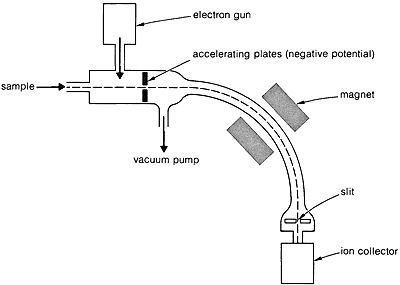
- In a nutshell: atoms are converted into ions, (remember ions?) accelerated, deflected before arriving at a detector. More details? Okay then.
- The steps are: Ionisation, acceleration, deflection then detection.
- Ionisation:
- a beam of high energy electrons is fired from an electron gun that collides with the sample inside the MS and knocks and electron from it.
- this forms positive (+1) ions.
- nearly all atoms lose 1 electron but in some cases (around 5%) 2 electrons can be lost forming 2+ ions.
- this forms positive (+1) ions.
- a beam of high energy electrons is fired from an electron gun that collides with the sample inside the MS and knocks and electron from it.
- Acceleration:
- the newly formed +ions are attracted to -charged plates and accelerated to a high speed.
- the speed they reach is proportional to their mass: the higher the mass, the slower they travel, the lower the mass, the faster they go.
- some ions pass through slits in the plates, this forms the ions in a beam (sounds pretty Sci-fi, doesn't it?)
- the speed they reach is proportional to their mass: the higher the mass, the slower they travel, the lower the mass, the faster they go.
- the newly formed +ions are attracted to -charged plates and accelerated to a high speed.
- Deflection:
- the beam of ions then travels into a magnetic field at right angles (90 degrees) to the direction it's travelling.
- the magnetic field deflects the ion beam (pew! pew!) into an arc of a circle. The deflection of an ion depends on it's m/z ratio, or mass to charge ratio.
- in the m/z ratio, 'm' is the mass of the ion and 'z' is the charge (usually +1)
- the magnetic field deflects the ion beam (pew! pew!) into an arc of a circle. The deflection of an ion depends on it's m/z ratio, or mass to charge ratio.
- heavier ions are deflected less (as we know) than lighter ones and 2+ ions are deflected twice as much as +1 ions of the same mass.
- the beam of ions then travels into a magnetic field at right angles (90 degrees) to the direction it's travelling.
- In a nutshell: atoms are converted into ions, (remember ions?) accelerated, deflected before arriving at a detector. More details? Okay then.
Detection:
- the magnetic field's strength is gradually increased so that the ions of increasing mass enter the detector one after the other.
- ions collide with the detector, accept electrons, lose their charge and create a current that is proportional to their abundance.
- Note: 'abundance' simply means 'amount of'.
- ions collide with the detector, accept electrons, lose their charge and create a current that is proportional to their abundance.
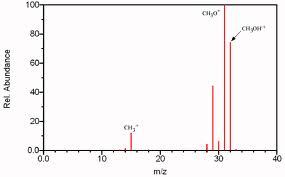
- a computer measures the strength of the current created and works out the m/z ratio. A read-out called a mass spectrum is produced - this is normally a graph.
- a mass spectrum
- the magnetic field's strength is gradually increased so that the ions of increasing mass enter the detector one after the other.
How to Calculate Low Resolution Mass Spectrometry:
- Take the readings/mass numbers from your mass spectrum (graph), e.g. neon has two isotopes of mass numbers 20 and 22 with abundances of 90% and 10% respectively.
- the mass number is the y axis, the abundance (%) is the x axis.
- to work out the relative atomic mass of an element, you do this: (90 x 20) + (10 x 22), then you divide the answer, which is 2020, by the total mass, which is 100.
- the answer is 20.2 which means the relative atomic mass of neon is 20.2
- Take the readings/mass numbers from your mass spectrum (graph), e.g. neon has two isotopes of mass numbers 20 and 22 with abundances of 90% and 10% respectively.
Images and files in the map
Information
- Description
- A-Levels Chemistry AS Mind Map on Chemistry Unit 1: 1.4: Mass Spectrometry, created by Daena Targaryen on 28/04/2014.
- Created by
- Daena Targaryen
- Views
- 111
- Rating