
Mind map
Translation commentary
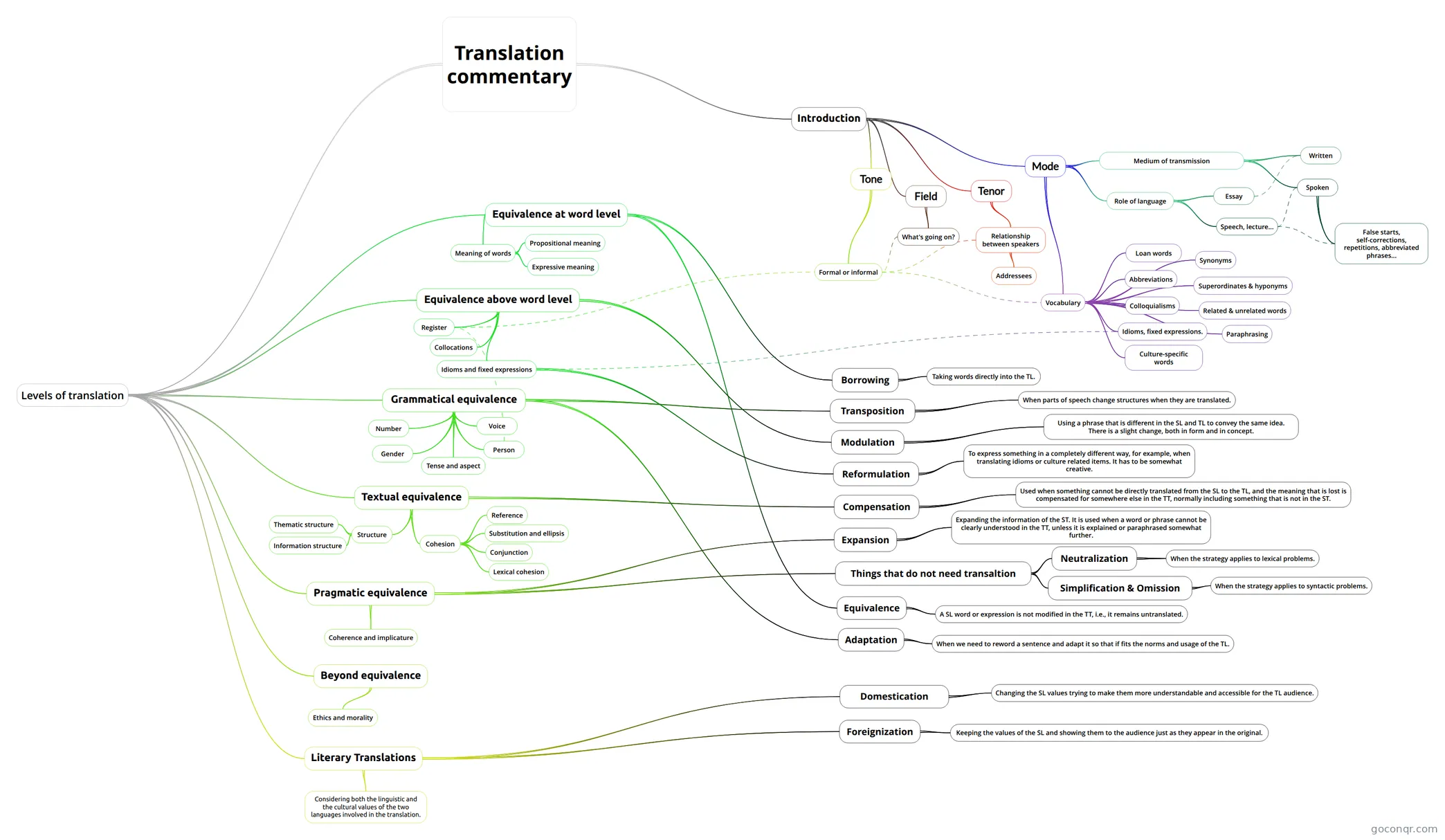
Mind map: Translation commentary
Map content
Translation commentary
- + Conclusion
Introduction
- Field
- What's going on?
- Tenor
- Relationship between speakers
- Addressees
- Relationship between speakers
- Mode
- Role of language
- Speech, lecture...
- Essay
- Medium of transmission
- Written
- Spoken
- False starts, self-corrections, repetitions, abbreviated phrases...
- Vocabulary
- Loan words
- Colloquialisms
- Idioms, fixed expressions.
- Abbreviations
- Synonyms
- Superordinates & hyponyms
- Related & unrelated words
- Paraphrasing
- Culture-specific words
- Role of language
- Tone
- Formal or informal
- Field
Levels of translation
- Equivalence at word level
- Meaning of words
- Propositional meaning
- Expressive meaning
- Borrowing
- Sometimes borrowings or calques pass into general usage, for example "software" or "reggae".
- The main reason to choose this strategy is when the TL has no obvious equivalent for the word or expression we are trying to translate.
- Taking words directly into the TL.
- Equivalence
- This often happens with proper names, such as "Robert" or places names, such as "Kansas".
- A SL word or expression is not modified in the TT, i.e., it remains untranslated.
- Meaning of words
- Equivalence above word level
- Register
- Collocations
- Idioms and fixed expressions
- Reformulation
- ·"a true and a fair view" -> "una visión ajustada a la realidad" ·"fails without just cause" -> "sin causa justificada"
- To express something in a completely different way, for example, when translating idioms or culture related items. It has to be somewhat creative.
- Reformulation
- Modulation
- ·"shall be subject" -> "deberán cumplir" ·"single most critical element" -> "el único elemento verdaderamente crítico" ·"has not complied with any provision" -> "ha incumplido todas las disposiciones"
- Using a phrase that is different in the SL and TL to convey the same idea. There is a slight change, both in form and in concept.
- Grammatical equivalence
- Number
- Gender
- Person
- Tense and aspect
- Voice
- Transposition
- ·"Relating to" -> "Con respecto a" ·"Governing Body" -> "Órgano de Gobierno" ·Passive voice -> Active voice
- When parts of speech change structures when they are translated.
- Adaptation
- ·"shall agree to pay all utility connections, user, and service charges" -> "deberá asumir todos los gastos de conexión de servicio, alta de usuario y suministro del servicio público"
- The translation becomes freer and, as long as the content is not changed, we may reword and adapt the message as we need to.
- When we need to reword a sentence and adapt it so that if fits the norms and usage of the TL.
- Textual equivalence
- Structure
- Thematic structure
- Information structure
- Cohesion
- Reference
- Substitution and ellipsis
- Conjunction
- Lexical cohesion
- Compensation
- ·Using formal markers in the TT (in English) to compensate for the use of "usted" in the ST (in Spanish).
- Used when something cannot be directly translated from the SL to the TL, and the meaning that is lost is compensated for somewhere else in the TT, normally including something that is not in the ST.
- Structure
- Pragmatic equivalence
- Coherence and implicature
- Expansion
- ·"Such information and explanation" -> "cualquier información o cualesquiera explicaciones". ·"YMCA" - "una famosa asociación cristiana para jóvenes (YMCA)" ·"an Industry and Trade Competition Commission" -> "una Comisión de Defensa de la Competencia en la Industria y el Comercio"
- Expanding the information of the ST. It is used when a word or phrase cannot be clearly understood in the TT, unless it is explained or paraphrased somewhat further.
- Things that do not need transaltion
- Neutralization
- ·"brokers" -> "intermediarios"
- When the strategy applies to lexical problems.
- Simplification & Omission
- ·"have an interest" -> "les interesa" ·"Minister responsible for finance" -> "Ministro de finanzas"
- When the strategy applies to syntactic problems.
- Neutralization
- Beyond equivalence
- Ethics and morality
- Literary Translations
- Domestication
- Changing the SL values trying to make them more understandable and accessible for the TL audience.
- Foreignization
- Keeping the values of the SL and showing them to the audience just as they appear in the original.
- Considering both the linguistic and the cultural values of the two languages involved in the translation.
- Domestication
- Equivalence at word level
Information
- Description
- Estudios Ingleses (Traducción) Mind Map on Translation commentary, created by Anika Ech on 15/03/2017.
- Created by
- Anika Ech
- Views
- 147
- Rating