
Mind map
Judicial Creativity
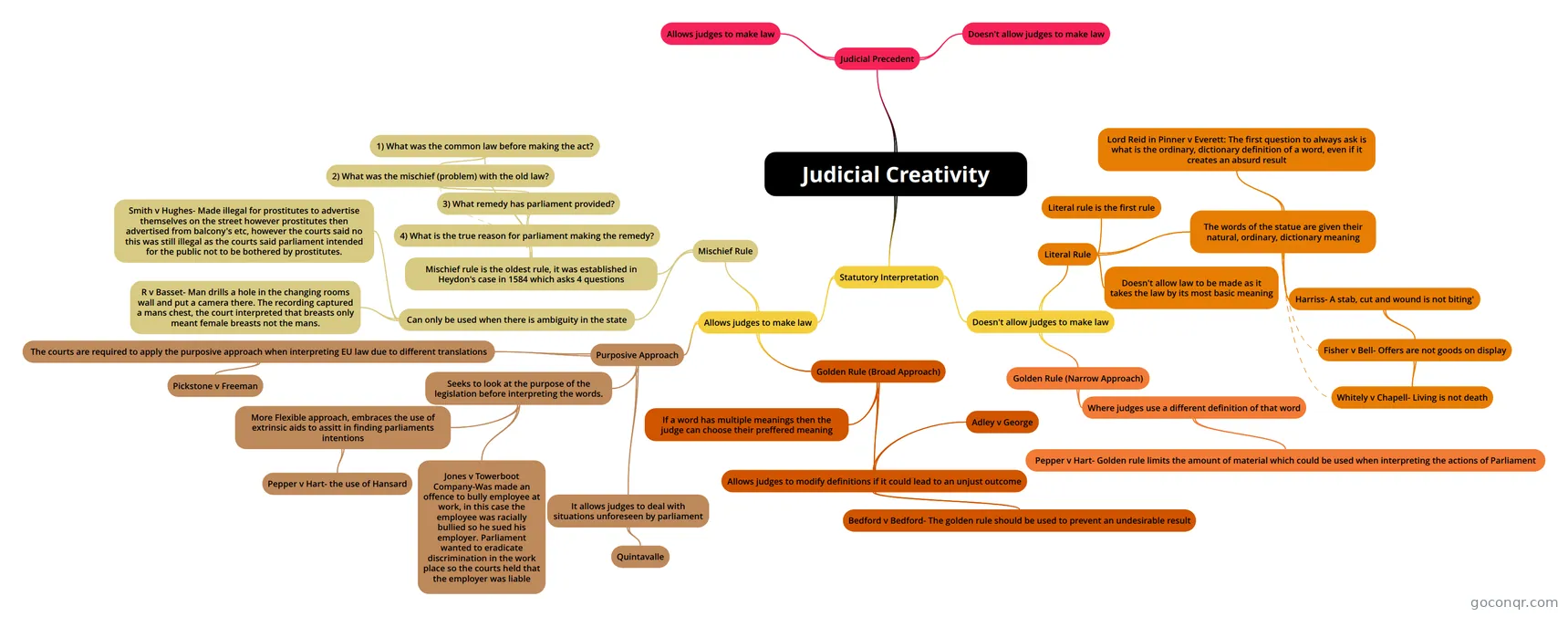
Mind map: Judicial creativity
Map content
Judicial Creativity
Judicial Precedent
- Allows judges to make law
- Doesn't allow judges to make law
Statutory Interpretation
- Doesn't allow judges to make law
- Literal Rule
- Literal rule is the first rule
- The words of the statue are given their natural, ordinary, dictionary meaning
- Lord Reid in Pinner v Everett: The first question to always ask is what is the ordinary, dictionary definition of a word, even if it creates an absurd result
- Harriss- A stab, cut and wound is not biting'
- Fisher v Bell- Offers are not goods on display
- Whitely v Chapell- Living is not death
- Fisher v Bell- Offers are not goods on display
- Doesn't allow law to be made as it takes the law by its most basic meaning
- Golden Rule (Narrow Approach)
- Where judges use a different definition of that word
- Pepper v Hart- Golden rule limits the amount of material which could be used when interpreting the actions of Parliament
- Where judges use a different definition of that word
- Literal Rule
- Allows judges to make law
- Mischief Rule
- Mischief rule is the oldest rule, it was established in Heydon's case in 1584 which asks 4 questions
- 1) What was the common law before making the act?
- 2) What was the mischief (problem) with the old law?
- 3) What remedy has parliament provided?
- 4) What is the true reason for parliament making the remedy?
- 3) What remedy has parliament provided?
- 2) What was the mischief (problem) with the old law?
- 1) What was the common law before making the act?
- Can only be used when there is ambiguity in the state
- Smith v Hughes- Made illegal for prostitutes to advertise themselves on the street however prostitutes then advertised from balcony's etc, however the courts said no this was still illegal as the courts said parliament intended for the public not to be bothered by prostitutes.
- R v Basset- Man drills a hole in the changing rooms wall and put a camera there. The recording captured a mans chest, the court interpreted that breasts only meant female breasts not the mans.
- Mischief rule is the oldest rule, it was established in Heydon's case in 1584 which asks 4 questions
- Golden Rule (Broad Approach)
- Allows judges to modify definitions if it could lead to an unjust outcome
- Adley v George
- Bedford v Bedford- The golden rule should be used to prevent an undesirable result
- If a word has multiple meanings then the judge can choose their preffered meaning
- Allows judges to modify definitions if it could lead to an unjust outcome
- Purposive Approach
- Seeks to look at the purpose of the legislation before interpreting the words.
- Jones v Towerboot Company-Was made an offence to bully employee at work, in this case the employee was racially bullied so he sued his employer. Parliament wanted to eradicate discrimination in the work place so the courts held that the employer was liable
- More Flexible approach, embraces the use of extrinsic aids to assitt in finding parliaments intentions
- Pepper v Hart- the use of Hansard
- The courts are required to apply the purposive approach when interpreting EU law due to different translations
- Pickstone v Freeman
- It allows judges to deal with situations unforeseen by parliament
- Quintavalle
- Seeks to look at the purpose of the legislation before interpreting the words.
- Mischief Rule
- Doesn't allow judges to make law
Information
- Description
- A level Law (Unit 4C) Mind Map on Judicial Creativity, created by Yasmin Allwood on 30/03/2017.
- Created by
- Yasmin Allwood
- Views
- 32
- Rating