
Mind map
Learning Approach
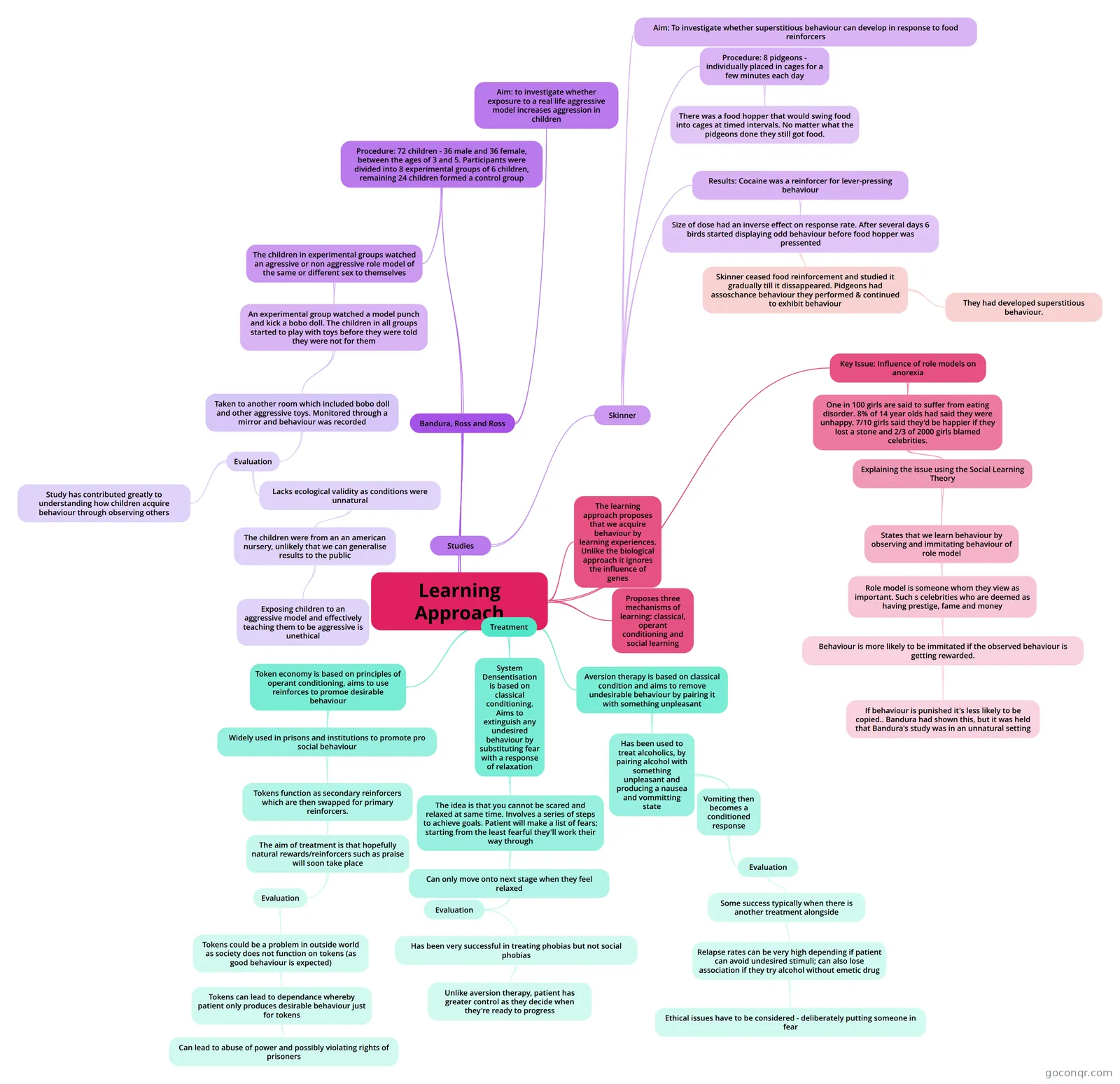
Mind map: learning approach psychology
Map content
Learning Approach
The learning approach proposes that we acquire behaviour by learning experiences. Unlike the biological approach it ignores the influence of genes
Proposes three mechanisms of learning: classical, operant conditioning and social learning
Treatment
- Aversion therapy is based on classical condition and aims to remove undesirable behaviour by pairing it with something unpleasant
- Has been used to treat alcoholics, by pairing alcohol with something unpleasant and producing a nausea and vommitting state
- Vomiting then becomes a conditioned response
- Evaluation
- Some success typically when there is another treatment alongside
- Relapse rates can be very high depending if patient can avoid undesired stimuli; can also lose association if they try alcohol without emetic drug
- Ethical issues have to be considered - deliberately putting someone in fear
- Relapse rates can be very high depending if patient can avoid undesired stimuli; can also lose association if they try alcohol without emetic drug
- Some success typically when there is another treatment alongside
- Evaluation
- Vomiting then becomes a conditioned response
- Has been used to treat alcoholics, by pairing alcohol with something unpleasant and producing a nausea and vommitting state
- System Densentisation is based on classical conditioning. Aims to extinguish any undesired behaviour by substituting fear with a response of relaxation
- The idea is that you cannot be scared and relaxed at same time. Involves a series of steps to achieve goals. Patient will make a list of fears; starting from the least fearful they'll work their way through
- Can only move onto next stage when they feel relaxed
- Evaluation
- Has been very successful in treating phobias but not social phobias
- Unlike aversion therapy, patient has greater control as they decide when they're ready to progress
- Has been very successful in treating phobias but not social phobias
- Evaluation
- Can only move onto next stage when they feel relaxed
- The idea is that you cannot be scared and relaxed at same time. Involves a series of steps to achieve goals. Patient will make a list of fears; starting from the least fearful they'll work their way through
- Token economy is based on principles of operant conditioning, aims to use reinforces to promoe desirable behaviour
- Widely used in prisons and institutions to promote pro social behaviour
- Tokens function as secondary reinforcers which are then swapped for primary reinforcers.
- The aim of treatment is that hopefully natural rewards/reinforcers such as praise will soon take place
- Evaluation
- Tokens could be a problem in outside world as society does not function on tokens (as good behaviour is expected)
- Tokens can lead to dependance whereby patient only produces desirable behaviour just for tokens
- Can lead to abuse of power and possibly violating rights of prisoners
- Tokens can lead to dependance whereby patient only produces desirable behaviour just for tokens
- Tokens could be a problem in outside world as society does not function on tokens (as good behaviour is expected)
- Evaluation
- The aim of treatment is that hopefully natural rewards/reinforcers such as praise will soon take place
- Tokens function as secondary reinforcers which are then swapped for primary reinforcers.
- Widely used in prisons and institutions to promote pro social behaviour
- Aversion therapy is based on classical condition and aims to remove undesirable behaviour by pairing it with something unpleasant
Bandura, Ross and Ross
- Aim: to investigate whether exposure to a real life aggressive model increases aggression in children
- Procedure: 72 children - 36 male and 36 female, between the ages of 3 and 5. Participants were divided into 8 experimental groups of 6 children, remaining 24 children formed a control group
- The children in experimental groups watched an agressive or non aggressive role model of the same or different sex to themselves
- An experimental group watched a model punch and kick a bobo doll. The children in all groups started to play with toys before they were told they were not for them
- Taken to another room which included bobo doll and other aggressive toys. Monitored through a mirror and behaviour was recorded
- Evaluation
- Study has contributed greatly to understanding how children acquire behaviour through observing others
- Lacks ecological validity as conditions were unnatural
- The children were from an an american nursery, unlikely that we can generalise results to the public
- Exposing children to an aggressive model and effectively teaching them to be aggressive is unethical
- The children were from an an american nursery, unlikely that we can generalise results to the public
- Evaluation
- Taken to another room which included bobo doll and other aggressive toys. Monitored through a mirror and behaviour was recorded
- An experimental group watched a model punch and kick a bobo doll. The children in all groups started to play with toys before they were told they were not for them
- The children in experimental groups watched an agressive or non aggressive role model of the same or different sex to themselves
- Studies
- Skinner
- Aim: To investigate whether superstitious behaviour can develop in response to food reinforcers
- Procedure: 8 pidgeons - individually placed in cages for a few minutes each day
- There was a food hopper that would swing food into cages at timed intervals. No matter what the pidgeons done they still got food.
- Results: Cocaine was a reinforcer for lever-pressing behaviour
- Size of dose had an inverse effect on response rate. After several days 6 birds started displaying odd behaviour before food hopper was pressented
- Skinner ceased food reinforcement and studied it gradually till it dissappeared. Pidgeons had assoschance behaviour they performed & continued to exhibit behaviour
- They had developed superstitious behaviour.
- Skinner ceased food reinforcement and studied it gradually till it dissappeared. Pidgeons had assoschance behaviour they performed & continued to exhibit behaviour
- Size of dose had an inverse effect on response rate. After several days 6 birds started displaying odd behaviour before food hopper was pressented
- Skinner
Key Issue: Influence of role models on anorexia
- One in 100 girls are said to suffer from eating disorder. 8% of 14 year olds had said they were unhappy. 7/10 girls said they'd be happier if they lost a stone and 2/3 of 2000 girls blamed celebrities.
- Explaining the issue using the Social Learning Theory
- States that we learn behaviour by observing and immitating behaviour of role model
- Role model is someone whom they view as important. Such s celebrities who are deemed as having prestige, fame and money
- Behaviour is more likely to be immitated if the observed behaviour is getting rewarded.
- If behaviour is punished it's less likely to be copied.. Bandura had shown this, but it was held that Bandura's study was in an unnatural setting
- Behaviour is more likely to be immitated if the observed behaviour is getting rewarded.
- Role model is someone whom they view as important. Such s celebrities who are deemed as having prestige, fame and money
- States that we learn behaviour by observing and immitating behaviour of role model
- Explaining the issue using the Social Learning Theory
- One in 100 girls are said to suffer from eating disorder. 8% of 14 year olds had said they were unhappy. 7/10 girls said they'd be happier if they lost a stone and 2/3 of 2000 girls blamed celebrities.
Information
- Description
- Mind Map on Learning Approach, created by david_ndhlovu96 on 15/05/2014.
- Created by
- david_ndhlovu96
- Views
- 25
- Rating