
Mind map
The Collapse of Communism
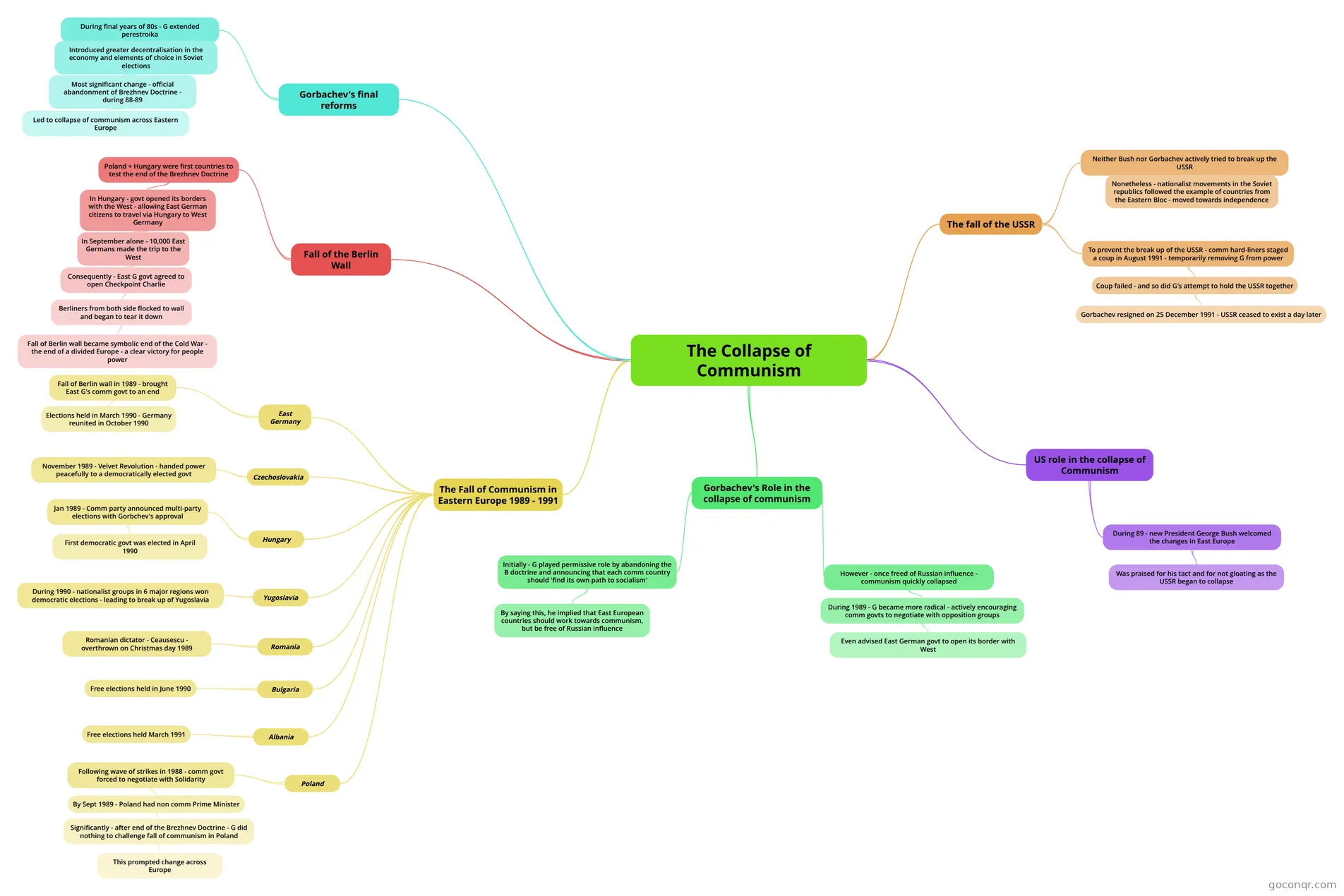
Mind map: The collapse of communism
Map content
The Collapse of Communism
Gorbachev's final reforms
- During final years of 80s - G extended perestroika
- Introduced greater decentralisation in the economy and elements of choice in Soviet elections
- Most significant change - official abandonment of Brezhnev Doctrine - during 88-89
- Led to collapse of communism across Eastern Europe
- Most significant change - official abandonment of Brezhnev Doctrine - during 88-89
- Introduced greater decentralisation in the economy and elements of choice in Soviet elections
- During final years of 80s - G extended perestroika
Fall of the Berlin Wall
- Poland + Hungary were first countries to test the end of the Brezhnev Doctrine
- In Hungary - govt opened its borders with the West - allowing East German citizens to travel via Hungary to West Germany
- In September alone - 10,000 East Germans made the trip to the West
- Consequently - East G govt agreed to open Checkpoint Charlie
- Berliners from both side flocked to wall and began to tear it down
- Fall of Berlin wall became symbolic end of the Cold War - the end of a divided Europe - a clear victory for people power
- Berliners from both side flocked to wall and began to tear it down
- Consequently - East G govt agreed to open Checkpoint Charlie
- In September alone - 10,000 East Germans made the trip to the West
- In Hungary - govt opened its borders with the West - allowing East German citizens to travel via Hungary to West Germany
- Poland + Hungary were first countries to test the end of the Brezhnev Doctrine
The Fall of Communism in Eastern Europe 1989 - 1991
- East Germany
- Fall of Berlin wall in 1989 - brought East G's comm govt to an end
- Elections held in March 1990 - Germany reunited in October 1990
- Fall of Berlin wall in 1989 - brought East G's comm govt to an end
- Czechoslovakia
- November 1989 - Velvet Revolution - handed power peacefully to a democratically elected govt
- Hungary
- Jan 1989 - Comm party announced multi-party elections with Gorbchev's approval
- First democratic govt was elected in April 1990
- Jan 1989 - Comm party announced multi-party elections with Gorbchev's approval
- Yugoslavia
- During 1990 - nationalist groups in 6 major regions won democratic elections - leading to break up of Yugoslavia
- Romania
- Romanian dictator - Ceausescu - overthrown on Christmas day 1989
- Bulgaria
- Free elections held in June 1990
- Albania
- Free elections held March 1991
- Poland
- Following wave of strikes in 1988 - comm govt forced to negotiate with Solidarity
- By Sept 1989 - Poland had non comm Prime Minister
- Significantly - after end of the Brezhnev Doctrine - G did nothing to challenge fall of communism in Poland
- This prompted change across Europe
- Significantly - after end of the Brezhnev Doctrine - G did nothing to challenge fall of communism in Poland
- By Sept 1989 - Poland had non comm Prime Minister
- Following wave of strikes in 1988 - comm govt forced to negotiate with Solidarity
- East Germany
Gorbachev's Role in the collapse of communism
- Initially - G played permissive role by abandoning the B doctrine and announcing that each comm country should 'find its own path to socialism'
- By saying this, he implied that East European countries should work towards communism, but be free of Russian influence
- However - once freed of Russian influence - communism quickly collapsed
- During 1989 - G became more radical - actively encouraging comm govts to negotiate with opposition groups
- Even advised East German govt to open its border with West
- During 1989 - G became more radical - actively encouraging comm govts to negotiate with opposition groups
- Initially - G played permissive role by abandoning the B doctrine and announcing that each comm country should 'find its own path to socialism'
US role in the collapse of Communism
- During 89 - new President George Bush welcomed the changes in East Europe
- Was praised for his tact and for not gloating as the USSR began to collapse
- During 89 - new President George Bush welcomed the changes in East Europe
The fall of the USSR
- Neither Bush nor Gorbachev actively tried to break up the USSR
- Nonetheless - nationalist movements in the Soviet republics followed the example of countries from the Eastern Bloc - moved towards independence
- To prevent the break up of the USSR - comm hard-liners staged a coup in August 1991 - temporarily removing G from power
- Coup failed - and so did G's attempt to hold the USSR together
- Gorbachev resigned on 25 December 1991 - USSR ceased to exist a day later
- Coup failed - and so did G's attempt to hold the USSR together
- Neither Bush nor Gorbachev actively tried to break up the USSR
Information
- Description
- A-Levels Cold War (End of Cold War) Mind Map on The Collapse of Communism, created by jacksearle on 26/05/2014.
- Created by
- jacksearle
- Views
- 156
- Rating