
Mind map
Oxidative Phosphorylation
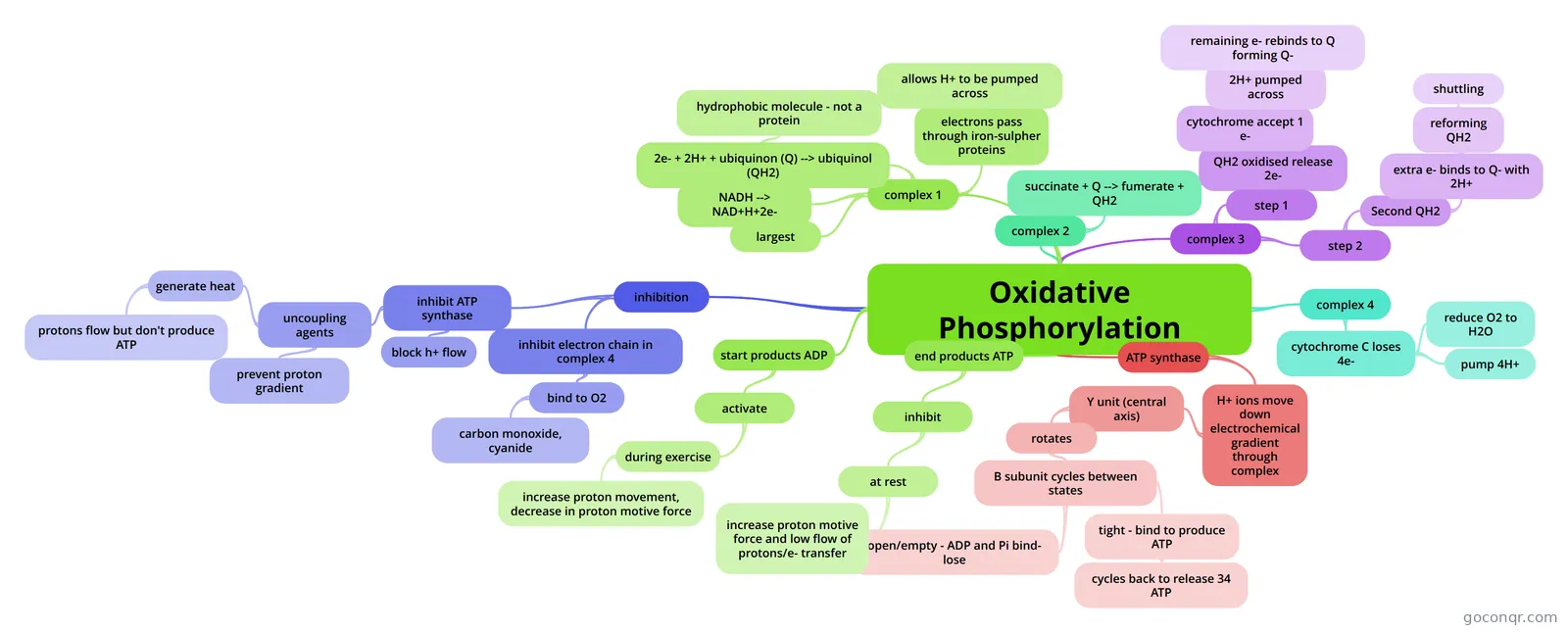
Mind map: Oxidative phosphorylation
Map content
Oxidative Phosphorylation
complex 1
- largest
- NADH --> NAD+H+2e-
- 2e- + 2H+ + ubiquinon (Q) --> ubiquinol (QH2)
- hydrophobic molecule - not a protein
- electrons pass through iron-sulpher proteins
- allows H+ to be pumped across
complex 2
- succinate + Q --> fumerate + QH2
complex 3
- step 1
- QH2 oxidised release 2e-
- cytochrome accept 1 e-
- 2H+ pumped across
- remaining e- rebinds to Q forming Q-
- 2H+ pumped across
- cytochrome accept 1 e-
- QH2 oxidised release 2e-
- step 2
- Second QH2
- extra e- binds to Q- with 2H+
- reforming QH2
- shuttling
- reforming QH2
- extra e- binds to Q- with 2H+
- Second QH2
- step 1
complex 4
- cytochrome C loses 4e-
- pump 4H+
- reduce O2 to H2O
- cytochrome C loses 4e-
ATP synthase
- H+ ions move down electrochemical gradient through complex
- Y unit (central axis)
- rotates
- B subunit cycles between states
- open/empty - ADP and Pi bind- lose
- tight - bind to produce ATP
- cycles back to release 34 ATP
- B subunit cycles between states
- rotates
- Y unit (central axis)
- H+ ions move down electrochemical gradient through complex
end products ATP
- inhibit
- at rest
- increase proton motive force and low flow of protons/e- transfer
- at rest
- inhibit
start products ADP
- activate
- during exercise
- increase proton movement, decrease in proton motive force
- during exercise
- activate
inhibition
- inhibit electron chain in complex 4
- bind to O2
- carbon monoxide, cyanide
- bind to O2
- inhibit ATP synthase
- block h+ flow
- uncoupling agents
- prevent proton gradient
- generate heat
- protons flow but don't produce ATP
- inhibit electron chain in complex 4
Information
- Description
- Mind Map on Oxidative Phosphorylation, created by devans1 on 05/06/2014.
- Created by
- devans1
- Views
- 53
- Rating