
Notes
Chapter 2
Content of the notes (10)
Page 1
Atomic Theory >Dalton
1. Each element is composed of tiny, indestructible particles; atoms.
2. All atoms of a given element have the same mass and other properties that distinguish them from the atoms of other elements.
3. Atoms combine in simple, white number ratios to form compounds.
4. Atoms of one element cannot change into atoms of another element, In a chemical reaction, atoms only change the way they are bound together with other atoms.
Page 2
Electrostatic Forces
1. Opposites attract.
2. Same charges repel each other.
3. Positive/negative charges of the same magnitude cancel out the attractive force.
Page 3
Electrons
The magnitude of its charge is important because it determines how strongly an atom holds its electrons.
Atoms form compounds by exchanging and sharing electrons; without this diversity life would not be possible.
Page 4
types of Radioactivity
alpha:
positive charge
biggest particle of the three
Page 5
Electrical imbalance corrects fast
An example of this is lightning or electricity from a storm. The negative charge builds up on clouds, while positive charge builds up on the ground, which is then discharged to equalize that imbalance.
Page 6
Elements defined by Protons #
Most important number that dictates the identity of an atom is the number of protons in the nucleus.
All atoms of an element have the same number of protons
Neutrons vary; differing by 1,2,3
Not all atoms of an element have the same number of neutrons.
Mass number
THE SUM NUMBER OF AN ATOM'S NEUTRONS AND PROTONS IS CALLED THE MASS NUMBER
Page 7
Ions
During chemical reactions, atoms can lose or gain an electron.
If an element loses an electron it is now positive charged and symbolized by a PLUS + because the electric majority is now positive. cation
When gaining an electron the opposite is also true, creating a negative charge being symbolized with a MINUS --. anion
Page 8
metals tend to lose e- > cations
main group of metals lose e-, forming cation w/ same # of e- as the nearest noble gas
nonmetals tend to gain e- > anions
main group nonmetals tend to gain e-, forming anion w/ same # of e- as the nearest noble gas
Main group elements forming cations, charge equals the group#
Main group elements forming anions w/ predictable charge, charge equals group# minus 8
Transition elements form various ions/charges
Page 9
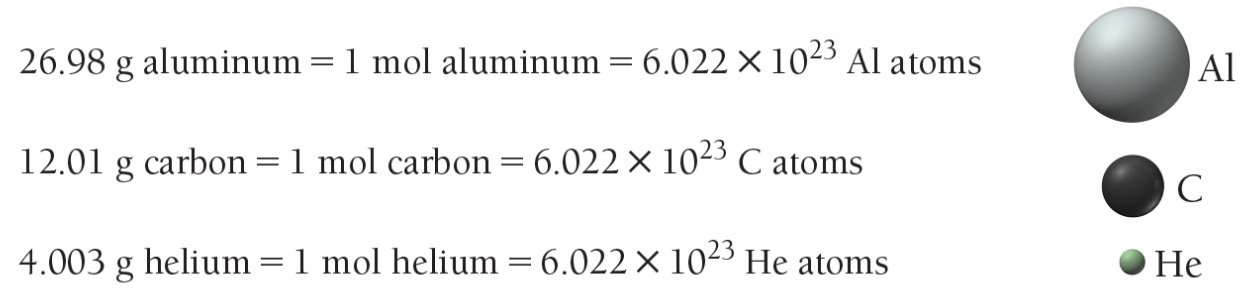
Molar Mass
molar mass: a mass of one mole of atoms of an element
an elements molar mass in grams per mole is numerically equal to the element's atomic mass in atomic mass units
Example of atomic mass to molar mass relationship:
Copper atomic mass = 63.55 amu --> molar mass: = 63.55 g/mol
Page 10
Information
- Description
- Chemistry Note on Chapter 2, created by Ariana Isaacs on 11/10/2020.
- Created by
- Ariana Isaacs
- Views
- 0
- Rating