
Notes
Structure of DNA
Content of the notes (1)
Page 1
Introduction
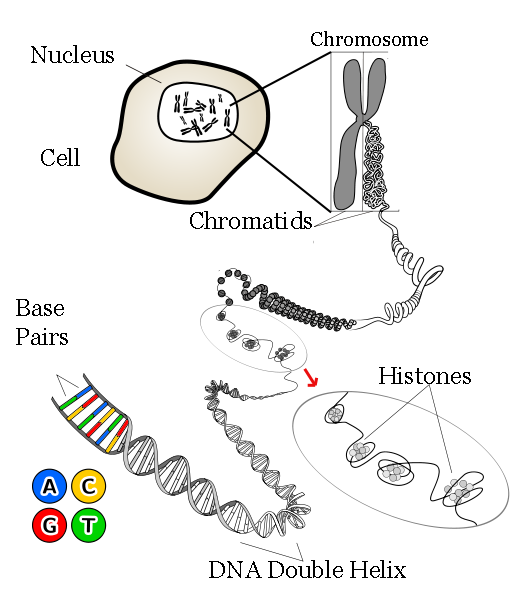
About 40 human cells would fit beside one another across a full stop at the end of this sentence. The DNA from just one of these cells would stretch to about 3 metres if it was fully unwound from the nucleus. This means that DNA must be very long in comparison to the size of the cell.
Histones
To enable DNA to fit into the nucleus, it is heavily coiled and folded, very similar to an elastic band twisted repeatedly until it forms solid ball. Proteins called histones, are responsible for holding the DNA in its folded state. Histones are a family of basic proteins that associate with DNA in the nucleus and help condense it into chromatin. Nuclear DNA does not appear in free linear strands; it is highly condensed and wrapped around histones in order to fit inside of the nucleus and take part in the formation of chromosomes. Histones are basic proteins, and their positive charges allow them to associate with DNA, which is negatively charged. Some histones function as spools for the thread-like DNA to wrap around.
Structure of DNA
The structure of DNA is similar to that of a ladder. DNA has two strands, just like the sides of a ladder. The strands are linked together by pairs of chemicals, called nucleotide bases. Each pair of nucleotides form a 'rung' on the DNA molecule. There are only 4 different nucleotide bases used in DNA. These include -
1. Adenine (A)
2. Thymine (T)
3. Guanine (G)
4. Cytosine (C)
Each of the four bases can only join or bond with one other base. For example, Adenine forms a bond with Thymine (A-T), and Guanine forms a bond with Cytosine (G-C). These pairs of bases are called complementary base pairs.
Double Helix
DNA can be thought of as a rope ladder, with pairs of complementary bases form the rungs of the ladder. If the rope latter is twisted to form a spiral structure, each of the side strands will form a spiral, or a helix. DNA is arranged in this way to form a double helix shape. Watson and Crick used stick-and-ball models to test their ideas on the possible structure of DNA. Other scientists used experimental methods instead. Among them were Rosalind Franklin and Maurice Wilkins, who were using X-ray diffraction to understand the physical structure of the DNA molecule.
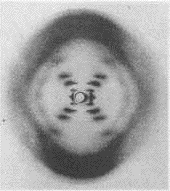
Diffraction pattern of DNA double helix
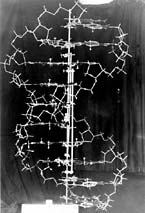
Ball and Stick model of DNA - Watson and Crick.
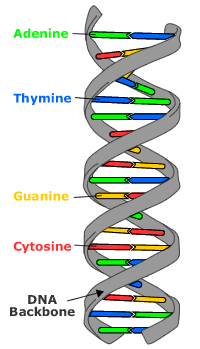
DNA Double Helix
Structure of DNA
Information
- Description
- This note focuses on the structure of DNA. It would appeal to anyone studying intermediate level biology.
- Created by
- daniel.praecox
- Views
- 245
- Tags
- History
-
- Created by jill.examtime · Jan 22, 2014
- Copied by daniel.praecox · Jan 22, 2014
- Rating