
Notes
Revision Notes 2
Content of the notes (1)
Page 1
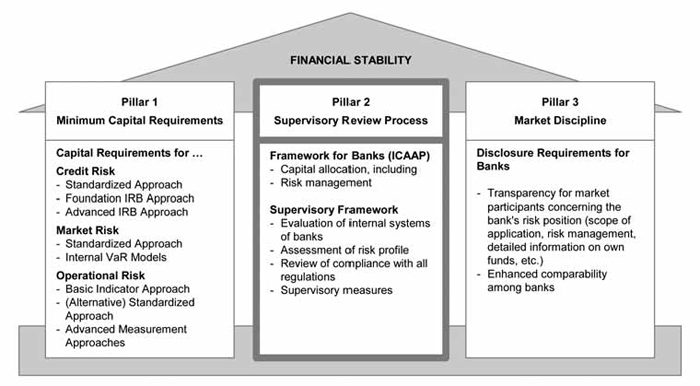
Basel II Three Pillars Approach: In response to the criticism of Basel I and its amendment, a number
of changes were made
More option for banks to determine its capital charge for risk
improved credit risk weighting
Recognition of operational risk
Subject to National supervisory approval, banks will be allowed to use their own internal rating models as a measurement of risk
Introduction of "Supervisory" and "Market Disciple" pillars
The fundamental ratio to be computed in Basel II for the minimum capital requirements is:
Capital (tier 1 and 2) / Amended credit risk + market risk + operational risk
Criticism of Basel II:
The internal approach to forecasting risk, based on VaR, neglects crucial aspects of risk in the financial markets. It is assumed that the bank’s own actions, based on its forecast of future volatility, does
not affect this volatility. Financial risk is created by the market behavior of all agents,
including the banks which are forecasting their risk. This leads to the contagion phenomena known
from financial crises, where expectation of falling prices triggers more sales with an increased down-
turn of prices as result
Too many rules, excessive prescription
Pro-Cylclical - A condition where value of goods and services tend to move in correlation with the economy
Failure to recognise benefits of diversification. Overestimating risk of lending to developing countries.
High cost of implementation
The main points of Basel III:
Increased capital reserves: In addition to the existing system of capital regulation, two new Items are added, namely
capital buffer, which comes into force in cases where the activities of the bank increase very rapidly
countercyclical buffer, which should prevent the tendency that capital reserves according to the existing rules will be small during booms and large in slumps
Leverage rule: This is a rule which is aimed to prevent too small capital reserves even in cases where assets have low risk and therefore would not give rise to building up reserves by using the existing rules
Liquidity rules: High quality assets should be large enough to cover one month net cash out- flow.
The Financial Services and Markets Act was passed in 2000. It established the FSA as the sole regulator of all UK financial institutions.
FSA Goals:
Maintain confidence in the UK financial system
Educate the public with risk associated with different forms of investing
Protect consumers but encourage them to take responsibility for their financial decisions
Reduce financial crime
FSA Risk Based Approach To Regulation:
The core of the operating framework for the FSA is sometimes described by the acronym, ARROW, which stands for Advanced, Risk-Responsive Operating Framework. ARROW defines the essence of the FSA's risk-based approach to regulating financial markets, services, and firms.
As supervisor for all financial
institutions, the FSA is trying to move away from specific rules for each of
the different types of financial institutions
The RTO Approach (risk to our
objectives) involves computing a score for each firm supervised by the FSA.
The score shows the probability of
the firm having an impact on the ability of the FSA to meet its statutory
objectives
The score is obtained from a simple
equation:
Impact Score = Impact of the
problem X Probability of the problem arising
A firm’s score determine how
closely the FSA monitors it
The FSA (Financial Services Authority) is an independent, non-governmental body that regulates the financial services industry in the UK, including most financial services markets, exchanges and firms. It sets standards to which such organizations must comply and can take action against them should they fail to meet required standards.
Bank
structure and regulation in the USA:
Large number of banks, banking
market not concentrated
Federal Reserve System: 12 Federal
Reserve Banks
By the 1990s, 92% of banks were
owned by BHCs (any firm holding at least 25% of the voting stock of a bank
subsidiary); BHCs could circumvent the interstate branching laws, via
“multi-bank” holding companies
The
US Financial Holding Companies:
Supervision of the FHCs is functional, i.e. insurance firms continue to
be supervised by the Department of Trade and Industry, investment banks by the
Securities and Exchange Commission, and the banking subsidiaries by the Federal
Reserve Bank
Firewall between commercial
securities subsidiaries: they are prohibited from cross marketing with each
other, and a bank can sell but may not underwrite insurance
US
Branch Banking Regulations:
To discourage concentration in
banking sector there were limitation in setting up banks’ branches, mainly
interstate branching
Each state had different degrees of
restriction
Bank Holding Companies might
establish bank subsidiaries in each state, but each was an individual legal
entity, which had to be separately capitalised
In 1994 the Riegle Neal Interstate Banking and Branching Efficiency Act largely
eliminated these restrictions
To prevent excessive concentration,
a BHC/FHC may not hold more than 30% of total deposits in any given state, and
10% nationally
Deposit
Insurance in US:
All member banks of the Federal
Reserve System are required to join the Federal Deposit Insurance Corporation
(FDIC)
The FDIC member banks pay an
insurance premium, which is used to purchase securities to provide the
insurance fund with a steam of revenue
The FDIC insures deposits of up to
$ 100,000; deposits are fully insuranced and it can creates moral hazard
problems
Premia are linked to capital at risk
Bank
Structure in Japan:
Keiretsu system
A Keiretsu is a group of companies
with cross-shareholdings and shared directorships which normally include a
bank, trust company, insurance firm and a major industrial concern (i.e. cars,
steel)
The bank supplies services to the
other keiretsu members, including loans
The Ministry of Finance (MoF) was the key regulator through
three bureaux: Banking, Securities and International Finance
Bank
Regulation in Japan:
MoF’s responsibilities included all
aspects of financial institution supervision: examination of financial firms,
control of interest rates and products, supervision of the deposit protection
scheme, setting the rules on activities to be undertaken by financial firms
Bank of Japan was responsible for
the implementation of monetary policy, but under the influence of MoF
High protected market
Japanese companies largely
dependant on banks’ loans
Theories (Functions) for Financial Intermediation:
Delegated Monitoring
Information Production
Liquidity Transformation
Consumption smoothing
Commitment Mechanisms
Basel II & III
Bank Structure and Regulation
General
Information
- Description
- university Global Banking Note on Revision Notes 2, created by dekanola on 10/12/2013.
- Created by
- dekanola
- Views
- 698
- Tags
- Rating