
Notes
OLD TESTAMENT EXAM #1
Content of the notes (15)
Page 1
BOOKS OF THE OLD TESTAMENT
GENESIS
EXODUS
LEVITICUS
NUMBERS
DEUTERONOMY
JOSHUA
JUDGES
RUTH
1 SAMUEL
2 SAMUEL
1 KINGS
2 KINGS
1 CHRONICLES
2 CHRONICLES
EZRA
NEHEMIAH
ESTHER
JOB
PSALMS
PROVERBS
ECCLESIASTES
SONG OF SOLOMON
ISAIAH
JEREMIAH
LAMENTATIONS
EZEKIEL
DANIEL
HOSEA
JOEL
AMOS
OBADIAH
JONAH
MICAH
NAHUM
HABAKKUK
ZEPHANIAH
HAGGAI
ZECHARIAH
MALACHI
Page 2
I. INTRODUCTION
A. Why Study the Old Testament?
- High relevance in culture and literature throughout history (i.e. David & Goliath, patience of Job)
- The OT is the foundation of NT Christianity
1. As the NT was being written, OT was used, and it points to Christ, predicts how things will happen, explains how old things were, and is the source of NT allusions
- To know God
- God is perfect; He knows the beginning and end, everything orbits around Him, and nobody can stop his hand
Page 3
B. What is the Bible?
- Bible = "biblos", Greek word meaning book
- Bible went from a scroll to "codex" (a bound book presumably created by Christians to contain all Scripture)
- OT: 39 books | NT: 27 books (3 * 9 = 27)
- Testament = can be defined as a covenant; a binding and personal agreement
- Old Testament: God's covenant with Abraham and his descendants
- New Testament: In the prophet Jeremiah, God supplants the OT covenant and makes a new one
a. Key difference: OT covenant on stone tablets, NT covenant "is the law etched in their hearts so they will know me"
- NATURE OF THE BIBLE
a. REVELATION: God reveals himself to us, showing us things we could not know
b. INSPIRATION: God directed the writing of the Bible
c. AUTHORITY: If you believe the Bible is true/inspired but don't come under the authority of God, there's no point
2 Timothy 3:16 "All Scripture is breathed out by God and profitable for teaching, for reproof, for correction, and for training in righteousness"
2 Peter 1:21 "For no prophecy was ever produced by the will of man, but men spoke from God as they were carried along by the Holy Spirit."
- FOUR THEORIES OF INSPIRATION
1. Neo-Orthodox
The Bible is witness to, or contains the Word of God; it is a fallible product of fallible man
2. Dictation Theory
God is speaking, and the authors are writing down what he speaks
3. Limited Inspiration
God inspired the idea and the writer wrote it, but a lot of details may be wrong even though the big picture is true
4. Plenary Verbal Idea
Every word is inspired. Each author writes different, but the Holy Spirit guides them so every word is true
Page 4
C. What is the Old Testament?
- TESTS FOR CANONICITY (standards for sorting the content of Bible):
a. Written by a prophet
b. Written to all generations
c. Written in accord with previous revelation
- Council of Jamnia (70AD) = Jewish gathering that confirmed which books would be in OT canon; the events were known but C of J made it official
- Apocrypha (means hidden) = other books from OT time; not in Protestant Bible for multiple reasons
a. Palestinian Jews never accepted them
b. In Septuagint
c. Jerome didn't consider Apocrypha on par with rest of scripture
d. Not in Hebrew Text
- # of Books = 24 C of J, 39 Protestant, 53 Roman Catholic
- DIVISIONS
a. HEBREW: Law, Prophets, Writings
b. ENGLISH: Law, History, Poetry/Wisdom, Prophets
- The original Biblical languages were Hebrew and Aramaic, sibling languages
- HOW CAN WE KNOW THE BIBLE IS ACCURATE, AFTER ALL THESE GENERATIONS?
1. Masoretic Text - 1000AD
Masoretes were Hebrew scribes, careful and deliberate when penning text. This is the most reliable text we have.
2. Samaritan Pentateuch - 1100 AD (oldest ver. 100-200 BC)
Samaritan ver of first five books, aka the law
3. Dead Sea Scrolls - 100-200 BC
Manuscripts that weren't published hidden in caves; people thought they were valuable
4. Septuagint - 200-300 BC
Greek translations of the OT; well-known Bible in ancient world
5. Targums
Jewish translations / commentaries on the OT in Aramaic
- We've moved through a millenia with accuracy. We have a large amount of data which lines up with the Bible we have.
Page 5
D. What do we do with it?
- PRINCIPLES FOR INTERPRETATION
a. OBSERVATION: What's going on?
Be observant, especially of what actually happened (for ex: the Bible never mentioned Mary rode on a donkey to Bethlehem)
b. INTERPRETATION: What does this mean?
Background = Bible comes from different history and culture
Author Trying to Communicate = The text can't mean what it never meant; what the author meant is most important
Clearer Passages Dominate = In difficult passage, use what you know to make them more clear
Only One Correct Interpretation = If Bible can mean anything, then it means nothing
c. APPLICATION: What will you do with it?
Apply the Bible to your life
Bad application example: reading "demons in pig" story to express "the beach is bad and sinful"
d. SPIRITUAL (MORE PERSONAL) ASPECT: Being in tune with God
You can't fully grasp the Bible without the Holy Spirit
The Bible was written for the church and must be interpreted within that context; shared with others
Engage with God in the scripture by being humble
Isaiah 66:1-2 "Thus says the Lord: 'Heaven is my throne, and the earth is my footstool; what is the house that you would build for me, and what is the place of my rest? All these things my hand has made, and so all these things came to be, declares the Lord. But this is the one to whom I will look: he who is humble and contrite in spirit and trembles at my word."
- A -> a -> BOOK -> R -> r
a. divine author -> human author -> scripture -> original reader -> later reader
Page 6
E. The Land of the Old Testament
- Ancient Near East (A.N.E.)
- 3 MAIN REGIONS: Mesopotamia, Syria-Palestine, and Egypt
a. Left to right: Egypt, Syria-Palestine, Mesopotamia
b. Mesopotamia = "Mezzo", Greek word (Meso = mezzo, potamia = river)
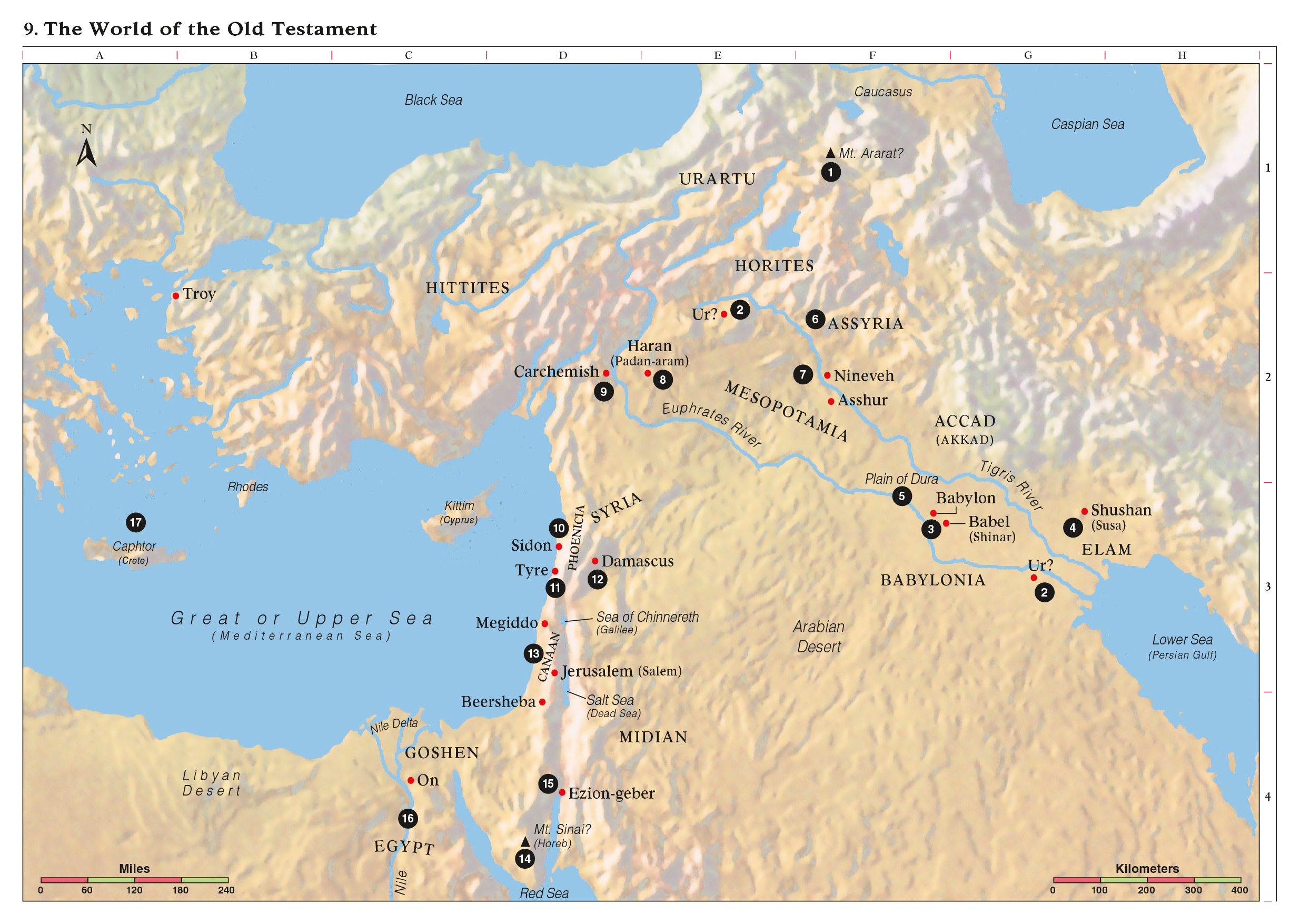
- Egypt and Mesopotamia were hubs, and Israel connected them as the olden highway. Everywhere else was desert
- ALTERNATE NAMES OF THE HOLY LAND
Canaan
named after descendant of Noah who settled there
Israel
Palestine
comes from the Philistines
Judea
tribe of Judah came back; the term Jew comes from here
- The climate was subtropical meditteranean. Rain came in winter and spring, with almost no rain in the summer - and people die if there's no rain.
- GEOGRAPHIC REGIONS OF PALESTINE
1. Coastal Plain: area of the sea with rich, fertile land
a. Valley of Jezreel: saw lots of battles because it was where the road came together
2. Central Highland: has the capital, Jerusalem; mountains were good for defense
3. Jordan Rift: significant bodies of water are here (Sea of Galilee, Jordan River, Dead Sea)
a. Salt ratio in Dead Sea was 6x more than in the ocean. Dead Sea is super dense; lowest point on Earth
4. Trans Jordan (trans = across in Latin): upper land
5. Mt. Carmel: had the most rainfall; if it withered, everything would die
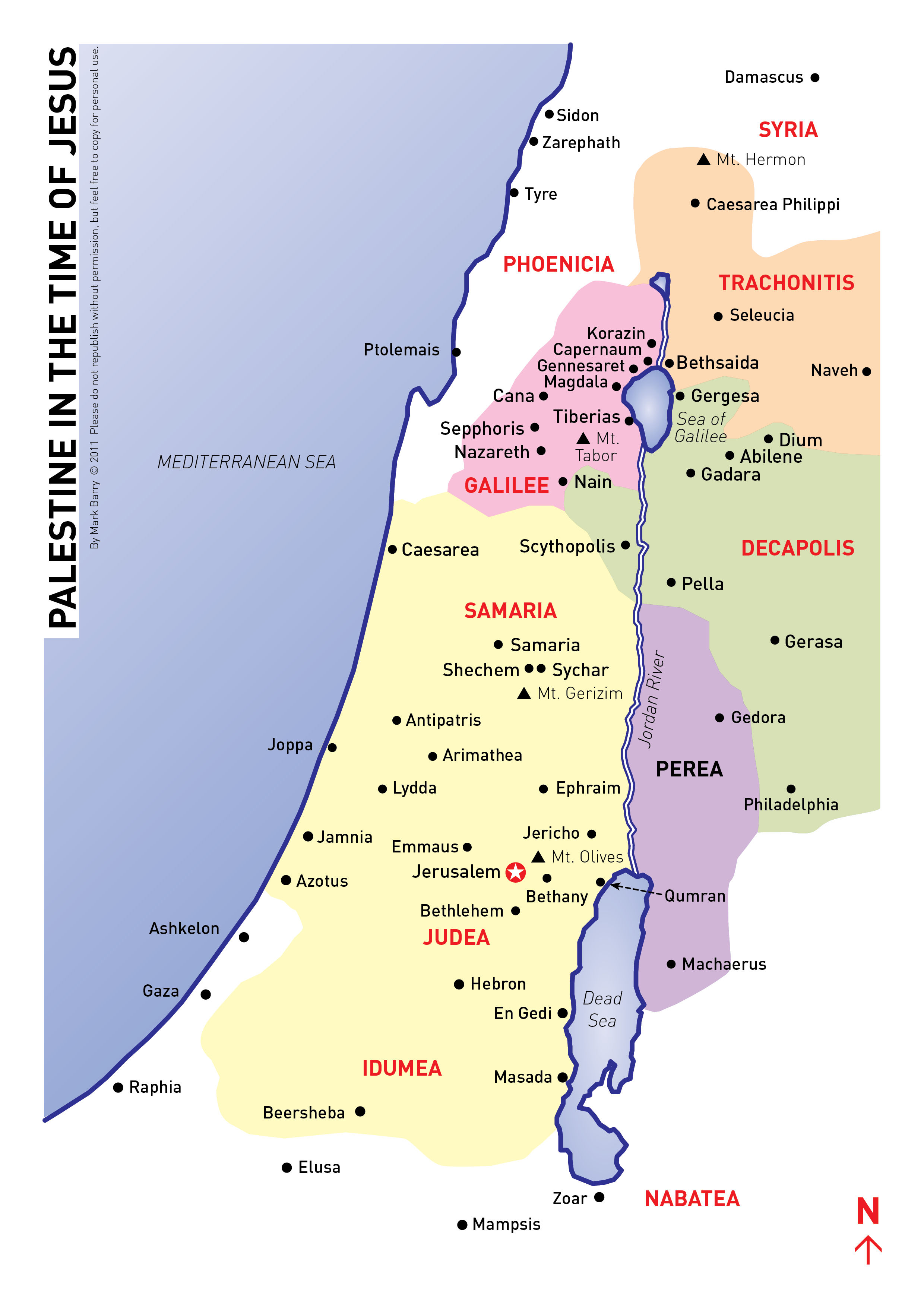
- PEOPLE WITHIN PALESTINE
a. Hebrews/Isrealites/Jews - lived around all 4 regions; the same but called differently throughout the Bible
b. Canaanites - people of Canaan; descendants of Canaan, Noah's grandson
- GROUPS SURROUNDING PALESTINE
a. Edomites - descendants of Esau; live south of Dead Sea
b. Moabites - descendants of Lot; live in Dead Sea area
c. Philistines - live on bottom-most coast area
d. Phoenecians (PURPLE PEEPS) - live along the coast; has two key city states Tyre and Sidon
- POWERFUL ENEMIES OF ISREALITES
a. Egypt
b. Assyrians - 722BC destroyed Northern Kingdom
c. Babylonians - 587BC destroyed Southern Kingdom
Page 7
II. The Pentateuch
AUTHORSHIP:
- Traditional View = Moses write it, supported by moments in the books were God says "Moses, write this down"
- Documentary Hypothesis = books are amalgamation of 4 separate documents that was put together by scribes
a JEPD = Jehovah, Elohim, Priestly, Deuteronomy
GENESIS:
- Greek word meaning "beginnings" / Hebrew word meaning "In the beginning"
- Practically every great theological doctrine can be traced back to Genesis
- You could say Genesis exists to refute other beliefs
Page 8
A. Creation
- Ex Nihilo = God created all things out of nothing
- The most basic confession of the Bible: "In the beginning, God created..." / "We believe in God the father almighty, maker of heaven and earth"
- The Bible never argues for the existence of God; it argues against the idea of multiple gods and strongly asserts sovereignty
- Atheism can be called a modern error, because everybody knew a God existed
- GENESIS 1 & 2: 1 = 7 day creation, 2 = Continues ch1 and restarts to talk about Adam and Eve
a. People might say 1 & 2 are contradictory and come from different sources, but the reality is that Gen 2 elaborates on Gen 1.
- God created by speaking, calling stuff into being, and we owe Him allegiance, worship, and obedience
- CREATION -> DISTINCTION -> NAMING -> EVALUATION
a. "God saw that it was good", and verse 31 "it wasn't just good, it was very good"
- The Bible was not written to be a scientific commentary; it was written to be accessible
- SOME APPROACHES:
1. Scientific Creationism
Earth and universe were thousands of years old (6-10k). Also called Young Earth View, that Genesis is taken literally. To explain why the Earth looks billions of years old, God could have created it with age and accelerated the processes.
2. The Gap Theory
The first verse was the reality of the universe, until Satan messed stuff up and the second verse onward is the recount of God fixing the universe.
3. Literary Artistic Description
Not historical, but a theological account that's poetic. Celebration of creation.
Light/darkness ---> stars
Sky/sea ---> birds/fish
Land ---> animals/man
4. Day Age Theory
Each "day" is actually an age (but "day" is never meant as "age" in the Bible)
5. Theistic Evolution
Darwin's theory was correct but guided by God
6. Naturalistic Evolution
Genesis is not connected to reality at all; everything evolved naturally
- MAIN THEMES: God is the transcendent ruler of creation, and opposing gods are nothing compared to Him
- MAN: God's ultimate creation, unique because we're made in his image
a. Man is like God in some ways, and reps God
b. The value of a human isn't tied to ability; it's tied to being created in his image
- GIFT OF SEXUALITY: Men and women equal in eyes of God
a. Genesis 2:18 "'It is not good that the man should be alone; I will make him a helper fit for him.'"
Page 9
B. The Fall (GEN 3)
- defined as Man's fall from fellowship of God after the first sin
- The Tree of Life prolonged life, so now that we're born outside Eden we'll die and are separated from God
- SIN: anything done against the will of God
a. Temptation is the invitation to sin
- STEPS OF TEMPTATION
a. Deception
b. Doubt (i.e. Eve doubting God's goodness, and the existence of consequence)
c. Desire [for wrong things]
d. Disobedience
- RESPONSES TO SIN
a. Shame (they turned away from God, and didn't feel comfortable with themselves)
b. Blame
c. Fear (hiding from God)
- GOD'S RESPONSE TO SIN
a. Judgment (death, childbirth, serpent slither)
b. Grace - the protoevangelium (promise that offspring will crush the serpent head and deliver dominion)
- Cain and Abel were the first two sins of Adam and Eve; Cain grew crops and Abel herded sheep
a. God was satisfied with Abel's offering but not Cain's
b. Cain killed his brother and became the first murderer
Page 10
C. The Flood (GEN 6-9)
- Lifespan was drastically shortened after the flood
- Just about every ancient culture has their own flood story (i.e. Gilgamesh Epic), but the claim of Genesis is it's the true flood story
- People didn't know what flooding/rain was, so it makes the story - and Noah's efforts - more substantial
- The rainbow afterward represents God's covenant with Noah that he'd never flood the earth like that again
D. Tower of Babel (GEN 11:1-9)
- PURPOSE OF STORY
a. To introduce Babylon
b. To explain the source of linguistic division
- The tower was a Ziggurat, a big building in the ancient world shaped like a layered cake (with each tier smaller than the last)
- God was displeased with the building of the tower because he ordered people to populate the earth, not stay in one city and build
a. Furthermore, they did this "tower to heaven" to make a name for themselves but God's like "where's this tower I have to go down to see?"
- God scrambles their languages, and they disperse
- The key lesson is that God's will is done no matter what; He gives us the opportunity to join him, but He'll accomplish his purposes without help
- Reversal of Babel: they will always understand God
Page 11
III. PATRIARCHS (GEN 12-50)
- patria = "father", archion = "ruler", so Patriarchs aka chief fathers
- "I am the God of your fathers" is the formulaic way God reveals himself
A. Introduction
- After human history (the creation story), there is a narrative shift at ch12 to the Patriarchs
a. Abraham, Isaac, Jacob
- Patriarchs were still presented as flawed; their misdeeds weren't glossed over
- SIGNIFICANCES
a. They were the beginning of the Hebrew people (because God makes a promise)
b. They mark the beginning of a people for God
c. They receive the covenant of God and promises
- COVENANT DETAILS
a. Genesis 15:5 "And he brought him outside and said, 'Look toward heaven, and number the stars, if you are able to number them.' Then he said to him, “So shall your offspring be.”
b. Genesis 5:18-21 "On that day the Lord made a covenant with Abram, saying, 'To your offspring I give this land, from the river of Egypt to the great river, the river Euphrates, the land of the Kenites, the Kenizzites, the Kadmonites, the Hittites, the Perizzites, the Rephaim, the Amorites, the Canaanites, the Girgashites and the Jebusites.”
Page 12
B. Important Concepts Found in the Patriarchal Stories
1. COVENANT: binding agreement by grace; two types are EQUAL/EQUAL and LESSER/GREATER
2. SURROGATE MOTHERHOOD: there was a stigma and practical problems surrounding barrenness
Sarai offers her servant Hagar to Abram
Ishmael, the son, gets cast out
Hagar becomes prideful and Sarai resentful/jealous
Could have been avoided if Abram had simply told her of God's promise and waited
3. CIRCUMCISION: "this will mark you physically" (not just with a new name)
sign of the covenant unique to Israel
All newborn male descendants at age 8
Also applies to all males in his house
This may have to do with sexual purity
4. CHILD SACRIFICE: was common to appease pagan gods
a. GEN22 is the pinnacle of the test of Abram
5. BIRTHRIGHT: first son gets greater shares and becomes family leader
6. ARRANGED MARRIAGES: didn't get to pick their partner; their famiy did
7. BLESSINGS: supernatural ceremony which would affect son's future
Page 13
C. Biographies of Abraham
- HIS CALLING (GEN12)
1. From a town called Ur
2. Abram probably worshipped the moon god - Tera - before God called him
3. Wealthy
4. Moved to Haran, where God calls him and sends him to a special land
- HIS COVENANT
1. God says he'll make him a great nation
2. God will give him land
3. He'll be the god of Abraham's descendants
4. All people of the earth shall be blessed through him
5. Protection - those who bless you I'll bless, those who curse you I'll curse (GEN20)
- SODOM AND GOMORRAH
Starts with 3 visitors at Abraham's tent, who are God and two angels disguised as humans. Townspeople say, "Let them out so we may know them." The place is filled with sinful people and God decides to destroy them; Abraham is invested in preserving the cities because his nephew Lot lived there. Abraham pleads with God that if he finds 10 righteous people, the city should be saved, but that's a failure.
- THE TEST
Ishmael is technically Abram's firstborn, but is not the promised son
Abram is 99 when the birth of Isaac is announced (in addition to the circumcision announcement and the change of his name to Abraham)
Abraham = "father of nations"; father of faith in Christ
Abraham is 100 when Isaac is born
Isaac means laughter, because Sarah laughed
- THE BIG TEST
a. At Mt. Moriah, God asks Abraham to sacrifice Isaac
b. Yahweh-Yileh: the Lord will provide, and that's the essence of Abraham's faith
c. By faith, Abraham obeyed; he left his wealth and sojourned to places he did not know, always following the Lord's orders
Page 14
D. Patriarch Family Tree
ABRAHAM ---> [ISAAC] AND [ISHMAEL]
Jacob and Esau
JACOB'S SONS: Reuben - Simeon - Levi - Judah - Zebulun - Isaachar - Dan - Gad - Asher - Naphtali - Joseph - Benjamin
Isaac, Abraham's son, AKA Son of Promise
a) FINDING A WIFE: biggest part of his story
- That was a big deal because the covenant needed to be fulfilled
- There's also a huge concern about who he marries (avoidance of Canaanite marriage was crucial)
- Abraham tells his servant to find his son a wife who's not from Canaan but from the land of his [Abraham's] people. The servant goes to Nahor and goes to the well, where all the ladies draw water. He prays that the young lady who decides to give him and his camels water be the one who he brings back to Abraham and Isaac, and his prayer is fulfilled by Rebecca.
Jacob, Isaac's son
a) BIRTH: Jacob and Esau, Rebecca's two sons, are in conflict
- The Lord stated that the older would serve the younger
- Jacob comes out with his hand holding onto Esau's heel
- Jacob tends sheep and is the favorite of his mother
b) CONFLICT: Esau is a hunter and is the favorite of his father
- Esau lived for immediate gratification. He didn't hold his birthright in high enough esteem, trading it for a bowl of soup.
- When Isaac decides to give away his blessing, he is blind and almost dead
- Isaac tells Esau to hunt and make food for him before receiving the blessing
- Rebecca overhears this and figures out a way for Jacob to receive the blessing instead; she cooks the stew for him, and she gives him Esau's clothes + sheep's wool to trick Isaac
c) ENCOUNTER WITH GOD - BETHEL: Esau despises Jacob after he stole the blessing, and Jacob fled to Paddan-Aram
- Along the way he stops at Bethel to sleep, and his dream shows a ladder to heaven
- God affirms his covenant with Jacob (even though Jacob wasn't deserving)
- Jacob wakes up and names the place Bethel, which means "the house of God"
d) JACOB IS DECEIVED: Jacob goes to the well and sees shepherds there, including Rachel and her family. After figuring out that Rachel is from an acceptable family (not Canaanite!!), Jacob agrees to work for Rachel's father for 7 years before marrying her.
- But the father gives him Leah, the older daughter, and while he ends up marrying both Leah and Rachel, Jacob got a taste of his own medicine
e) NAME CHANGE: At night, Jacob wrestled with an unknown man until daybreak
- His hip gets dislocated, and he'll forever have a limp
- Jacob asks the unknown man to bless him before leaving; this is understandable if you consider "the greater blesses the lesser"
- The wrestling match happens before Jacob's presumed "battle of his life" against Esau
- Jacob is given the name Israel, and the place is called Peniel (pen-NILE), which means face of God
Page 15
Joseph, the favored son
a) CHILD OF RACHEL: Because of this, Jacob's favoritism towards Joseph is obvious
- He has a technicolor coat and gets dreams of the future (i.e. the moon and the stars bowing down to him represent his brothers)
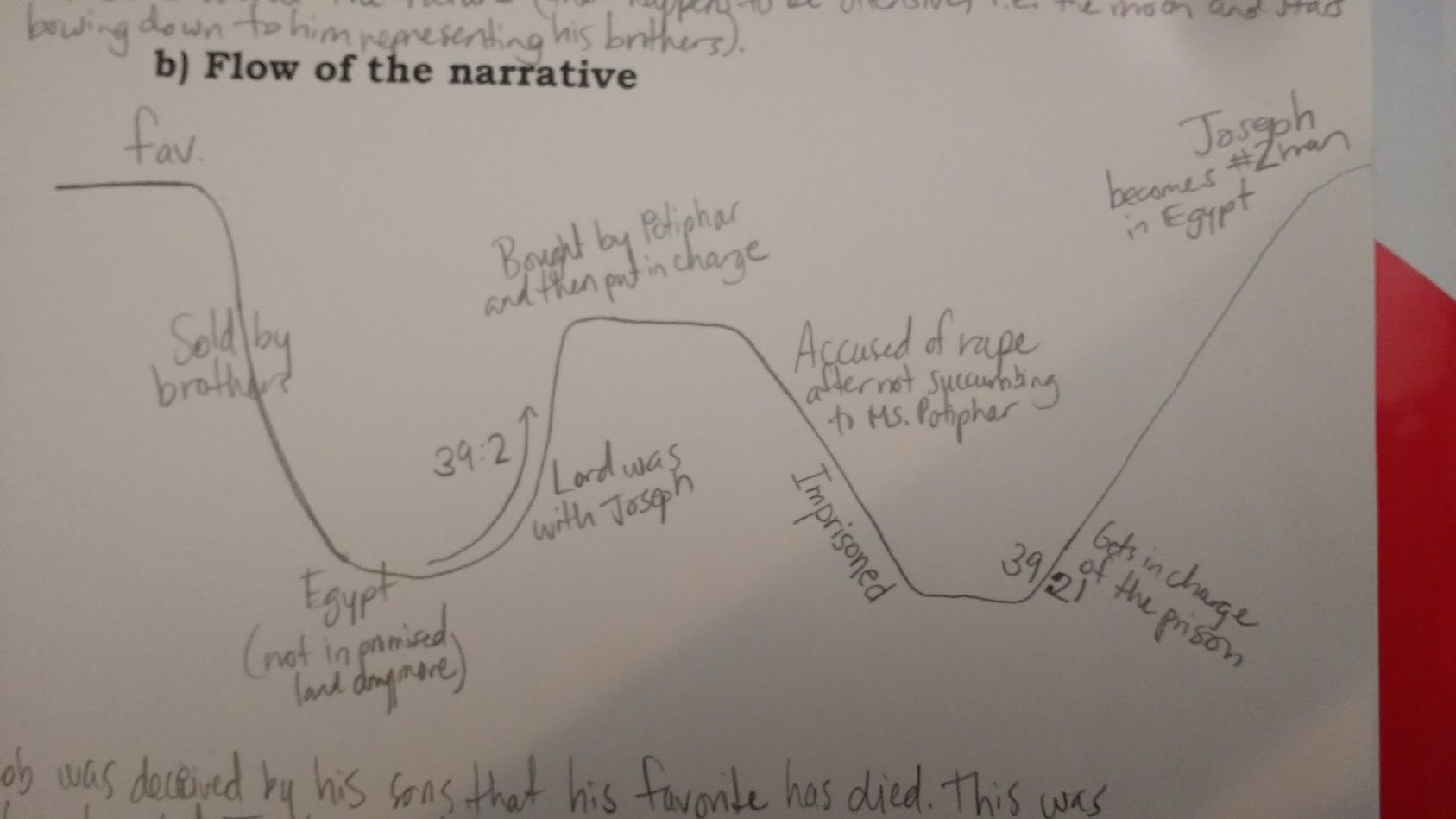
b) FLOW OF NARRATIVE:
FAVORITE ----> SOLD BY BROTHERS ----> TAKEN TO EGYPT (not in promised land anymore) ----> [GEN 39:2 "THE LORD WAS WITH JOSEPH AND HE BECAME A SUCCESSFUL MAN"] ----> BOUGHT BY POTIPHAR AND PUT IN CHARGE ----> ACCUSED OF RAPE AFTER NOT SUCCUMBING TO MS. POTIPHAR ----> IMPRISONED ----> GETS IN CHARGE OF THE PRISON ----> JOSEPH BECOMES #2 MAN IN EGYPT
Jacob was deceived by his other sons that Joseph died; he was deceived, just like how Jacob deceived Isaac
Joseph FEARS God; he refused Ms. Potiphar because "God would know" and instead of claiming his skill of interpreting dreams as his own, he attributes it to God ("it's God's power, not mine")
KEY TRUTHS =
1. GOD IS IN CONTROL of the suffering we encounter and the good we encounter
2. SUFFERING OFTEN TRAINS US for usefulness
Information
- Description
- Religious Studies Note on OLD TESTAMENT EXAM #1, created by Anton Nguyen on 15/09/2017.
- Created by
- Anton Nguyen · Sep 2017
- Updated
- Feb 3, 2018
- Views
- 1
- Rating