
Quiz
BIOL 108: Human Body Final Exam
This quiz has question types that open in the usual player.
Questions in this quiz (118)
1Select the following which are molecules of life:
- AProteins
- BLipids
- CNucleic acids
- DCarbohydrates
- EMonosaccharides
- FSaturated fats
- GPolysaccharides
- HNon-carbon based molecules
- INon-sugar carbohydrates
2A farmer wants to improve crop yield in his fields by testing the effectiveness of a new pesticide available on the market. Which one of the following is the best control for this experiment?
- AA higher concentration of new pesticide used on the control field than the experimental field
- BMore shade on the control field than on the experimental field
- CA lower concentration of new pesticide used on the control field than on the experimental field
- DMore water on the control field than on the experimental field
- ENo new pesticide used on the control field; new pesticide used only on the experimental field
3Which of the following determines the reactivity of an atom, or likelihood of forming a bond with another atom?
- ANumber of neutrons
- BNumber of electrons
- CNumber of protons
- DAtomic mass
4Please organize the terms regarding scientific levels of organization from LEAST COMPLEX (1) to MOST COMPLEX (5). Each term will be used only once.
1. [blank_start]Cells[blank_end]
2. [blank_start]Tissues[blank_end]
3. [blank_start]Organs[blank_end]
4. [blank_start]Organ systems[blank_end]
5. [blank_start]Organism[blank_end]- A1. Cells
- B1. Tissues
- C1. Organs
- D1. Organ systems
- E1. Organism
- F2. Tissues
- G2. Cells
- H2. Organs
- I2. Organ systems
- J2. Organism
- K3. Organs
- L3. Cells
- M3. Tissues
- N3. Organ systems
- O3. Organism
- P4. Organ systems
- Q4. Cells
- R4. Tissues
- S4. Organs
- T4. Organism
- U5. Organism
- V5. Cells
- W5. Tissues
- X5. Organs
- Y5. Organ systems
5The proper sequence of steps involved in the scientific method is: (1) state hypothesis, (2) observe, (3) experiment, (4) support or disprove the hypothesis.
- ATrue
- BFalse
6A student needs information from the National Institutes of Health, a governtment agency. Which one of the following endings should (s)he look for in the Internet address?
- A.edu
- B.com
- C.gov
- D.nih
- E.org
7Causation is easier to demonstrate than correlation.
- ATrue
- BFalse
8"Double-blind" experiments are designed so that only subjects do not know if they are receiving the placebo or drug.
- ATrue
- BFalse
9The most biologically important characteristic of lipids is that lipids are hydrophobic.
- ATrue
- BFalse
10On the molecular structure of two bonded water molecules, label the following:
1. The meaning of "H"
2. The meaning of the orange, solid line
3. The meaning of the green, dashed line
4. The meaning of δ+
5. The meaning of δ-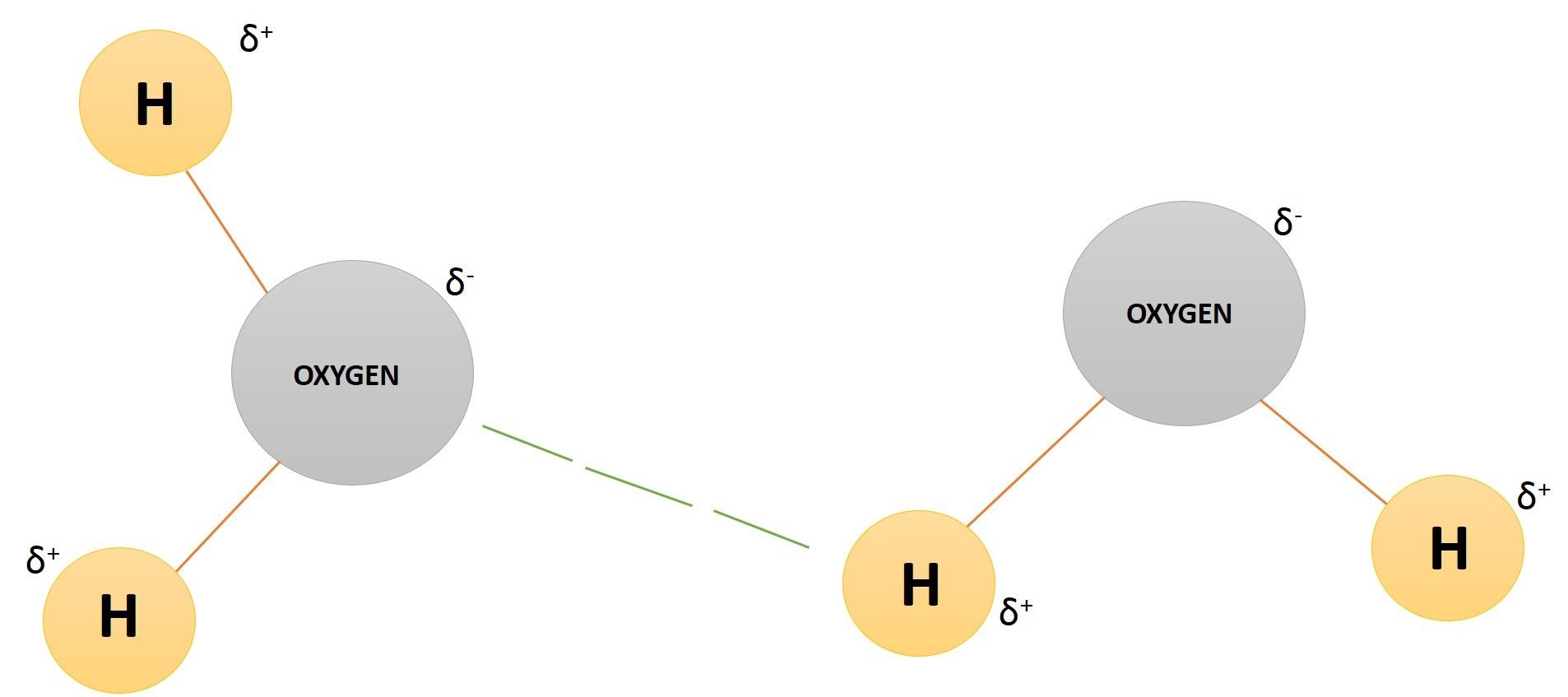
- A(1) Hydrogen
- B(1) Helium
- C(1) Holmium
- D(1) Hassium
- E(1) Hafnium
- F(4) positive charge
- G(4) negative charge
- H(2) hydrogen bond
- I(2) ionic bond
- J(2) covalent bond
- K(5) positive charge
- L(5) negative charge
- M(3) hydrogen bond
- N(3) ionic bond
- O(3) covalent bond
11An atom is the smallest unit of an element that demonstrates all of the properties of that element.
- ATrue
- BFalse
12Select the correct term from the drop-down box for each explanation. Each term will be used only ONCE, but NOT ALL TERMS will be used.
1. [blank_start]______[blank_end] The site of protein production in a cell
2. [blank_start]______[blank_end] Stack of flattened membranes. Site where cell products are modified and prepared for secretion from the cell
3. [blank_start]______[blank_end] Large network of membranes where lipids are synthesized
4. [blank_start]______[blank_end] Organelle that stores the genetic information of the cell
5. [blank_start]______[blank_end] Extensions of the cell membrane that increase the cell's surface area
6. [blank_start]______[blank_end] Double-membraned organelle believed to have originated through endosymbiosis
7. [blank_start]______[blank_end] Responsible for supporting the internal and external structure of the cell- A(A) Nucleus
- B(A) Mitochondria
- C(A) Cytoplasm
- D(A) Microvilli
- E(A) Cytoskeleton
- F(A) Smooth endoplasmic reticulum
- G(A) Ribosome
- H(A) Endosymbiont
- I(A) Golgi apparatus
- J(A) Lysosome
- K(B) Nucleus
- L(B) Mitochondria
- M(B) Cytoplasm
- N(B) Microvilli
- O(B) Cytoskelton
- P(B) Smooth endoplasmic reticulum
- Q(B) Ribosome
- R(B) Endosymbiont
- S(B) Golgi apparatus
- T(B) Lysosome
- U(C) Nucleus
- V(C) Mitochondria
- W(C) Cytoplasm
- X(C) Microvilli
- Y(C) Cytoskeleton
- Z(C) Smooth endoplasmic reticulum
- AA(C) Ribosome
- AB(C) Endosymbiont
- AC(C) Golgi apparatus
- AD(C) Lysosome
- AE(D) Nucleus
- AF(D) Mitochondria
- AG(D) Cytoplasm
- AH(D) Microvilli
- AI(D) Cytoskeleton
- AJ(D) Smooth endoplasmic reticulum
- AK(D) Ribosome
- AL(D) Endosymbiont
- AM(D) Golgi apparatus
- AN(D) Lysosome
- AO(E) Nucleus
- AP(E) Mitochondria
- AQ(E) Cytoplasm
- AR(E) Microvilli
- AS(E) Cytoskeleton
- AT(E) Smooth endoplasmic reticulum
- AU(E) Ribosome
- AV(E) Endosymbiont
- AW(E) Golgi apparatus
- AX(E) Lysosome
- AY(F) Nucleus
- AZ(F) Mitochondria
- BA(F) Cytoplasm
- BB(F) Microvilli
- BC(F) Cytoskeleton
- BD(F) Smooth endoplasmic reticulum
- BE(F) Ribosome
- BF(F) Endosymbiont
- BG(F) Golgi apparatus
- BH(F) Lysosome
- BI(G) Nucleus
- BJ(G) Mitochondria
- BK(G) Cytoplasm
- BL(G) Microvilli
- BM(G) Cytoskeleton
- BN(G) Smooth endoplasmic reticulum
- BO(G) Ribosome
- BP(G) Endosymbiont
- BQ(G) Golgi apparatus
- BR(G) Lysosome
13There are ribosomes located throughout the rough endoplasmic reticulum.
- ATrue
- BFalse
14Organize the following types of molecular bonds from weakest (1) to strongest (2).
1. [blank_start]Hydrogen bonds[blank_end]
2. [blank_start]Ionic bonds[blank_end]
3. [blank_start]Covalent bonds[blank_end]- A(1) Hydrogen bonds
- B(1) Ionic bonds
- C(1) Covalent bonds
- D(2) Ionic bonds
- E(2) Hydrogen bonds
- F(2) Covalent bonds
- G(3) Covalent bonds
- H(3) Ionic bonds
- I(3) Hydrogen bonds
15[blank_start]Oxygen[blank_end] is the basis of life; it gives your body life by helping with aerobic respiration and it also bonds with hydrogen to create water. Water is essential; it makes up 60% of the human body. [blank_start]Carbohydrates[blank_end] give you the food to feed your cells; for example, animals use [blank_start]glucose[blank_end] that they get from glycogen. [blank_start]Protiens[blank_end] have many functions; some examples of these functions are assisting molecular transfers, hormones, and muscle contractions. [blank_start]Fats[blank_end] store excess energy that can eventually be used by the body. [blank_start]DNA[blank_end] provides the genetic information for a cell and is located in the nucleus of a cell. [blank_start]ATP[blank_end] provides almost all of the energy for our cells in a rapid manner.
- A(1) Oxygen
- B(1) Carbohydrate
- C(1) Protein
- D(1) Fat
- E(1) DNA
- F(1) ATP
- G(2) Carbohydrates
- H(2) Oxygen
- I(2) Proteins
- J(2) Fats
- K(2) DNA
- L(2) ATP
- M(3) glucose
- N(3) triglycerides
- O(3) phospholipids
- P(4) Protiens
- Q(4) Oxygen
- R(4) Carbohydrates
- S(4) Fats
- T(4) DNA
- U(4) ATP
- V(5) Fats
- W(5) Oxygen
- X(5) Carbohydrates
- Y(5) Proteins
- Z(5) DNA
- AA(5) ATP
- AB(6) DNA
- AC(6) Oxygen
- AD(6) Carbohydrate
- AE(6) Protein
- AF(6) Fat
- AG(6) ATP
- AH(7) ATP
- AI(7) DNA
- AJ(7) Oxygen
- AK(7) Carbohydrate
- AL(7) Protein
- AM(7) Fat
16For a gene to produce hair color, it first has to come from your [blank_start]DNA[blank_end] that your parents gave you via their [blank_start]chromosomes[blank_end]. Chromosomes hold [blank_start]DNA[blank_end] in the nucleus. The DNA codes into [blank_start]RNA[blank_end], which then creates the [blank_start]proteins[blank_end] needed to produce that hair color.
- A(1) DNA
- B(1) RNA
- C(2) chromosomes
- D(2) proteins
- E(1) ATP
- F(3) DNA
- G(3) RNA
- H(3) ATP
- I(4) RNA
- J(4) ATP
- K(5) proteins
- L(5) chromosomes
17Organize the following steps of bone repair for a broken bone from first (1) to last (4). Please only type the number instead without any punctuation; for example, next to step one, type "1" without the quotation marks.
[blank_start]4[blank_end] Osteoclasts break down bone to begin remodeling
[blank_start]2[blank_end] A cartilage callous forms & holds together the 2 broken ends of bone
[blank_start]1[blank_end] A blood clot forms
[blank_start]3[blank_end] Osteoblasts secrete proteins to form a bony callous- A4
- B2
- C1
- D3
18A blood vessel is an organ.
- ATrue
- BFalse
19Select the correct organ system from the drop-down box for each statement. Each term will be used only ONCE. There are more terms than there are blanks, so not all answers will be used.
1. [blank_start]______[blank_end] Produces hormones that regulate many body functions
2. [blank_start]______[blank_end] Detects both external and internal stimuli and coordinates responses
3. [blank_start]______[blank_end] Produces blood cells and provides structural framework for movement
4. [blank_start]______[blank_end] Maintains the volume and composition of body fluids
5. [blank_start]______[blank_end] Exchanges gases (oxygen and carbon dioxide) between air and blood
6. [blank_start]______[blank_end] Transports materials to and from all cells- AA. Nervous system
- BA. Lymphatic system
- CA. Urinary system
- DA. Reproductive system
- EA. Circulatory system
- FA. Digestive system
- GA. Endocrine system
- HA. Skeletal system
- IA. Respiratory system
- JB. Nervous system
- KB. Lymphatic system
- LB. Urinary system
- MB. Reproductive system
- NB. Circulatory system
- OB. Digestive system
- PB. Endocrine system
- QB. Skeletal system
- RB. Respiratory system
- SC. Nervous system
- TC. Lymphatic system
- UC. Urinary system
- VC. Reproductive system
- WC. Circulatory system
- XC. Digestive system
- YC. Endocrine system
- ZC. Skeletal system
- AAC. Respiratory system
- ABD. Nervous system
- ACD. Lymphatic system
- ADD. Urinary system
- AED. Reproductive system
- AFD. Circulatory system
- AGD. Digestive system
- AHD. Endocrine system
- AID. Skeletal system
- AJD. Respiratory sytem
- AKE. Nervous system
- ALE. Lymphatic system
- AME. Urinary system
- ANE. Reproductive system
- AOE. Circulatory system
- APE. Digestive system
- AQE. Endocrine system
- ARE. Skeletal system
- ASE. Respiratory system
- ATF. Nervous system
- AUF. Lymphatic system
- AVF. Urinary system
- AWF. Reproductive system
- AXF. Circulatory system
- AYF. Digestive system
- AZF. Endocrine system
- BAF. Skeletal system
- BBF. Respiratory system
20Which of the following does not repair itself well (if at all) after an injury?
- ACartilage
- BBone
- CLigament
- DTendon
21Synovial joints are filled with a lubricating fluid.
- ATrue
- BFalse
22Slow twitch muscle fibers have more blood vessels than fast twitch muscle fibers.
- ATrue
- BFalse
23Which of the following injuries has occurred when a ligament is stretched or torn?
- ASprain
- BStrain
- CBreak
- DFracture
24Fast-twitch muscle fibers are [blank_start]anaerobic[blank_end], and slow-twitch muscle fibers are [blank_start]aerobic[blank_end].
- A(1) anaerobic
- B(1) aerobic
- C(2) aerobic
- D(2) anaerobic
25Which of the following types of muscle fibers is used for short bursts of activity?
- AFast-twitch muscle fibers
- BSlow-twitch muscle fibers
26Muscles controlling fine movements use [blank_start]small motor units[blank_end]. A small motor unit has about [blank_start]two to ten[blank_end] motor units, and a large motor unit has [blank_start]thousands[blank_end].
- Asmall motor units
- Blarge motor units
- C(1) two to ten
- D(1) thousands
- E(2) thousands
- F(2) two to ten
27Select the following process(es) which occur(s) throughout life:
- ABones grow in length
- BBones grow in width
- CBone marrow produces new blood cells
- DBones undergo remodeling
28Match the correct type of fracture with its appropriate description. Each blank only has one term, but since there are more terms than blanks not all terms will be used.
1. [blank_start]______[blank_end] When the neds of the bone no longer line up
2. [blank_start]______[blank_end] Partly broken, partly bent; usually happens in young children
3. [blank_start]______[blank_end] Bone fragments; shattered
4. [blank_start]______[blank_end] Many microscopic breaks- AA. Stress fracture
- BA. Displaced
- CA. Compound
- DA. Greenstick
- EA. Comminuted
- FA. Dislocated
- GB. Stress fracture
- HB. Displaced
- IB. Compound
- JB. Greenstick
- KB. Comminuted
- LB. Dislocated
- MC. Stress fracture
- NC. Displaced
- OC. Compound
- PC. Greenstick
- QC. Comminuted
- RC. Dislocated
- SD. Stress fracture
- TD. Displaced
- UD. Compound
- VD. Greenstick
- WD. Comminuted
- XD. Dislocated
29Match the correct type of muscle with the type of movement. Each muscle type will only be used once.
1. [blank_start]______[blank_end] Moves blood and nutrients throughout the body
2. [blank_start]______[blank_end] Moves and stabilizes the skeletal system
3. [blank_start]______[blank_end] Moves food, feces, etc.- AA. Skeletal
- BA. Cardiac
- CA. Smooth
- DB. Cardiac
- EB. Skeletal
- FB. Smooth
- GC. Smooth
- HC. Cardiac
- IC. Skeletal
30You would find smooth muscle in the stomach.
- ATrue
- BFalse
31You would find cardiac muscle in the heart.
- ATrue
- BFalse
32You would find skeletal muscle in your legs--specifically, in your femur.
- ATrue
- BFalse
33Select the following type(s) of muscle which is/are INVOLUNTARY:
- ACardiac muscle
- BSkeletal muscle
- CSmooth muscle
34The four types of tissues in the body are connective tissue, epithelial tissue, muscular tissue, and cardiac tissue.
- ATrue
- BFalse
35Complete the following table with the following information for EACH box:
1. Is ATP required?
2. Are transport proteins required?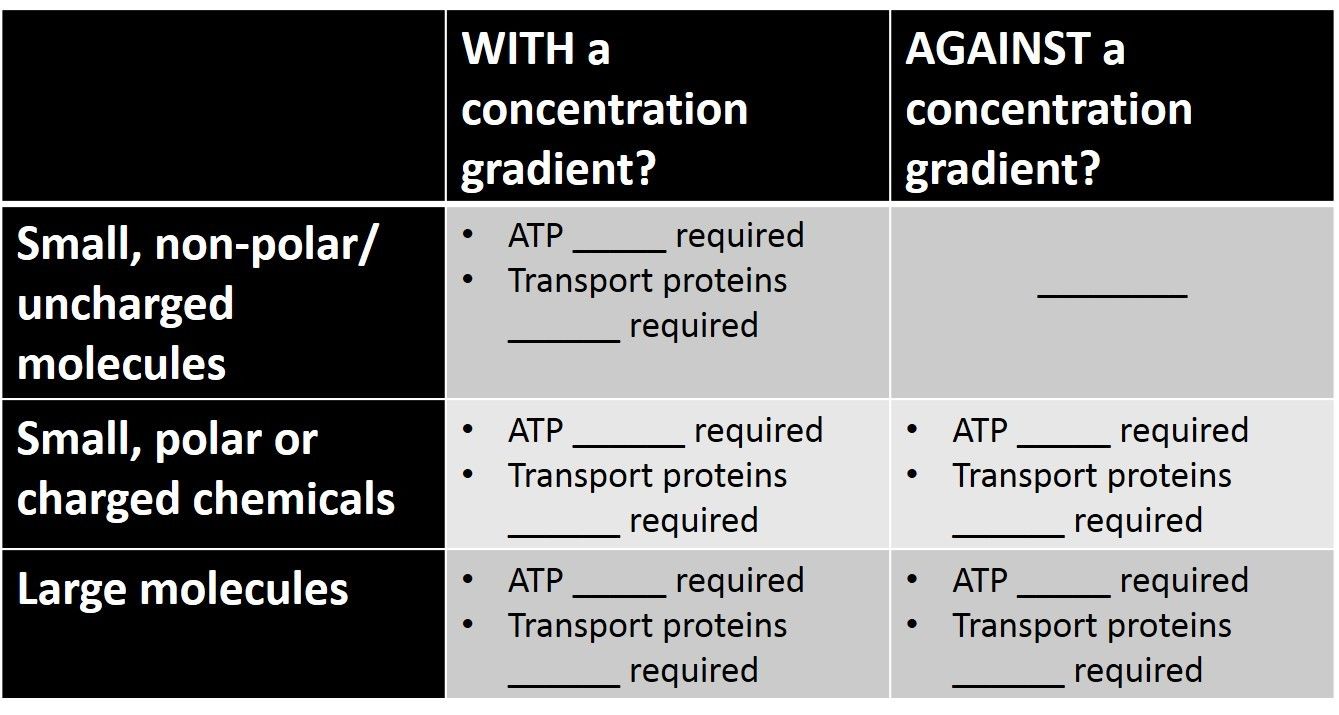
- Anot possible
- Bnot
- Cnot
- Dnot
- Eare
- Fis
- Gare
- His
- Iare
- Jis
- Kis
36Describe the events involved in a skeletal muscle contraction. You should accurately use the following terms: actin, action potential, calcium, motor neuron, myosin, sarcomere, sarcoplasmic reticulum, sliding, and troponin.
A(n) [blank_start]action potential[blank_end] moves down a [blank_start]motor neuron[blank_end] where Ach is released. This flows through the synapse to the receptors of the muscle fiber, which then allows the [blank_start]calcium ions[blank_end] to be released from the [blank_start]sarcoplasmic reticulum[blank_end] and bind. The [blank_start]actin[blank_end] and [blank_start]myosin[blank_end] of the sarcomere link to the myosin head and moves the muscle fiber into contraction. The [blank_start]sliding[blank_end] movement occurs due to the [blank_start]troponin[blank_end] and tropomyosin allowing binding sites to show.- Aaction potential
- Bmotor neuron
- Ccalcium ions
- Dsarcoplasmic reticulum
- Eactin
- Fmyosin
- Gsliding
- Htroponin
37Select the correct term from the drop-down box for each phrase. Each term will be used only once, but since there are more terms than blanks not all terms will be used.
1. [blank_start]______[blank_end] Develops into a cell that produces antibodies
2. [blank_start]______[blank_end] Can engulf and kill a bacterium or infected cells
3. [blank_start]______[blank_end] Fragments of cells that help form blood clots
4. [blank_start]______[blank_end] Carries most of the oxygen traveling in blood
5. [blank_start]______[blank_end] Makes up more than half of the volume of blood- AA. B cell
- BA. T cell
- CA. Natural Killer (NK) cell
- DA. Phagocytic cell
- EA. Erythrocyte
- FA. Plasma
- GA. Platelets
- HB. B cell
- IB. T cell
- JB. Natural killer (NK) cell
- KB. Phagocytic cell
- LB. Erythrocyte
- MB. Plasma
- NB. Platelets
- OC. B cell
- PC. T cell
- QC. Natural Killer (NK) cell
- RC. Phagocytic cell
- SC. Plasma
- TC. Erythrocyte
- UC. Platelets
- VD. B cell
- WD. T cell
- XD. Natural Killer (NK) cell
- YD. Erythrocyte
- ZD. Plasma
- AAD, Platelets
- ABD. Phagocytic cell
- ACE. B cell
- ADE. T cell
- AEE. Natural Killer (NK) cell
- AFE. Phagocytic cell
- AGE. Erythrocyte
- AHE. Plasma
- AIE. Platelets
38Both B cells and T cells can target specific antigens and can produce memory cells.
- ATrue
- BFalse
39Due to menstruation, women lose more blood than men which in turn reduces their iron levels and their hematocrit.
- ATrue
- BFalse
40Blood thinners reduce the thickness of your blood by adding a large amount of water to the bloodstream.
- ATrue
- BFalse
41When skeletal muscles contract, they pump oxygen-depleted blood back to the heart. This is an example of venous return.
- ATrue
- BFalse
42If you have blood type B, then select the following blood type(s) who you can GIVE blood to:
- AA
- BB
- CAB
- DO
43If your blood type is type B, who can you RECEIVE blood from? Select all blood type(s):
- AA
- BB
- CAB
- DO
44Three risk factors for hypertension include (but are not limited to) old age, a high-salt diet, and obesity.
- ATrue
- BFalse
45The left ventricle contraction generates diastolic pressure, and the left ventricle relaxation generates systolic pressure.
- ATrue
- BFalse
46Normal blood pressure is 120/80.
- ATrue
- BFalse
47Select the correct term from the drop-down box for each statement. Each term will be used only once, but since there are more terms than statements, some terms will not be used.
1. [blank_start]______[blank_end] A blood clot that is stuck in a vessel and blocking blood flow.
2. [blank_start]______[blank_end] Low oxygen carrying capacity
3. [blank_start]______[blank_end] A circulating blood clot
4. [blank_start]______[blank_end] A general term for any inappropriate blood clot
5. [blank_start]______[blank_end] Consequence of a cerebral embolism- AA. Embolus
- BA. Thrombus
- CA. Embolism
- DA. Myocardial infarction
- EA. Stroke
- FA. Coronary
- GA. Anemia
- HB. Embolus
- IB. Thrombus
- JB. Embolism
- KB. Myocardial infarction
- LB. Stroke
- MB. Coronary
- NB. Anemia
- OC. Embolus
- PC. Thrombus
- QC. Embolism
- RC. Myocardial infarction
- SC. Stroke
- TC. Coronary
- UC. Anemia
- VD. Embolus
- WD. Thrombus
- XD. Embolism
- YD. Myocardial infarction
- ZD. Stroke
- AAD. Coronary
- ABD. Anemia
- ACE. Embolus
- ADE. Thrombus
- AEE. Embolism
- AFE. Myocardial infarction
- AGE. Stroke
- AHE. Coronary
- AIE. Anemia
48Which of the following occurs after the platelet plug forms during blood clotting?
- AThe plug forms a clot that traps red blood cells.
- BThe smooth muscle lining the vessels spasms, reducing blood loss.
- CPlatelets recruit more platelets, causing a positive feedback loop.
49Ebola has a high [blank_start]virulence[blank_end] but a fairly low [blank_start]transmissibility[blank_end].
- A(1) virulence
- B(1) immunity
- C(1) transmissibility
- D(2) transmissibility
- E(2) virulence
- F(2) immunity
50Fungal pathogens are typically transmitted by vectors.
- ATrue
- BFalse
51Antigen-presenting cells (APCs) find antigens and activate T/B cells.
- ATrue
- BFalse
52Which of the following is NOT an example of passive immunity?
- AAntibodies crossing the placenta to the fetus
- BAntivenoms
- CBabies drinking breast milk
- DVaccines
53Redness, heat, swelling and pain are characteristics of [blank_start]inflammation[blank_end].
- Ainflammation
- Bvasoconstriction
- CT cell activation
- Dimmune tolerence
54Select the following attribute(s) which is/are associated with the IMMUNE SYSTEM:
- AOrgan system
- BDefends the body from pathogens
- CRegulates fluid balance
- DIncludes tonsils, thymus, spleen, and lymph nodes
- EFunctional system
55Select the following attribute(s) which is/are associated with the LYMPHATIC SYSTEM:
- AOrgan system
- BDefends the body from pathogens
- CRegulates fluid balance
- DIncludes tonsils, thymus, spleen, and lymph nodes
- EFunctional system
56The [blank_start]innate[blank_end] immune response is activated first in response to the first encounter with a new antigen.
- Ainnate
- Badaptive
57There are three different "types" of antibodies.
- ATrue
- BFalse
58Select the appropriate pathogen for each infection/disease from the drop-down box. Each term will only be used once.
1. [blank_start]______[blank_end] Athlete's foot
2. [blank_start]______[blank_end] Tapeworms
3. [blank_start]______[blank_end] Common cold
4. [blank_start]______[blank_end] Mad cow disease
5. [blank_start]______[blank_end] Lyme disease- AA. Animals (parasites)
- BA. Virus
- CA. Fungus
- DA. Prion
- EA. Bacteria
- FB. Animals (parasites)
- GB. Virus
- HB. Fungus
- IB. Prion
- JB. Bacteria
- KC. Animals (parasites)
- LC. Virus
- MC. Fungus
- NC. Prion
- OC. Bacteria
- PD. Animals (parasites)
- QD. Virus
- RD. Fungus
- SD. Prion
- TD. Bacteria
- UE. Animals (parasites)
- VE. Virus
- WE. Fungus
- XE. Prion
- YE. Bacteria
59One benefit of a fever is that it can help reduce bacteria growth.
- ATrue
- BFalse
60One risk of prolonged fever is that it can cause brain damage by causing the proteins to unfold.
- ATrue
- BFalse
61When you first get a fever, your hypothalamus sends a signal to your brain to tell you to readjust your temperature, so you feel [blank_start]cold[blank_end] even though your internal body temperature is [blank_start]still normal[blank_end]. Once your body fully recognizes what's going on, another signal is sent by your brain to make you feel "normal" again; however, because your body was getting used to the [blank_start]"cold"[blank_end], this change causes you to feel [blank_start]hot[blank_end].
- A(1) cold
- B(1) hot
- Cstill normal
- Dactually extremely hot
- Eactually extremely cold
- F"cold"
- G"hot"
- H(4) hot
- I(4) cold
62Which of the following structures is the site of gas exchange?
- ALarynx
- BTrachea
- CThymus
- DAlveoli
63Which of the following explains one reason why smokers cough more than non-smokers?
- ANicotine inflames the bronchioles
- BNicotine paralyzes the cilia
- CSmoking causes lower mucus production
- DThey have to deal with an increased vital capacity
64[blank_start]Tidal volume[blank_end] has the least variation.
- ATidal volume
- BResidual volume
- CVital capacity
- DTotal lung capacity
65White blood cells are also known as erythrocytes.
- ATrue
- BFalse
66Label the different parts of the neuron.
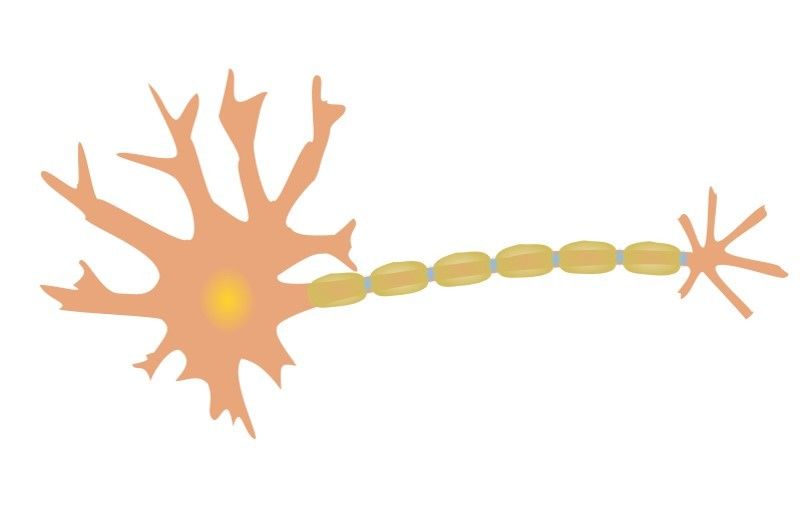
- A(A) axon
- B(A) cell body
- C(A) dendrite
- D(B) Axon
- E(B) Cell body
- F(B) Dendrite
- G(C) Axon
- H(C) Cell body
- I(C) Dendrite
67The part of a neuron responsible for protein production is the
- ACell body
- BAxon
- CDendrite
68Graded potentials differ from action potentials in that graded potentials
- Aare self-propagating
- Bare all the same based on the all-or-none principle
- Cbecome weaker with increasing distance
- Dare output signals to other cells
69The peripheral nervous system (PNS) is
- Aall nervous tissue outside the brain and spinal cord
- Bonly the motor output of the nervous system
- Conly the nervous tissue inside the brain and spinal cord
- Donly responsible for pain responses
70Myelination (the wrapping of neuronal axons by glial cells) is responsible for
- Aremoving waste products from the neuron
- Bproviding the axon with oxygen
- Cremoving inappropriately-placed axons
- Dproviding electrical insulation for action potentials
71White matter of the brain contains
- Aclusters of cell bodies and dendrites for processing information
- Bbundles of axons for transmitting information
- Cthe internal ganglia of the body
- Dall of the above
72The magnitude/size of the effect of a hormone depends on which of the following?
- AThe speed of the receptor response
- BThe rate of hormone degredation
- CThe amount of hormone circulating
- DThe input from the lymphatic system
73Oligodendrocytes are similar to Schwann cells in that they both
- AHelp neurons regenerate after injury
- BAre glial cells that forms a muelin sheath around axons
- CAre located in the central nervous system
- DConduct nerve impulses
74Select the appropriate term from the drop-down box for each definition. Each term will be used only once, but since there are more terms than definitions, not all terms will be used.
1. [blank_start]______[blank_end] The conscious part of the brain
2. [blank_start]______[blank_end] Area of the brain that modifies cerebral output
3. [blank_start]______[blank_end] Part of the brain responsible for your biological clock and body temperature
4. [blank_start]______[blank_end] Specific personality and decision-making part of the brain
5. [blank_start]_____[blank_end] System responsible for short-term memory
6. [blank_start]______[blank_end] Language center of the brain that interprets the meaning of speech- AA. Broca's area
- BA. Wernicke's area
- CA. Diencephalon
- DA. Brainstem
- EA. Cerebrum
- FA. Cerebellum
- GA. Somatosensory area
- HA. Prefrontal cortex
- IA. Limbic system
- JA. Ventricular system
- KB. Broca's area
- LB. Wernicke's area
- MB. Diencephalon
- NB. Brainstem
- OB. Cerebrum
- PB. Cerebellum
- QB. Somatosensory area
- RB. Prefrontal cortex
- SB. Limbic system
- TB. Ventricular system
- UC. Broca's area
- VC. Wernicke's area
- WC. Diencephalon
- XC. Brainstem
- YC. Cerebrum
- ZC. Cerebellum
- AAC. Somatosensory area
- ABC. Prefrontal cortex
- ACC. Limbic system
- ADC. Ventricular system
- AED. Broca's area
- AFD. Wernicke's area
- AGD. Diencephalon
- AHD. Brainstem
- AID. Cerebrum
- AJD. Cerebellum
- AKD. Somatosensory area
- ALD. Prefrontal cortex
- AMD. Limbic system
- AND. Ventricular system
- AOE. Broca's area
- APE. Wernicke's area
- AQE. Diencephalon
- ARE. Brainstem
- ASE. Cerebrum
- ATE. Cerebellum
- AUE. Somatosensory area
- AVE. Prefrontal cortex
- AWE. Limbic system
- AXE. Ventricular system
- AYF. Broca's area
- AZF. Wernicke's area
- BAF. Diencephalon
- BBF. Brainstem
- BCF. Cerebrum
- BDF. Cerebellum
- BEF. Somatosensory area
- BFF. Prefrontal cortex
- BGF. Limbic system
- BHF. Ventricular system
75In general, people are left- or right-brained depending on their personality.
- ATrue
- BFalse
76Label the regions of the brain.
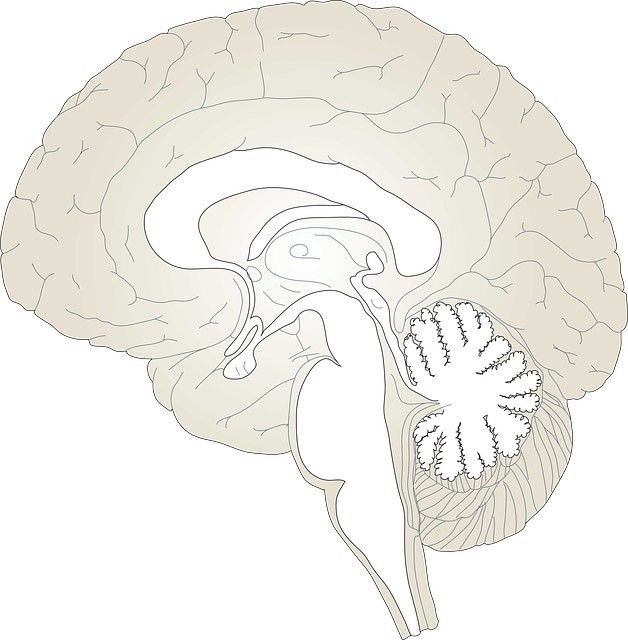
- A(A) Cerebrum
- B(A) Cerebellum
- C(A) Brainstem
- D(A) Diencephalon
- E(B) Cerebrum
- F(B) Cerebellum
- G(B) Diencephalon
- H(B) Brainstem
- I(C) Cerebrum
- J(C) Cerebellum
- K(C) Diencephalon
- L(C) Brainstem
- M(D) Brainstem
- N(D) Diencephalon
- O(D) Cerebrum
- P(D) Cerebellum
77Hormones are involved in maintaining circadian rhythm (melatonin) as well as regulating glucose in the bloodstream (glucagon and insulin).
- ATrue
- BFalse
78Select the correct term from the drop-down box for each definition. Terms may be used once or not at all.
1. [blank_start]______[blank_end] Visible portion of the outer ear
2. [blank_start]______[blank_end] Eardrum
3. [blank_start]______[blank_end] Connects the middle ear to the throat to equalize air pressure
4. [blank_start]______[blank_end] Where sound is converted from vibrations to action potentials
5. [blank_start]______[blank_end] One component of the vestibular apparatus of the inner ear
6. [blank_start]______[blank_end] Ringing in the ears
7. [blank_start]______[blank_end] Malleus, incus, and stapes- A(A) Pharyngotympanic tube
- B(A) Auditory ossicles
- C(A) Oval window
- D(A) Tympanic membrane
- E(A) Pinna
- F(A) Auditory canal
- G(A) Semicircular canals
- H(A) Cochlea
- I(A) Tinnitus
- J(B) Pharyngotympanic tube
- K(B) Auditory ossicles
- L(B) Oval window
- M(B) Tympanic membrane
- N(B) Pinna
- O(B) Auditory canal
- P(B) Semicircular canals
- Q(B) Cochlea
- R(B) Tinnitus
- S(C) Pharyngotympanic tube
- T(C) Auditory ossicles
- U(C) Oval window
- V(C) Tympanic membrane
- W(C) Pinna
- X(C) Auditory canal
- Y(C) Semicircular canals
- Z(C) Cochlea
- AA(C) Tinnitus
- AB(D) Pharyngotympanic tube
- AC(D) Auditory ossicles
- AD(D) Oval window
- AE(D) Tympanic membrane
- AF(D) Pinna
- AG(D) Auditory canal
- AH(D) Semicircular canals
- AI(D) Cochlea
- AJ(D) Tinnitus
- AK(E) Pharyngotympanic tube
- AL(E) Auditory ossicles
- AM(E) Oval window
- AN(E) Tympanic membrane
- AO(E) Pinna
- AP(E) Auditory canal
- AQ(E) Semicircular canals
- AR(E) Cochlea
- AS(E) Tinnitus
- AT(F) Pharyngotympanic tube
- AU(F) Auditory ossicles
- AV(F) Oval window
- AW(F) Tympanic membrane
- AX(F) Pinna
- AY(F) Auditory canal
- AZ(F) Semicircular canals
- BA(F) Cochlea
- BB(F) Tinnitus
- BC(G) Pharyngotympanic tube
- BD(G) Auditory ossicles
- BE(G) Oval window
- BF(G) Tympanic membrane
- BG(G) Pinna
- BH(G) Auditory canal
- BI(G) Semicircular canals
- BJ(G) Cochlea
- BK(G) Tinnitus
79Select the correct term from the drop-down box for each definition. Terms may be used once or not at all.
1. [blank_start]______[blank_end] Middle layer of the eye that contains the iris
2. [blank_start]______[blank_end] Center region of the retina with the highest density of photoreceptors
3. [blank_start]______[blank_end] White part of the eye
4. [blank_start]______[blank_end] Thin vascularized membrane of the outer eye
5. [blank_start]______[blank_end] Retinal cells that allow us to see color
6. [blank_start]______[blank_end] Portion of the eye responsible for the majority of light bending
7. [blank_start]______[blank_end] Elasticity of this part of the eye decreases with age
8. [blank_start]______[blank_end] Farsightedness- AA. Hyperopia
- BA. Myopia
- CA. Lens
- DA. Optic disk
- EA. Macula
- FA. Cornea
- GA. Selera
- HA. Uvea
- IA. Conjunctiva
- JA. Rods
- KA. Cones
- LB. Hyperopia
- MB. Myopia
- NB. Lens
- OB. Optic disk
- PB. Macula
- QB. Cornea
- RB. Selera
- SB. Uvea
- TB. Conjunctiva
- UB. Rods
- VB. Cones
- WC. Hyperopia
- XC. Myopia
- YC. Lens
- ZC. Optic disk
- AAC. Macula
- ABC. Cornea
- ACC. Selera
- ADC. Uvea
- AEC. Conjunctiva
- AFC. Rods
- AGC. Cones
- AHD. Hyperopia
- AID. Myopia
- AJD. Lens
- AKD. Optic disk
- ALD. Macula
- AMD. Cornea
- AND. Selera
- AOD. Uvea
- APD. Conjunctiva
- AQD. Rods
- ARD. Cones
- ASE. Hyperopia
- ATE. Myopia
- AUE. Lens
- AVE. Optic disk
- AWE. Macula
- AXE. Cornea
- AYE. Selera
- AZE. Uvea
- BAE. Conjunctiva
- BBE. Rods
- BCE. Cones
- BDF. Hyperopia
- BEF. Myopia
- BFF. Lens
- BGF. Optic disk
- BHF. Macula
- BIF. Cornea
- BJF. Selera
- BKF. Uvea
- BLF. Conjunctiva
- BMF. Rods
- BNF. Cones
- BOG. Hyperopia
- BPG. Myopia
- BQG. Lens
- BRG. Optic disk
- BSG. Macula
- BTG. Cornea
- BUG. Selera
- BVG. Uvea
- BWG. Conjunctiva
- BXG. Rods
- BYG. Cones
- BZhyperopia
- CAmyopia
80Select the following characteristic(s) or the NERVOUS SYSTEM:
- AUses electrical signals
- BSignals circulate in the blood
- CCoordinates responses in the body
- DSlow start and stop (seconds to weeks)
81Select the following characteristic(s) of the ENDOCRINE SYSTEM:
- AUses electrical signals
- BSignals circulate in the blood
- CCoordinates responses within the body
- DSlow start and stop (seconds to weeks)
82Select the following characteristic(s) of STEROID HORMONES:
- Alipid-soluble (hydrophobic)
- Breceptors are present on the outside of the target cell membrane
- Cexamples include estrogen, testosterone, and cortisol
- Dusually stimulate DNA to make RNA to make protein
- Etypically larger hormones
83Select the following characteristic(s) of NON-STEROID HORMONES:
- Alipid-soluble (hydrophobic)
- Breceptors are present on the outside of the target cell membrane
- Cexamples include estrogen, testosterone, and cortisol
- Dusually stimulate DNA to make RNA to make protein
- Etypically larger hormones
84Select the appropriate term for each definition. All terms will be used once.
1. [blank_start]______[blank_end] Produced by the pancreatic beta cells to lower blood sugar
2. [blank_start]______[blank_end] Produced by the anterior pituitary and stimulates cell division
3. [blank_start]______[blank_end] Produced by the pineal gland to regulate circadian rhythm
4. [blank_start]______[blank_end] Produced by the adrenal medulla and is part of the "fight or flight" response
5. [blank_start]______[blank_end] Produced by the thyroid gland to lower blood calcium levels
6. [blank_start]______[blank_end] Produced by the pancreatic alpha cells to raise blood sugar
7. [blank_start]______[blank_end] Produced by the adrenal cortex and decreases the immune response
8. [blank_start]______[blank_end] Produced by the posterior pituitary and reduces the amount of water lost in urine
9. [blank_start]______[blank_end] Produced by the parathyroid gland to increase blood calcium levels- AA. Calcitonin
- BA. Glucagon
- CA. Epinephrine
- DA. Human growth hormone (hGH)
- EA. Parathyroid hormone (PTH)
- FA. Melatonin
- GA. Cortisol
- HA. Insulin
- IA. Antidiuretic hormone (ADH)
- JB. Calcitonin
- KB. Glucagon
- LB. Epinephrine
- MB. Human growth hormone (hGH)
- NB. Parathyroid hormone (PTH)
- OB. Melatonin
- PB. Cortisol
- QB. Insulin
- RB. Antidiuretic hormone (ADH)
- SC. Calcitonin
- TC. Glucagon
- UC. Epinephrine
- VC. Human growth hormone (hGH)
- WC. Parathyroid hormone (PTH)
- XC. Melatonin
- YC. Cortisol
- ZC. Insulin
- AAC. Antidiuretic hormone
- ABD. Calcitonin
- ACD. Glucagon
- ADD. Epinephrine
- AED. Human growth hormone (hGH)
- AFD. parathyroid hormone (PTH)
- AGD. Melatonin
- AHD. Cortisol
- AID. Insulin
- AJD. Antidiuretic hormone (ADH)
- AKE. Calcitonin
- ALE. Glucagon
- AME. Epinephrine
- ANE. hGH
- AOE. PTH
- APE. Melatonin
- AQE. Cortisol
- ARE. Insulin
- ASE. ADH
- ATF. Calcitonin
- AUF. Glucagon
- AVF. Epinephrine
- AWF. hGH
- AXF. PTH
- AYF. Melatonin
- AZF. Cortisol
- BAF. Insulin
- BBF. ADH
- BCG. Calcitonin
- BDG. Glucagon
- BEG. Epinephrine
- BFG. hGH
- BGG. PTH
- BHG. Melatonin
- BIG. Cortisol
- BJG. Insulin
- BKG. ADH
- BLH. Calcitonin
- BMH. Glucagon
- BNH. Epinephrine
- BOH. hGH
- BPH. PTH
- BQH. Melatonin
- BRH. Cortisol
- BSH. Insulin
- BTH. ADH
- BUI. Calcitonin
- BVI. Glucagon
- BWI. Epinephrine
- BXI. hGH
- BYI. PTH
- BZI. Melatonin
- CAI. Cortisol
- CBI. Insulin
- CCI. ADH
85Type I Diabetes is an autoimmune condition.
- ATrue
- BFalse
86Lateralization is the tendency for some neural functions or cognitive processes to be more dominant in one hemisphere than in the other.
- ATrue
- BFalse
87The main function of the digestive system is to detoxify the body.
- ATrue
- BFalse
88________ is the process of releasing substances from cells into the lumen of the gut.
- Adigestion
- Bsecretion
- Cabsorption
89______ occurs when smooth muscle in front of a bolus relaxes, and contracts behind.
- APeristalsis
- BSweeping
- CAbsorption
- DSegmentation
90Which of the following occurs in the mouth?
- Amechanical digestion
- Bchemical digestion
- Csecretion
- Dall of these
91Acid reflux, the backflow of stomach fluid into the esophagus, most commonly occurs due to
- Aeating the wrong things
- Ban improperly functioning lower esophageal sphincter
- Can improperly functioning pyloric sphincter
- Dstomach cancer
92Pepsin and lipases are present in gastric juice to break down proteins and lipids, respectively.
- ATrue
- BFalse
93Gastric juice contains hydrochloric acid (HCl) that unfolds proteins and inhibits bacterial growth.
- ATrue
- BFalse
94Gastric juice contains mucus to protect the cells lining the stomach from acid.
- ATrue
- BFalse
95The majority of nutrient and water absorption occurs in the [blank_start]small intestine[blank_end].
- Asmall intestine
- Blarge intestine
- Cstomach
- Dappendix
96A normal gastric emptying time is [blank_start]2 to 6[blank_end] hours.
- A2 to 6
- Bless than 1
- Cless than 2
- D6 to 10
97The most common cause of peptic ulcers, or open sores of the stomach's mucosal lining, is
- Abacterial infection
- Bstomach cancer
- Cvitamin overconsumption
- Dstress
98The majority of feces is
- Aindigestible material
- Bwater
- Cbacteria (dead or alive)
- Denzymes
99Amylases (salivary and pancreatic) are the main contributors to the breakdown of
- Apolysaccharides
- Bproteins
- Clipids
100A main function of the urinary system is to maintain fluid volume of the lymphatic vessels.
- ATrue
- BFalse
101Women are more likely to develop urinary tract infections (UTIs) than men because
- Awomen have a shorter urethra
- Bwomen have a longer urethra
- Cwomen have a smaller bladder
- Dwomen have a larger bladder
102The [blank_start]ureter[blank_end] is a tube-like connection that supports the flow of urine from the kidney to the bladder.
- Aureter
- Burethra
- Cvas (ductus) deferens
- Doviduct
103The corpus luteum develops in the [blank_start]ovary[blank_end] from the [blank_start]ruptured follicle[blank_end].
- Aovary
- Buterus
- Cruptured follicle
- Dovulated follicle
- Eimmature oocyte
- Fembryo
104Put the following organs and structures in order (1-8) from the first place where food enters the body (1) to the last place where waste exits (8).
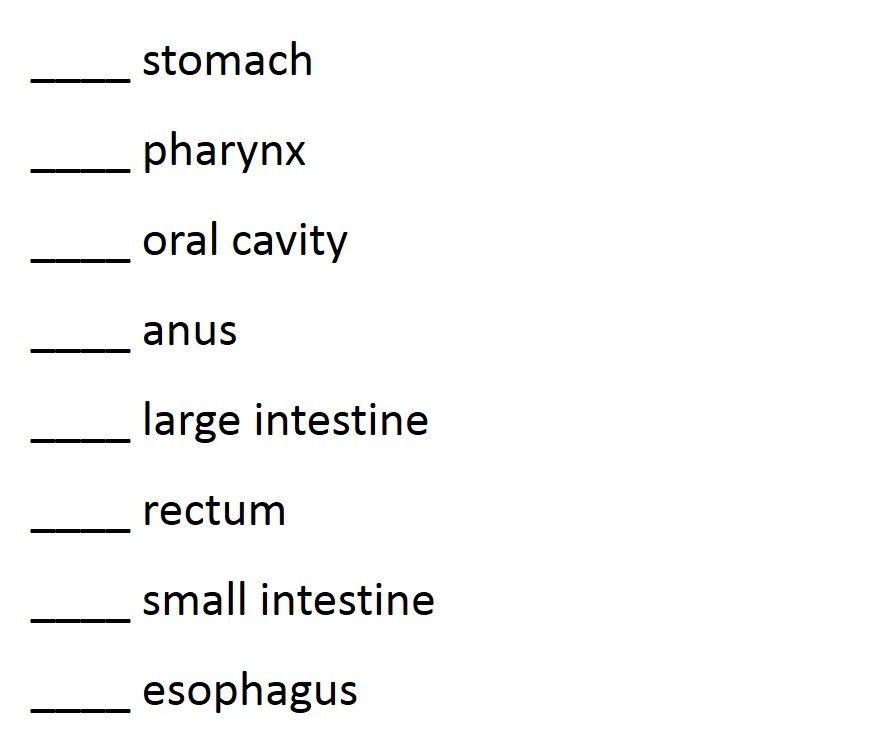
- A4
- B2
- C1
- D8
- E6
- F7
- G5
- H3
105Select the correct term from the drop-down box for each definition/statement. Each term will be used only once.
1. [blank_start]______[blank_end] Responsible for the movement of food/chyme/feces
2. [blank_start]______[blank_end] Anchors the gut to the surrounding tissue
3. [blank_start]______[blank_end] Only layer capable of absorption
4. [blank_start]______[blank_end] Contains blood vessels to carry away absorbed nutrients- AA. Submucosa
- BA. Mucosa
- CA. Muscularis externa
- DA. Serosa/adventitia
- EB. Serosa/adventitia
- FB. Submucosa
- GB. Mucosa
- HB. Muscularis externa
- IC. Mucosa
- JC. Submucosa
- KC. Muscularis externa
- LC. Serosa/adventitia
- MD. Submucosa
- ND. Mucosa
- OD. Serosa/adventitia
- PD. Muscularis externa
106The mucosa is highly folded to increase its surface area.
- ATrue
- BFalse
107Select the correct term from the drop-down box for each definition. Each term will only be used once, but since there are more terms than definitions, not all terms will be used.
1. [blank_start]______[blank_end] Stores/concentrates bile
2. [blank_start]______[blank_end] Major function is to produce digestive enzymes
3. [blank_start]______[blank_end] Processes/stores nutrients absorbed by the small intestine
4. [blank_start]______[blank_end] Small pouch extending from the cecum.- AA. Liver
- BA. Appendix
- CA. Gallbladder
- DA. Pancreas
- EA. Large intestine
- FB. Liver
- GB. Appendix
- HB. Gallbladder
- IB. Pancreas
- JB. Large intestine
- KC. Liver
- LC. Appendix
- MC. Gallbladder
- NC. Pancreas
- OC. large intestine
- PD. Liver
- QD. Gallbladder
- RD. Appendix
- SD. Pancreas
- TD. Large intestine
108Three main functions of the liver are that it processes/stores nutrients absorbed by the small intestine, it cleans/detoxifies blood, and it makes bile.
- ATrue
- BFalse
109Select the appropriate term from the drop-down box for each statement. Each term will be used once, but since there are more terms than statements, not all terms will be used.
1. [blank_start]______[blank_end] GI disorder that results from lacking an enzyme to digest a particular molecule
2. [blank_start]______[blank_end] GI disorder that results from T cells and/or other antibodies attacking a molecule in food
3. [blank_start]______[blank_end] Noncancerous growths
4. [blank_start]______[blank_end] Specific disorder where immune system responds to gluten by destroying small intestine microvilli
5. [blank_start]_____[blank_end] Inflammation of the liver
6. [blank_start]______[blank_end] Weakness of the large intestine wall- AA. Hepatitis
- BA. Diverticulosis
- CA. Polyps
- DA. Celiac disease
- EA. Food allergy
- FA. Food intolerance
- GA. Food sensitivity
- HB. Hepatitis
- IB. Diverticulosis
- JB. Polyps
- KB. Celiac disease
- LB. Food allergy
- MB. Food intolerance
- NB. Food sensitivity
- OC. Hepatitis
- PC. Diverticulosis
- QC. Polyps
- RC. Celiac disease
- SC. Food allergy
- TC. Food intolerance
- UC. Food sensitivity
- VD. Hepatitis
- WD. Diverticulosis
- XD. Polyps
- YD. Celiac disease
- ZD. Food allergy
- AAD. Food intolerance
- ABD. Food sensitivity
- ACE. Hepatitis
- ADE. Diverticulosis
- AEE. Polyps
- AFE. Celiac disease
- AGE. Food allergy
- AHE. Food intolerance
- AIE. Food sensitivity
- AJF. Hepatitis
- AKF. Diverticulosis
- ALF. Polyps
- AMF. Celiac disease
- ANF. Food allergy
- AOF. Food sensitivity
- APF. Food intolerance
110Select the appropriate term from the drop-down box for each statement. Each term will be used once, but since there are more terms than statements, not all terms will be used.
1. [blank_start]______[blank_end] Inner epithelial lining of the uterus where embryo implants
2. [blank_start]______[blank_end] Where immature oocytes develop within the ovary
3. [blank_start]______[blank_end] Narrow part of the uterus that extends slightly into the vagina
4. [blank_start]______[blank_end] Hollow muscular organ that is continuous with external genitalia
5. [blank_start]______[blank_end] Typical site of egg fertilization
6. [blank_start]______[blank_end] Most commoon type of ectopic pregnancy- AA. Cervix
- BA. Uterus
- CA. Vagina
- DA. Oviduct
- EA. Follicle
- FA. Myometrium
- GA. Endometrium
- HA. Ampullar
- IA. Intramural
- JB. Cervix
- KB. Uterus
- LB. Vagina
- MB. Oviduct
- NB. Follicle
- OB. Myometrium
- PB. Endometrium
- QB. Ampullar
- RB. Intramural
- SC. Cervix
- TC. Uterus
- UC. Vagina
- VC. Oviduct
- WC. Follicle
- XC. Myometrium
- YC. Endometrium
- ZC. Intramural
- AAC. Ampullar
- ABD. Cervix
- ACD. Uterus
- ADD. Vagina
- AED. Oviduct
- AFD. Myometrium
- AGD. Endometrium
- AHD. Intramural
- AID. Ampullar
- AJE. Cervix
- AKE. Uterus
- ALE. Vagina
- AME. Oviduct
- ANE. Follicle
- AOE. Myometrium
- APE. Endometrium
- AQE. Intramural
- ARE. Ampullar
- ASF. Cervix
- ATF. Vagina
- AUF. Oviduct
- AVF. Uterus
- AWF. Follicle
- AXF. Myometrium
- AYF. Endometrium
- AZF. Intramural
- BAF. Ampullar
111Select the appropriate term from the drop-down box for each statement. Two of the three terms will be used.
1. [blank_start]______[blank_end] Hormone secreted by the embryo that tells the corpus luteum to remain alive
2. [blank_start]______[blank_end] Hormone secreted by the pituitary gland that stimulates ovulation- AA. Follicle stimulating hormone (FSH)
- BA. Luteinizing hormone (LH)
- CA. Human chorionic gonadotropin (hcg)
- DB. follicle stimulating hormone (FSH)
- EB. luteinizing hormone (LH)
- FB. human chorionic gonadotropin (hcg)
112Luteinizing hormone (LH) is secreted by the pituitary gland, which causes testosterone to remain in the testes longer.
- ATrue
- BFalse
113Using the figure of meiosis, please write a number (for steps 1-3) or letter (for cells A-D) in the blanks below. There may be multiple answers per blank.
1. [blank_start]______[blank_end] Step where DNA replicates
2. [blank_start]______[blank_end] First cell that is haploid
3. [blank_start]______[blank_end] Division step that is identical to mitosis
4. [blank_start]______[blank_end] Daughter cells
5. [blank_start]______[blank_end] Diploid cells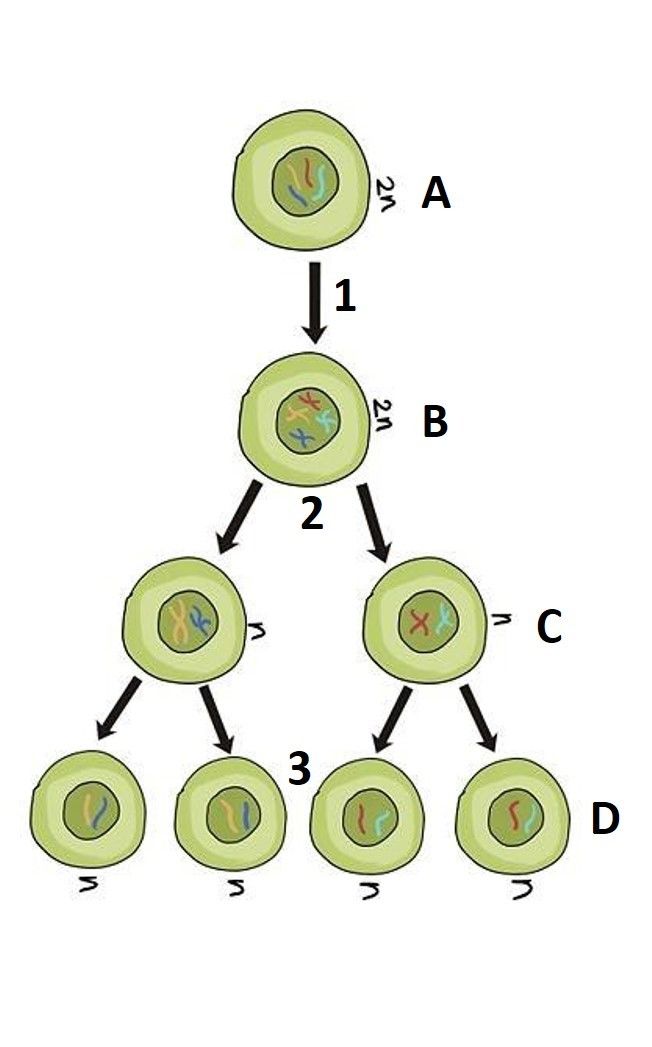
- A1
- BC
- C2
- DC, D
- EA, B
114The urethra also carries urine outside the body.
- ATrue
- BFalse
115The epididymis is cut and tied during a vasectomy.
- ATrue
- BFalse
116The testis is the site of meiosis.
- ATrue
- BFalse
117The urethra contains tightly-packed seminiferous tubules.
- ATrue
- BFalse
118Sperm develop mobility in the epididymis.
- ATrue
- BFalse
Information
- Description
- User has deleted their subject information Quiz on BIOL 108: Human Body Final Exam, created by Deleted user on 05/03/2018.
- Author
- Deleted user
- Language
- English
- Views
- 13
- History
- Created on 5 Mar 2018 · updated on 5 Mar 2018
- Tags
- Rating
- No ratings yet Rate this quiz