
Flashcards
Redox
Cards in this deck (16)
- 1What does the oxidation number of an element tell you?The total number of electrons it has donated or accepted to form an ion or to form part of a compound
- 2Name the rules for oxidation numbers1. Uncombined elements (or elements bonded to identical atoms) have an oxidation number of 0
2. The oxidation number of a simple monatomic ion is the same as its charge
3. For molecular ions, each of the constituent atoms has an oxidation number of its own and the sum of their oxidation numbers equals the overall oxidation number
4. The sum of the oxidation numbers for a neutral compound is 0
5. Oxygen nearly always has an oxidation number of -2, EXCEPT in peroxides (O₂²⁻) where it's -1 and molecular oxygen (O₂) where it's 0
6. Hydrogen always has an oxidation number of +1, EXCEPT in metal hybrids (MHₓ) where it's -1 and in molecular hydrogen (H₂) where it's 0 - 3Complete the sentences: If an element can have multiple __________ numbers, or isn't in its 'normal' oxidation state, its oxidation number can be shown by using __________ __________. The _________ ___________ are written _______ the name of the element they correspond to.If an element can have multiple OXIDATION numbers, or isn't in its 'normal' oxidation state, its oxidation number can be shown by using ROMAN NUMERALS. The ROMAN NUMERALS are written AFTER the name of the element they correspond to.
- 4What do ions with names ending in -ate contain?Oxygen
Another element - 5What is the formula for sulphate (VI) ions?The sulphur has oxidation number +6
The ion is SO₄²⁻ - 6What is the formula for sulphate (IV) ions?The sulphur has oxidation number +4
The ion is SO₃²⁻ - 7What is the formula for nitrate (III) ions?Nitrogen has oxidation number +3
The ion is NO₂⁻ - 8What is oxidation, in terms of electron transfer?Loss of electrons
(OIL) - 9What is reduction, in terms of electron transfer?Gain in electrons
(RIG) - 10What do oxidising agents do?An oxidising agent accepts electrons and gets reduced
- 11What do reducing agents do?A reducing agent donates electrons and gets oxidised
- 12When metals form compounds, what happens to the oxidation number?When metals form compounds, they generally donate electrons to form positive ions - the oxidation number INCREASES
- 13When non-metals form compounds, what happens to the oxidation number?When non-metals form compounds, they generally gain electrons and form negative ions - the oxidation number DECREASES
- 14What happens during a redox reaction?Something is oxidised (loses electrons) and something is reduced (gains electrons)
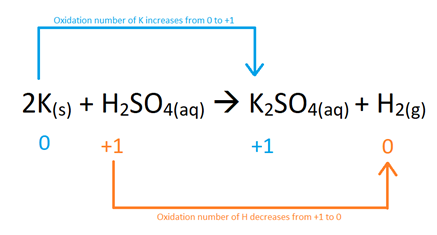
- 15TRUE OR FALSE: The reaction between acids and metals is a redox reactionTRUE
The metal atoms are oxidised to form positive metal ions (in salts). The hydrogen ions in solution are reduced, forming hydrogen molecules - 16In the following reaction, which compound is oxidised and which compound is reduced? 2K + H₂SO₄ --> K₂SO₄ + H₂
Information
- Description
- User has deleted their subject information Flashcards on Redox, created by Deleted user on 05/03/2018.
- Created by
- Deleted user · Mar 2018
- Updated
- Mar 5, 2018
- Views
- 10
- History
-
- Created by Yinka F · Feb 19, 2018
- Copied by Yinka F · Mar 5, 2018
- Rating