
Notes
p-block elements
Content of the notes (19)
Page 1
Introduction
The absence of d-orbitals in second and third period, and presence of d or f orbitals fourth period onwards has significant effects on properties of elements.
Page 2
Group 15 - General Trends
E.C- ns2np3- half filled p orbital (extra stability)
Atomic Radii- increases down the group
Ionization Enthalpy- decreases down the grp
E.N.- decreases DTG
Add occurrence
Physical Properties
all elements are polyatomic
metallic char increases DTG
except nitrogen, all show allotropy
dinitrogen is gas, others are solids
b.p. increases DTG
m.p. increases upto As, then decreases upto Bi
Chemical Properties
common oxidation states exhibited- +3, -3, +5. DTG, the stability of +5 state decreases and +3 state increases. Only stable Bi (V) compound is BiF5.
nitrogen exhibits +1,+2, +4, +5. however, doesn't form compounds in +5 state with halogens due to absence of d-orbitals.
phosphorus shows +1 and +4 in some oxoacids.
Anomalous Properties of Nitrogen
differs due to small size, high EN, high I.E, non-availability of d-orbitals
has unique ability to form pπ- pπ multiple bonds with itself and others with high EN and small size ( C, O etc)
N-N single bond is weaker than P-P, due to high interionic repulsion, leading to weaker catenation tendency
N cannot form dπ-pπ bonds with heavier elements due to absence of d-orbitals and has its covalency restricted to 4 (1 s, 3 p)
P and As can form dπ-dπ bonds with transition metals.
1. Reactivity towards hydrogen
All elements form hydrides of type EH3, where E= N, P, As, Sb, Bi
stability of hydrides decreases from NH3 to BiH3
reducing character of hydrides increases down the group
basicity decreases down the group
2. Reactivity towards oxygen
All elements form 2 types of oxides- E2O3 and E2O5
Acidic char decreases down the group
Acids of type E2O3 of N and P are purely acidic, As and Sb are amphoteric and bismuth are predominantly basic.
3. Reactivity towards halogens
These elements form EX3 and EX5 halides
N doesn't form pentahalide
Pentahalides are more covalent than trihalides due to more polarising power of +5 state than +3 state.
4. Reactivity towards metals
These react with metals to form binary compounds exhibiting the -3 oxidation state.
Ca3N2 (calcium nitride), Ca3P2 (calcium phosphide), Na3As (sodium arsenide), Zn3Sb2 (zinc antimonide), Mg3Bi2 ( magnesium bismuthide).
Page 3
Dinitrogen
Preparation (3)
1. Treating NH4Cl with NaNO2
NH4Cl (aq.) + NaNO2 (aq.) ---> N2 (g) + 2H2O(l) + NaCl (aq.)
Small amounts of NO and HNO3 are also formed in this reaction; these impurities can be removed by passing the gas through aqueous sulphuric acid containing potassium dichromate.
2. Thermal Decomposition of Ammonium Dichromate
(NH4 )2Cr2O7 (heat)→ N2 + 4H2O + Cr2O3
3. Thermal decomposition of sodium or barium azide
Ba(N3 )2→ Ba + 3N2
Properties
Colourless
Odourless
Tasteless
Non-toxic
Low Solubility in water
Low F.P. and B.P.
Inert at room temp (due to triple bond).
Reactivity increases with increase in temp.
Forms Ionic nitrides with metals; covalent nitrides with non-metals.
6Li + N2→ 2Li3N
3Mg + N2 → Mg3N2
Haber's process:
N2 (g) + 3H2 (g) at 773 k <---> 2NH3 (g)
N2 (g) + O2 (g) at about 2000 K ----> 2NO (g)
Uses
Manufacture of Ammonia
Creating an inert atmosphere (iron and steel industry)
As inert diluent for reactive chemicals
Liquid N2 is used as refrigerant to store biological matter and food
Cryosurgery
Page 4
Ammonia
Preparation
1. decay of nitrogenous matter in air and soil i.e urea
NH2CONH2+H2O → (NH4)2CO3 <-----> 2NH3 + H2O + CO2
2. on a small scale we can prepare ammonia from ammonium salts which decompose when treated with caustic soda or calcium hydroxide
2NH4Cl + Ca(OH)2--> 2NH3 + 2H2O + CaCl2
(NH4)SO4 + 2NaOH --> NH3 + 2H2O + Na2SO4
3. on a large scale by Haber's process
N2 (g) + 3H2 (g) at 773 k <---> 2NH3 (g)
Optimum conditions - temp ~ 700 K, pressure about 200 x 10^5 Pa or 200 atm, catalyst- iron oxide with K2O and Al2O3
Properties
colourless
pungent smell
F.P. - 198.4 K, B.P.- 239.7 K
in solid and liquid state, it is associated thru hydrogen bonds
trigonal pyramidal shape with N at apex and 3 bond pairs and 1 loan pair
NH3 gas is highly soluble in water
Aq. sol. is weakly basic- NH4OH due to formation of OH- ions
It behaves as a Lewis base because of lone pair of electrons and thus can act as an electron donor
It behaves as weak base that means it precipitates hydroxides.
Page 5
Nitric Acid
Preparation
1. Heating KNO3 or NaNO3 and concentrated H2SO4 in a glass retort (in lab)
NaNO3 + H2SO4 --> NaHO4 + HNO3
2. On large scale, Ostwald's Process
4NH3 + 5O2 ↔ 4NO + 6H2O with Pt/Rh gauge catalyst, 500 K, 9 bar
2NO + O2 ↔2 NO2
3NO2 + H2O --> 2HNO3 + NO
NO is recycled and HNO3 can be distilled to 68% concentration by mass. Concentration can be increased up to 98% by dehydration with conc. H2SO4.
Properties
Colourless liquid
Lab HNO3 has conc. - 68% by mass with specific gravity of 1.504
exists as a planar molecule
In aq. sol., it acts as a strong acid giving hydronium and nitrate ions
Conc. HNO3 is a strong oxidising agent and attacks most metals except inert ones like Au and Pt
with metals
M + HNO3 ---> metal nitrates + H2O+ N(in some form) however products depend on concentration.
Concentrated nitric acid also oxidises non–metals and their compounds. Iodine is oxidised to iodic acid, carbon to carbon dioxide, sulphur to H2SO4 , and phosphorus to phosphoric acid.
Test for Nitrates- the BROWN RING TEST
The test is usually carried out by adding dilute ferrous sulphate solution to an aqueous solution containing nitrate ion, and then carefully adding concentrated sulphuric acid along the sides of the test tube. A brown ring at the interface between the solution and sulphuric acid layers indicates the presence of nitrate ion in solution.
The ring that is formed is chemically [Fe(H2O)5(NO)]2+(Nitroso ferrous sulphate ).
2HNO3+ 3H2SO4 + 6FeSO4 —>> 3Fe2(SO4)3 + 2NO + 4H2O
(Remaining) [Fe(H2O)6]SO4 + NO = [Fe(H2O)5(NO)]SO4+ H2O
Page 6
Group 16 elements- General Trends
Oxygen, Sulphur, Selenium, Tellurium, Polonium and Livermorium }} chalcogens
Occurrence
Oxygen- 46.6% by mass in crust, 20.946% in dry air
Sulphur- 0.03-0.1% in crust, exists as sulphates (gypsum, epsom salt, baryte) and sulphides (galena, zinc blende, copper pyrites). As H2S in volcanoes. Present in organic material such as eggs, protein, garlic, onion, wool etc.
Se and Te found as metal selenides and tellurides in sulphide ores.
Po- decay product of thorium and uranium.
Lv- synthetic radioactive element.
Electronic Config.
ns2np4
Atomic and Ionic Radii
increase DTG. Oxygen is exceptionally small
Ionization Enthalpy
due to increase in size, I.E decreases down the group.
however, I.E of this group is less than group 15 due to extra stable half filled p-orbitals in grp 15.
Electron Gain Enthalpy
Oxygen has less negative EGE due to its small size than sulphur. Sulphur onwards, it becomes less -ve upto Po (basically, S has the most negative EGE)
EN
EN decreases with increase in atomic no. i.e. decreases DTG. O is the most EN element after F.
metallic char increases from O to Po.
Physical Properties
O and S are are NM, Se and Te are metalloids, Po is a metal.
All these exhibit allotropy.
M.P. and B.P.- increase DTG
Large difference btw M.P. and B.P. of O and S can be explained by their atomicity: O exists as a diatomic mol- O2 whereas S as a polyatomic S8.
Chemical Properties
stability of -2 oxi state decreases DTG. Po hardly shows -2 state
common states are +2, +4, +6 however the latter 2 are more common
O exhibits negative states due to high EN i.e. -2. However +2 in the case of OF2 since F is more EN than O.
S, Se, Te show +4 in compounds with oxygen, +6 with F
stability of +6 decreases DTG and that of +4 increases.
bonding in +4 & +6 is primarily covalent.
Anomalous Behaviour of Oxygen
is due to small size and high EN.
eg. of effects of the above- strong hydrogen bonding in H2O and not in H2S.
absence of d-orbitals limits covalency to 4 however it barely exceeds 2 irl.
1. Reactivity with Hydrogen
mainly form hydrides of type H2E, E= O, S, Se, Te, Po
acidic char increases from H2O to H2Te
thermal stability decreases from H2O to H2Po
reducing char increases from H2S to H2Po. H2O doesn't have reducing char.
2. Reactivity with Oxygen
form oxides of EO2 and EO3 types, E= S, Se, Te, Po
O3 and SO2 are gases, SeO2 is solid.
reducing char decreases from SO2 (reducing agent) to TeO2 (oxidising agent)
SO3, SeO3, TeO3 are also formed
All oxides are acidic in nature.
3. Reactivity towards halogens
form halides of the type EX6, EX4, EX2.
stability decreases in the order F- > Cl- > Br- > I-
all hexafluorides are gaseous in nature, have octahedral structure, SF6 is exceptionally stable for steric reasons.
among tetrafluorides, SF4 is gas, SeF4 is a liquid, TeF4 is solid, they have sp3d hybridisation, trigonal bipyramidal structure and see-saw geometry
all elements except oxygen form dichlorides and dibromides, sp3, tetrahedral structure
monohalides, SF, SCl, SBr etc. are dimeric in nature, i.e. Dimer contains two identical, simpler elements/ molecules like S2F2, S2Cl2, S2Br2. These undergo disproportionation.
Page 7
Dioxygen
Preparation
1. by heating oxygen containing salts like chlorates, nitrates, permanganates
KClO3 ----(with heat and MnO2)---> 2KCl + 3O2
2. thermal decomposition of oxides of metals
2Ag2O ---> 4Ag (s) + O2 (g)
2Pb3O4 ---> PbO (s) + O2 (g)
3. hydrogen peroxide readily decomposes into water and oxygen with catalysts like finely divided metal and MnO2
2H2O2 ----> 2H2O (l) + O2 (g)
On large scale, it can be produced from water (electrolysis) or air (removing CO2 and water vapour, liquification, fractional distillation to give dioxygen and dinitrogen)
Properties
Colourless
Odourless
Soluble enough in water to support aquatic and marine life
Liquefies at 90K and freezes at 55K
stable isotopes- O16, O17, O18
its combination with other elements is exothermic thus sustainable, however some initial heat is reqd. as bond diss. enthalpy of O-O bond is high
doesnt react with Pt, Au and some noble gases
2Ca + O2 --> 2CaO
4Al + 3O2 ---> 2Al2O3
CH4 + 2O2 ---> CO2 + 2H2O
C + O2 ---> CO2
catalytic- 2SO2 +O2 --(V2O5)--> 2SO3
4HCl + O2 --(CuCl2)--> 2Cl2 + 2H2O
Uses
respiration and combustion
oxyacetylene welding
manufacture of metals, like steel
oxygen cylinders in hospitals & mountaineering
combustion of fuels for thrust in rockets.
Page 8
Simple Oxides
A binary compound of oxygen with another element is called oxide.
Classification:
1. Simple (MgO, Al2O3)
2. Mixed (Pb3O4, Fe3O4)
Classification of SIMPLE OXIDES:
1. Acidic Oxide: An oxide that combines with water to give an acid is termed acidic oxide (e.g., SO2 , Cl2O7 , CO2 , N2O5 ).
Generally, non-metallic oxides are acidic, however some metallic are as well, like Mn2O7, CrO3, V2O5.
2. Basic Oxide: The oxides which give a base with water are known as basic oxides (e.g., Na2O, CaO, BaO).
In general, metallic oxides are basic.
3. Amphoteric Oxide: Dual nature. They show characteristics of both acidic as well as basic oxides. Eg: Al2O3
Al2O3+ 6HCl+ 9H2O ---> 2[Al (H2o)6]3+ + 6Cl-
Al2O3 + 6NaOH + 3H2O ---> 2Na3 [Al (Oh)6]
4. There are some oxides which are neither acidic nor basic. Such oxides are known as neutral oxides. Examples of neutral oxides are CO, NO and N2O.
Page 9
Ozone
Allotropic form of oxygen
Preparation
slow dry stream of oxygen is passed through a silent electrical discharge, conversion of oxygen to ozone (10%) occurs
3O2 →2O3
endothermic process
If concentrations of ozone greater than 10 per cent are required, a battery of ozonisers can be used, and pure ozone (b.p. 101.1K) can be condensed in a vessel surrounded by liquid oxygen.
Properties
pale blue gas, dark blue liquid, violet-black solid
has characteristic smell
if conc. rises about 100 ppm, breathing becomes difficult
thermodynamically unstable w.r.t oxygen
delta H is negative, delta S is positive resulting in highly negative Gibb's energy delta G for its conversion to oxygen.
thus, can be explosive.
strong oxidising agent since liberates nascent oxygen with ease.
Estimation of O2 concentration:
When ozone reacts with an excess of potassium iodide solution buffered with a borate buffer (pH 9.2), iodine is liberated which can be titrated against a standard solution of sodium thiosulphate.
Depletion of O3 layer
Nitrogen oxides (particularly NO) combines rapidly with O3 to form NO2+ O2. Thus NO released from exhaust systems of jet aeroplanes might be responsible for depletion of conc. of O3 in the atmosphere.
Another, freons present in aerosol sprays and refrigerants.
Uses:
germicides
disinfectants
sterilising water
bleaching oils, ivory, flour, starch
oxidising agent in manufacture of potash permanagate
Page 10
Sulphur- Allotropic Forms
The stable form at room temperature is rhombic sulphur, which transforms to monoclinic sulphur when heated above 369 K.
1. Rhombic Sulphur (α-sulphur)
yellow in colour
m.p. 385.8 K
specific gravity- 2.06
insoluble in water, but dissolves to some extent in benzene, alcohol and ether
readily soluble in CS2
crystals can be prepared by evaporating the solution of roll sulphur in CS2
2. Monoclinic Sulphur (β-sulphur)
m.p. 393 K
specific gravity- 1.98
soluble in CS2
prepared by melting rhombic sulphur in a dish and cooling, till crust is formed. Two holes are made in the crust and the remaining liquid poured out. On removing the crust, colourless needle shaped crystals of β-sulphur are formed
stable above 369 K, transforms to rhombic under it
At 369 K both the forms are stable. This temperature is called transition temperature.
both are puckered and have a crown shape.
cyclo S6, ring adopts a chair shape.
at elevated temp., 1000 K, S2 is the dominant species and paramagnetic like O2
Page 11
Sulphur Dioxide
Preparation
1. with 6-8% SO3 when sulphur is burnt in air/oxygen
S(s) + O2 (g) → SO2 (g)
2. in lab, it's readily generated by treating sulphite with dil. H2SO4
(SO3)2-(aq) + 2H+ (aq) → H2O(l) + SO2 (g)
3. industrially, produced as by-product of the roasting on sulphide ores
4FeS2 (s) + 11O2 (g) → 2Fe2O3 (s) + 8SO2 (g)
The gas after drying is liquefied under pressure and stored in steel cylinders.
Properties
colourless gas
pungent smell
highly soluble in water
liquefies at room temp with pressure of 2 atm
boils at 263 K
SO2 (g) + H2O <-->H2SO4 (aq)
2NaOH + SO2 → Na2SO3 + H2O; Na2SO3 + H2O + SO2 → 2NaHSO3
Sulphur dioxide reacts with chlorine in the presence of charcoal (which acts as a catalyst) to give sulphuryl chloride, SO2Cl2.
SO2 (g) + Cl2 (g) → SO2Cl2 (l)
oxidised to sulphur trioxide by oxygen in the presence of vanadium(V) oxide catalyst
2SO2 (g) + O2 (g) --(V205)---> 2SO3 (g)
When moist, sulphur dioxide behaves as a reducing agent - decolourises acidified potassium permanganate(VII) solution; the latter reaction is a convenient test for the gas.
Uses
in refining petroleum and sugar
in bleaching wool and silk
as an anti-chlor, disinfectant and preservative.
Liquid SO2 is used as a solvent to dissolve a number of organic and inorganic chemicals.
industrial production of H2SO4, sodium hydrogen sulphite, calcium hydrogen sulphite
Page 12
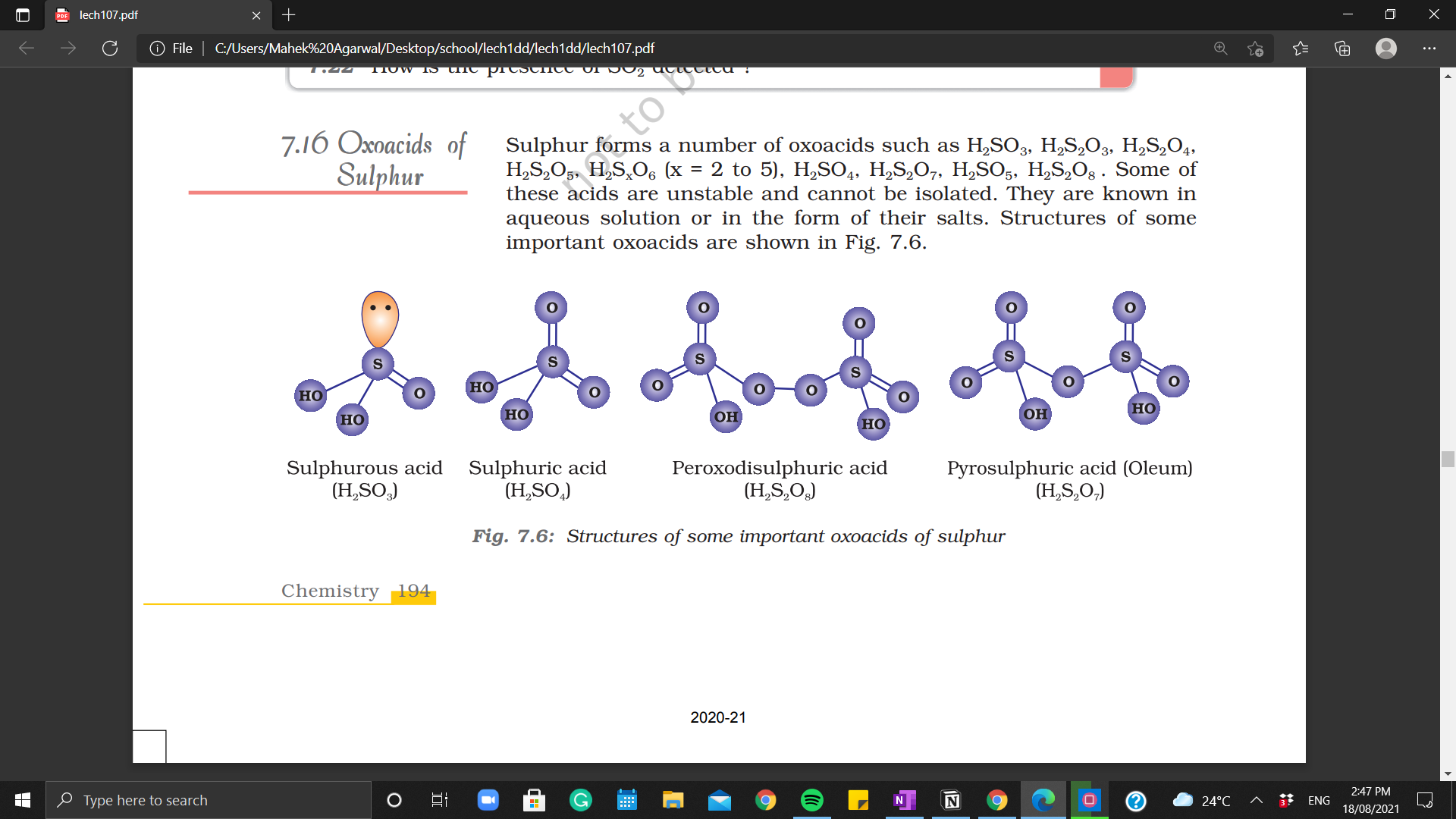
Oxoacids of Sulphur
Page 13
Sulphuric Acid
Properties
colourless
dense
oily liquid
spec gravity- 1.84 at 298 K
Freezing point- 283 K
b.p. 611 K
dissolves in water, releasing a lot of heat, conc. H2SO4 must be added to water slowly with stirring.
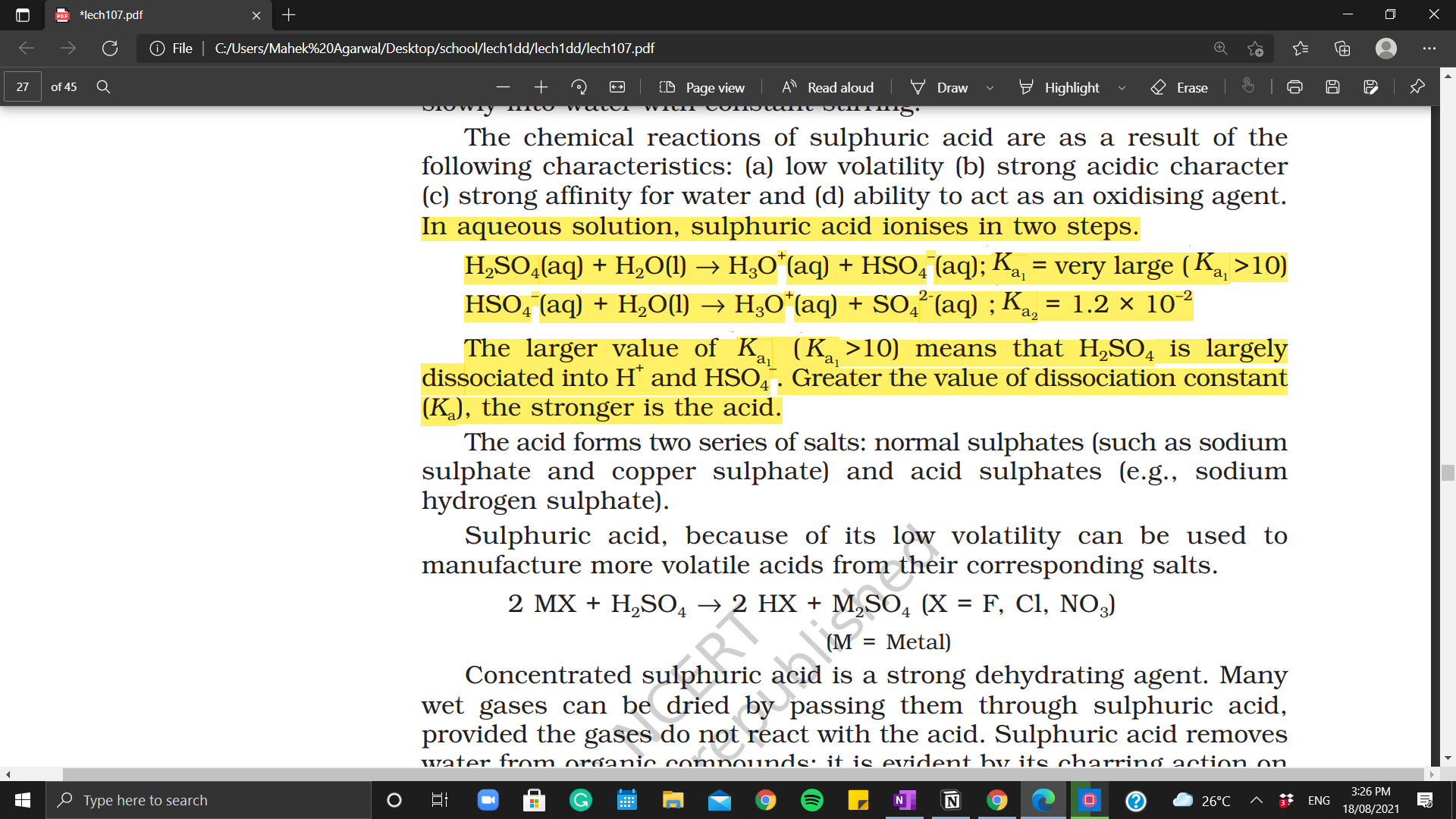
it has low volatility, strong acidic char, strong affinity for water, ability to act as oxidising agent
The acid forms two series of salts: normal sulphates (such as sodium sulphate and copper sulphate) and acid sulphates (e.g., sodium hydrogen sulphate).
Sulphuric acid, because of its low volatility can be used to manufacture more volatile acids from their corresponding salts.
2 MX + H2SO4 → 2 HX + M2SO4 (X = F, Cl, NO3 ) (M=Metal)
Concentrated sulphuric acid is a strong dehydrating agent. Many wet gases can be dried by passing them through sulphuric acid, provided the gases do not react with the acid. Sulphuric acid removes water from organic compounds; it is evident by its charring action on carbohydrates.
C12H22O11→ (H2SO4)--->12C + 11H2O
Hot concentrated sulphuric acid is a moderately strong oxidising agent. Both metals and non-metals are oxidised by concentrated sulphuric acid, which is reduced to SO2 .
Cu + 2 H2SO4 (conc.) → CuSO4 + SO2 + 2H2O
C + 2H2SO4 (conc.) → CO2 + 2 SO2 + 2H2O
S + 2H2SO4 (conc.) → 3SO2 + 2H2O
Uses
manufacture of fertilizers
petroleum refining
manufacture of pigments, paints, dyestuff,
detergents
metallurgical applications
storage batteries
manufacture of nitrocellulose products
lab reagent
Page 14
Group 17- General Trends
F, Cl, Br, I, At, Ts
Occurrence
Fluorine is present as insoluble fluorides (CaF2, Na3Al6, 3Ca3 (PO4)2.CaF2 and in small quantities in soil, river water plants, bones, teeth.
Sea water contains chlorides, bromides, iodides of Na, K, Mg, Ca; but mainly NaCl
Various seaweeds contain Iodine in their system, 0.5% , or Chile saltpetre contains 0.2% of NaI
Electronic Config.- ns2np5
Atomic/Ionic Radii- increases from fluorine to iodine and they are the smallest in their respective periods due to max. effective nuclear charge.
I.E
Due to small size, very high I.E. It decreases down the group.
E.G.E
Have maximum negative EGE due to only 1 electron reqd. for stable noble gas config.
Becomes less -ve DTG.
Exception: -ve EGE OF F is smaller than Cl due to very small size leading to more interionic repulsions in the small 2p orbitals and thus less attraction towards incoming electron
EN
Very high EN. It decreases down the group.
Physical Properties
F and Cl are gases, bromine is a liquid, iodine is a solid.
MP and BP regularly increases with atomic number.
All halogens are coloured due to absorption of radiations in the visible region of the EMR spectrum.
By absorbing different quanta of radiation, they display different colours. Eg. F2- yellow, Cl2- greenish yellow, Br2- red, I2- violet.
F and Cl react with water. Br and I are sparingly soluble in water but soluble in chloroform, CCl4, CS2, and HCs to give coloured sols.
the enthalpy of dissociation for F2 is smaller than Cl2 which is an anomaly, it is due to large e--e- repulsions among lone pairs in F2 molecule as they are closer to each other as compared to Cl2.
Chemical Properties
All halogens exhibit -1 oxidation state.
Cl, Br and I also exhibit +1, +3, +5, 7
These states are observed when they combine with small, highly EN atoms like F, O, i.e. in interhalogens, oxides, oxoacids.
+4 and +6 occur in oxides and oxoacids of Cl and Br.
highly reactive. react with metals/non. to form halides. reactivity decreases DTG.
F2 is the strongest oxidising halogen, In general, a halogen oxidises halide ions of higher atomic number.
F2 + 2X– → 2F– + X2 (X = Cl, Br or I)
Cl2 + 2X– → 2Cl– + X2 (X = Br or I)
Br2 + 2I– → 2Br– + I2
Fluorine oxidises water to oxygen whereas chlorine and bromine react with water to form corresponding hydrohalic and hypohalous acids
reaction of I with water is non-spontaneous, and I- can be oxidised by O2 in acidic medium; reverse of the reaction of F2 with H20
2F2(g) + 2H2O(l) ---> 4H+ (aq) + 4F- (aq) + O2 (g)
X2 + H20 ---> HX + HOX where X= Cl or Br
4I- + 4H+ + O2----> I2 + 2H20
Anomalous Behaviour of F
due to small size, highest electronegativity, low F-F bond dissociation enthalpy, and non availability of d orbitals in valence shell.
Most of the reactions of fluorine are exothermic (due to the small and strong bond formed by it with other elements).
It forms only one oxoacid
Hydrogen fluoride is a liquid (b.p. 293 K) due to strong hydrogen bonding. Hydrogen bond is formed in HF due to small size and high electronegativity of fluorine
1. Reactivity towards Hydrogen
They all react with hydrogen to give hydrogen halides.
affinity for hydrogen decreases DTG.
hydrogen halides dissolve in water to give hydrohalic acids. Acidic strength of these acids : HF < HCl < HBr < HI
stability of halides decreases DTG due to decrease in bond (H-X) diss enthalpy :: H–F > H–Cl > H–Br > H–I.
2. Reactivity towards oxygen
most oxides formed are unstable.
F forms OF2 and O2F2; OF2 is thermally stable at 298K; these form due to high EN of F than O; these are strong fluorinating agents.
O2F2 oxidises plutonium to PuF6 and the reaction is used in removing plutonium as PuF6 from spent nuclear fuel.
Cl, Br and I form oxides with oxidation states varying from +1 to +7.
Stability of oxides formed by halogens : I > Cl > Br
Higher stability of oxides of iodine is due to greater polarisability of bond between iodine and oxygen, multiple bond formation between chlorine and oxygen takes place due to availability of d–orbitals. This leads to increase in stability. Bromine lacks both the characteristics hence stability of oxides of bromine is least.
Chlorine oxides, Cl2O, ClO2 , Cl2O6 and Cl2O7 are highly reactive oxidising agents and tend to explode ; ClO2 is used as a bleaching agent for paper pulp and textiles and in water treatment.
Br2O, BrO2 , BrO3 are the least stable halogen oxides (middle row anomaly) and exist only at low temperatures. They are very powerful oxidising agents.
I2O4 , I2O5 , I2O7 are insoluble solids and decompose on heating. I2O5 is a very good oxidising agent and is used in the estimation of carbon monoxide
3. Reactivity towards metals
Halogens react with metals to form metal halides
The ionic character of the halides decreases in the order MF > MCl > MBr > MI (M= monovalent metal)
If a metal exhibits more than one oxidation state, the halides in higher oxidation state will be more covalent than the one in lower oxidation state
4. Reactivity of halogens towards other halogens
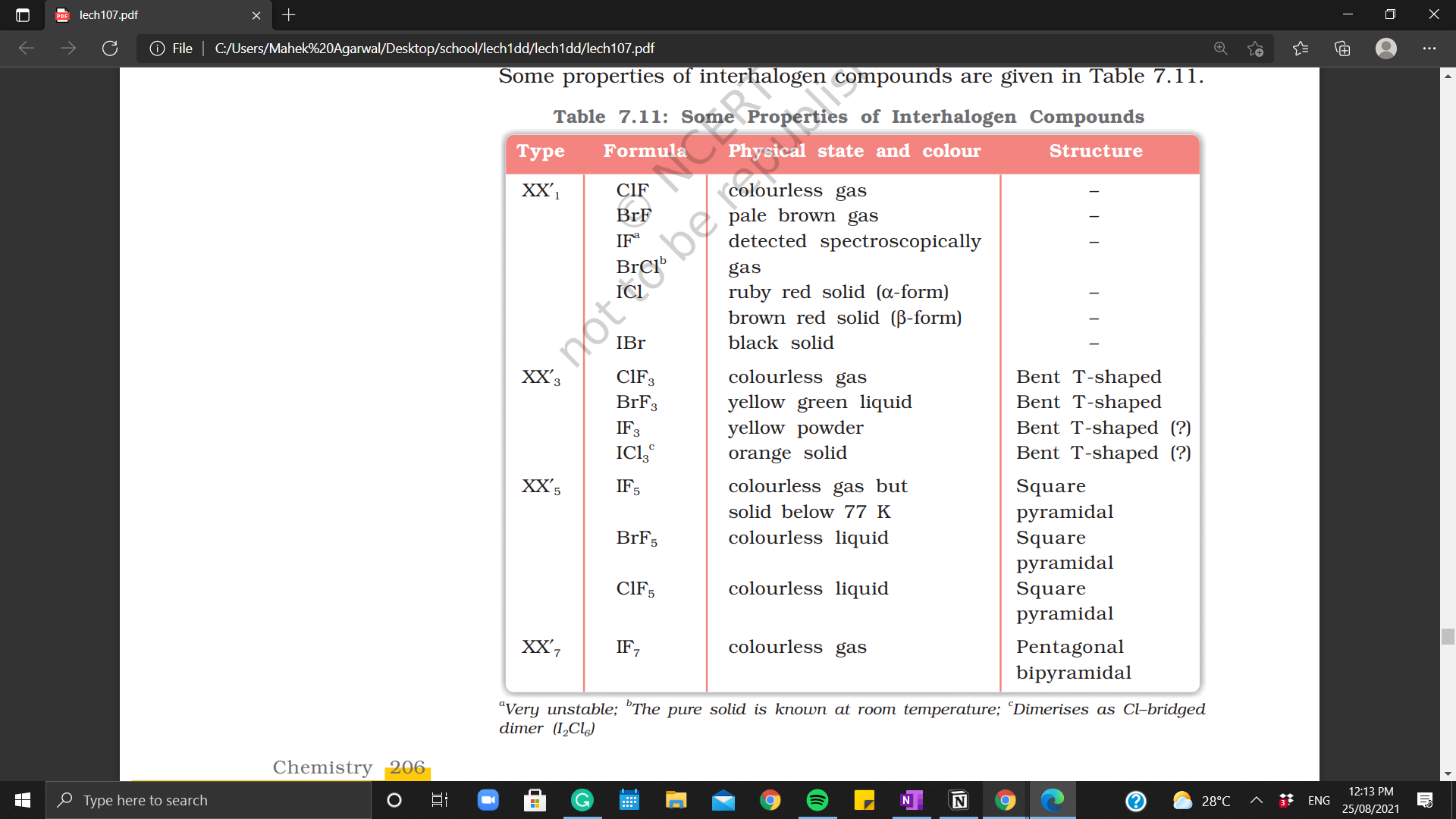
Halogens combine amongst themselves to form a number of compounds known as interhalogens of the types XX ′ , XX3 ′ , XX5 ′ and XX7 ′ where X is a larger size halogen and X′ is smaller size halogen.
Page 15
Chlorine
Chlorine was discovered in 1774 by Scheele by the action of HCl on MnO2 .
(Greek, chloros = greenish yellow)
Preparation
By heating manganese dioxide with concentrated hydrochloric acid MnO2 + 4HCl → MnCl2 + Cl2 + 2H2O
contd. a mixture of common salt and concentrated H2SO4 is used in place of HCl ::: 4NaCl + MnO2 + 4H2SO4 → MnCl2 + 4NaHSO4 + 2H2O + Cl2
By the action of HCl on potassium permanganate. 2KMnO4 + 16HCl → 2KCl + 2MnCl2 + 8H2O + 5Cl2
Manufacture of Cl
1. Deacon's Process
By oxidation of hydrogen chloride gas by atmospheric oxygen in the presence of CuCl2 (catalyst) at 723 K.
4HCl +O2 → 2Cl2 + 2H2O (in presence of CuCl2)
2. Electrolytic Process
Chlorine is obtained by the electrolysis of brine (concentrated NaCl solution). Chlorine is liberated at anode.
Properties
Greenish yellow gas
pungent and suffocating odour
heavier than air
easily liquefiable, b.p. 239 K, soluble in water
reacts with metals and non-metals to form chlorides.
great affinity for hydrogen, combines to form HCl.
With cold and dilute alkalies chlorine produces a mixture of chloride and hypochlorite but with hot and concentrated alkalies it gives chloride and chlorate: 2NaOH + Cl2 → NaCl + NaOCl + H2O (cold and dilute NaOH) : 6NaOH + 3Cl2 → 5NaCl + NaClO3 + 3H2O (hot and conc. NaOH)
With dry slaked lime it gives bleaching powder (Ca(OCl)2 .CaCl2 .Ca(OH)2 .2H2O): 2Ca(OH)2 + 2Cl2 → Ca(OCl)2 + CaCl2 + 2H2O
Chlorine reacts with hydrocarbons and gives substitution products with saturated hydrocarbons and addition products with unsaturated hydrocarbons
Chlorine water on standing loses its yellow colour due to the formation of HCl and HOCl. Hypochlorous acid (HOCl) so formed, gives nascent oxygen which is responsible for oxidising and bleaching properties of chlorine.
Cl oxidises ferrous to ferric, sulphite to sulphate, SO2 to SO3, I2 to IO3 (iodate)
2FeSO4 + H2SO4 + Cl2 → Fe2 (SO4 )3 + 2HCl
Na2SO3 + Cl2 + H2O → Na2SO4 + 2HCl
SO2 + 2H2O + Cl2 → H2SO4 + 2HCl
I2 + 6H2O + 5Cl2 → 2HIO3 + 10HCl
It bleaches vegetable or organic matter in the presence of moisture; bleaching effect is permanent
Cl2 + H2O → 2HCl + O // Coloured substance + O → Colourless substance
Uses
bleaching wood pulp (mf of paper and rayon)
bleaching cotton and textiles
extraction of Au and Pt
mf of dyes, drugs, organic compounds- CCl4, DDT, refrigerants etc
sterilising drinking water
preparation of poisonous gases such as phosgene (COCl2 ), tear gas (CCl3NO2 ), mustard gas (ClCH2CH2SCH2CH2Cl)
Page 16
Hydrogen Chloride
Glauber prepared it by heating common salt with concentrated sulphuric acid.
Preparation
1. by heating sodium chloride with concentrated sulphuric acid
NaCl + H2SO4 → NaHSO4 + HCl (420 K)
NaHSO4 + NaCl → Na2SO4 + HCl (823 K)
HCl gas can be dried by passing through concentrated sulphuric acid.
Properties
colourless
pungent smelling
easily liquefied; b.p. 189 K
freezes into a white crystalline solid with f.p. 159 K
extremely soluble in water
ionizes as HCl (g) + H2O (l) ---> H3O+ (aq) + Cl- (aq) with acid dissociation constant Ka= 10^7
its aq. sol. is called HYDROCHLORIC ACID. High value of dissociation constant (Ka ) indicates that it is a strong acid in water.
It reacts with NH3 and gives white fumes of NH4Cl ---- NH3 + HCl → NH4Cl
When three parts of concentrated HCl and one part of concentrated HNO3 are mixed, aqua regia is formed which is used for dissolving noble metals, e.g., gold, platinum.
Au + 4H+ + NO3- + 4Cl- ----> AuCl4- +NO 2H2O
3Pt +16H + 4NO3- + 18Cl- ---> 3PtCl6 ^2- + 4NO + 8H2O
Hydrochloric acid decomposes salts of weaker acids, e.g., carbonates, hydrogencarbonates, sulphites, etc
Na2CO3 + 2HCl → 2NaCl + H2O + CO2
NaHCO3 + HCl → NaCl + H2O + CO2
Na2SO3 + 2HCl → 2NaCl + H2O + SO2
Uses
manufacture of chlorine, NH4Cl and glucose
extracting glue from bones and purifying bone black
in medicine and as a laboratory reagent
Page 17
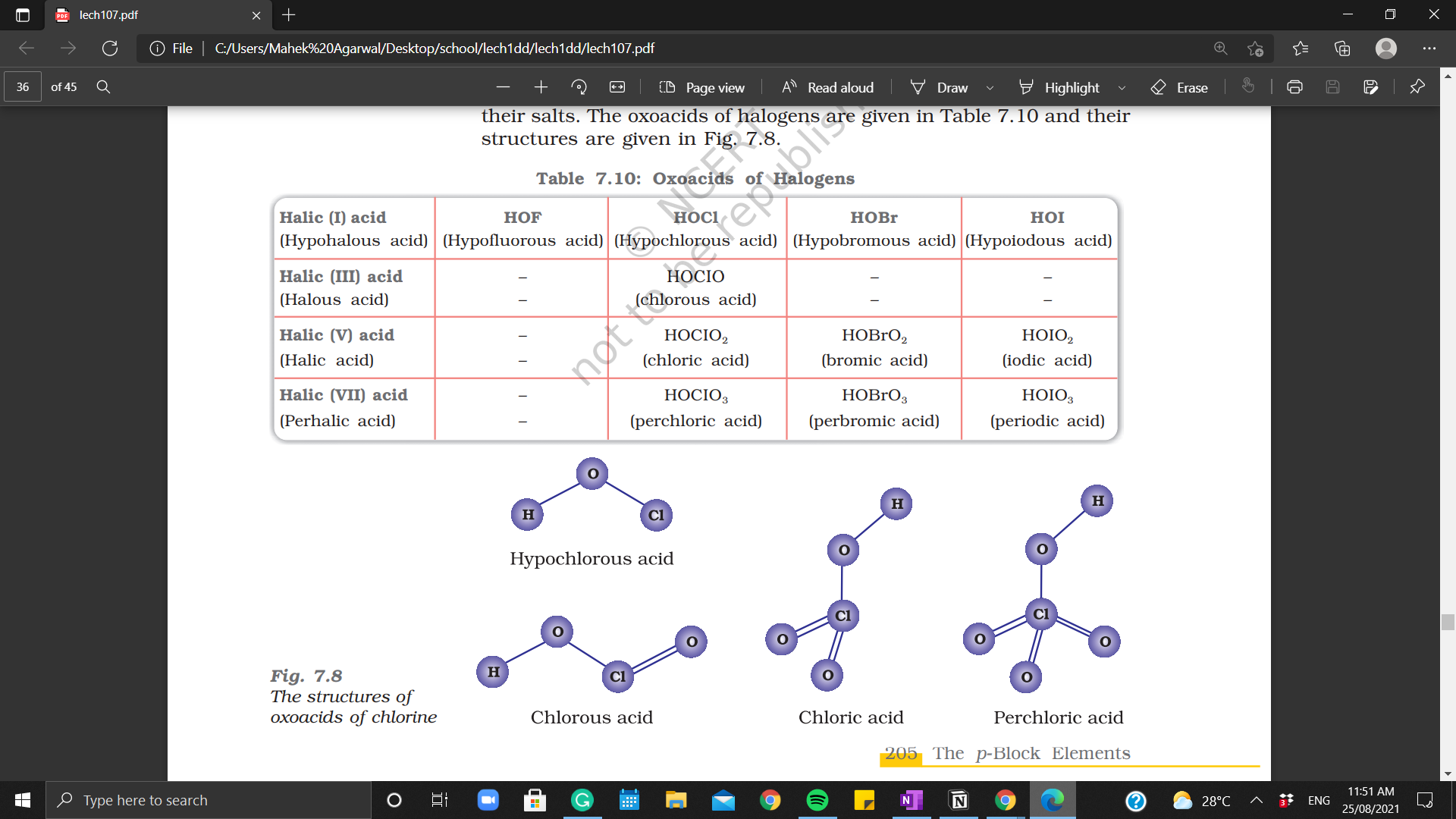
Oxoacids of Halogens
HOF known as fluoric (I) acid or hypofluorous acid.
Page 18
Interhalogen Compounds
When two different halogens react with each other, interhalogen compounds are formed. They can be assigned general compositions as XX′ , XX3 ′ , XX5 ′ and XX7 ′ where X is halogen of larger size and X′ of smaller size and X is more electropositive than X′ .
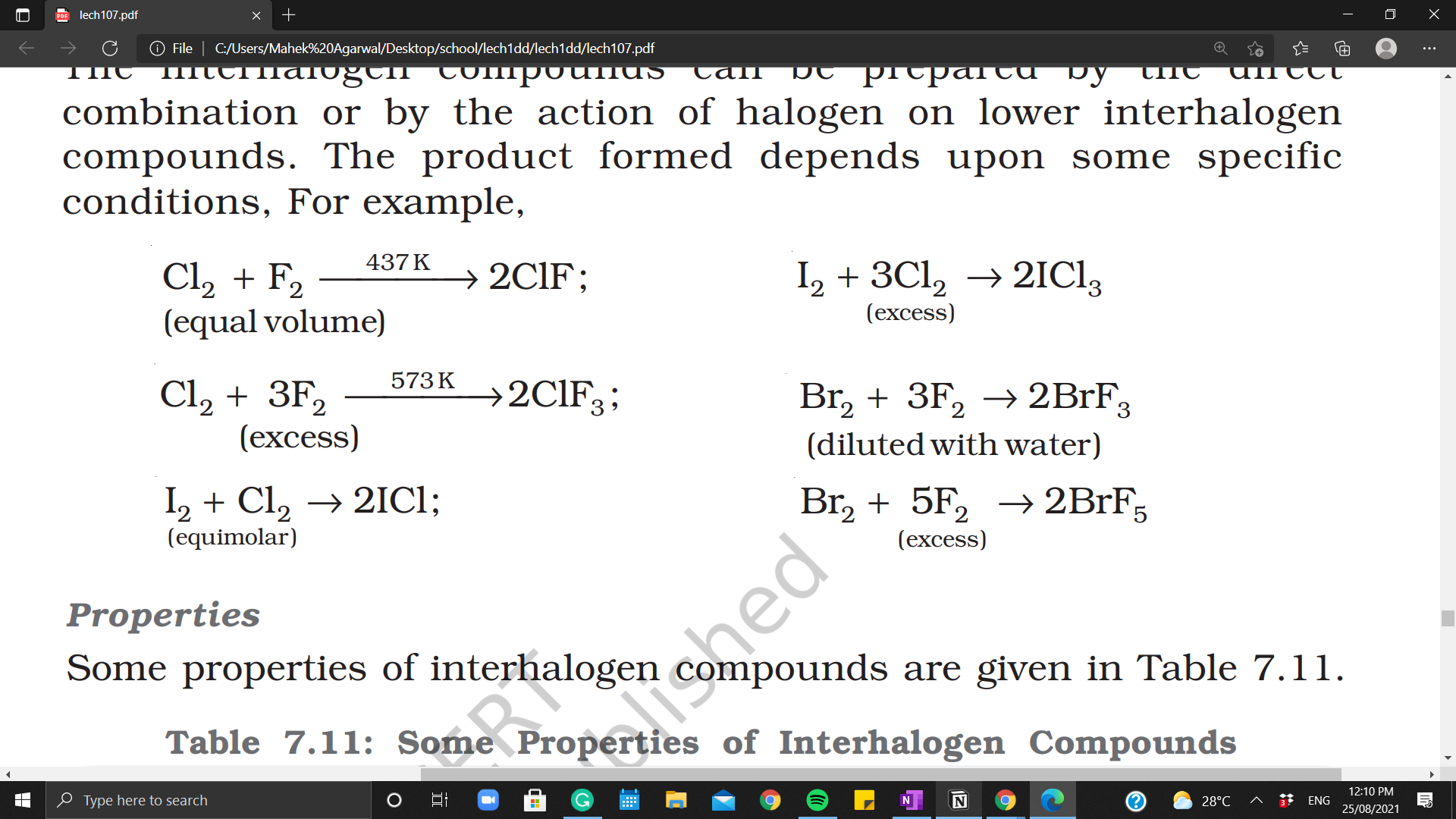
The interhalogen compounds can be prepared by the direct combination or by the action of halogen on lower interhalogen compounds.
These are all covalent molecules and are diamagnetic in nature.
They are volatile solids or liquids at 298 K except ClF which is a gas.
their m.p. and b.p. are a little higher than expected.
interhalogen compounds are more reactive than halogens (except fluorine). This is because X–X′ bond in interhalogens is weaker than X–X bond in halogens except F–F bond.
All these undergo hydrolysis giving halide ion derived from the smaller halogen and a hypohalite ( when XX′), halite ( when XX′3 ), halate (when XX′5 ) and perhalate (when XX′7 ) anion derived from the larger halogen.
XX' + H2O --> HX' + HOX
Uses
non aqueous solvents
useful fluorinating agents
ClF3 and BrF3 are used for the production of UF6 in the enrichment of 235U.
U(s) + 3ClF3 (l) → UF6 (g) + 3ClF(g)
Page 19
Group 18 elements
helium, neon, argon, krypton, xenon, radon and oganesson; chemically unreactive; noble gases
Occurrence
All these gases except radon and oganesson occur in the atmosphere.
Their atmospheric abundance in dry air is ~ 1% by volume of which argon is the major constituent
He and Ne are found in minerals of radioactive origin like pitchblende, monazite, cleveite
commercial source of He- Natural gas
Xe and Rn are rare- Rn is obtained as decay product of 226Ra : 226/88 Ra--> 222/86 Rn + 4/2 He
Oganesson has been synthetically produced by collision of 249/98 Cf atoms and 48/ 20Ca ions
EC
ns2np6
I.E
very high I.E. decreases DTG
Radii
increase DTG
EGE
no tendency to accept electrons
Physical Properties
monoatomic
colourless
odourless
tasteless
sparingly soluble in water
very low mp and bp because the only type of interatomic interaction in these elements is weak dispersion forces.
He has lowest mp of any known element; has an unusual property of diffusing through most commonly used laboratory materials such as rubber, glass or plastics.
Chemical Properties
INERT due to- except for He all have completely filled ns2np6 config. in valence shell; have high I.E and more positive EGE
a number of xenon compounds mainly with most electronegative elements like fluorine and oxygen, have been synthesised after a long time and attempts to make noble gases react by replacing oxygen with xenon in red coloured compound- O2+PtF6- to Xe+PtF6- as first IE of O and Xe are almost identical
Compounds of Kr are few- only difluoride (KrF2) has been studied
. Compounds of radon have not been isolated but only identified (e.g., RnF2 ) by radiotracer technique and Ar, Ne or He have no known compounds.
a) Xe-F compounds
XeF2 , XeF4 and XeF6 - colourless crystalline solids and sublime readily at 298 K ; powerful fluorinating agents; readily hydrolysed even by traces of water
XeF2 is linear, XeF4 is square planar and XeF6 is distorted octahedral
Xe (g) + F2 (g) → (673 K, 1bar) → XeF2 (s) where Xe is in excess
Xe (g) + 2F2 (g) → (873 K, 7 bar) → XeF4 (s) where Xe is in 1:5 ratio
Xe (g) + 3F2 (g) → (573 K, 60-70 bar) → XeF6 (s) where Xe is in 1:20 ratio
XeF4 + O2F2 → XeF6 + O2
Xenon fluorides react with fluoride ion acceptors to form cationic species and fluoride ion donors to form fluoroanions :
XeF2 + PF5 → [XeF]+ [PF6 ] – ; XeF4 + SbF5 → [XeF3 ] + [SbF6 ] –
XeF6 + MF → M+ [XeF7 ] – (M = Na, K, Rb or Cs)
b) Xe- O compounds
Hydrolysis of XeF4 and XeF6 with water gives Xe03,
6XeF4 + 12 H2O → 4Xe + 2Xe03 + 24 HF + 3 O2
XeF6 + 3 H2O → XeO3 + 6 HF
Partial hydrolysis of XeF6 gives oxyfluorides, XeOF4 and XeO2F2.
XeF6 + H2O → XeOF4 + 2 HF
XeF6 + 2 H2O → XeO2F2 + 4HF
XeO3 is colourless and explosive solid with pyramidal molecular structure
XeOF4 is a colourless volatile liquid and has a square pyramidal molecular structure
Uses
He- non-inflammable and light gas / filling balloons for meteorological observations/ used in gas-cooled nuclear reactors/ liquid He used in cryogenic agent/ used to produce and sustain powerful superconducting magnets in modern NMR spectrometers and MRI systems/ as a diluent for oxygen in modern diving apparatus
Ne- discharge tubes and fluorescent bulbs for ad displays/ Ne bulbs in botanical gardens and green houses
Ar is used to create inert atmosphere in metallurgical processes (arc welding of metals or alloys)/ filling electric bulbs/ handling air-sensitive substances in labs
No significant uses of Xe and Kr- used in light bulbs designed for special purposes.
Information
- Description
- notes
- Created by
- Mahek Agarwal · Aug 2021
- Updated
- Aug 25, 2021
- Views
- 165
- Tags
- Rating