
Notes
The Nervous stystem
Content of the notes (1)
Page 1
Sense organs detect stimuli
a stimulus is a change in your environment that your may need to react to.
sense organs:
eyes- light receptors
ears- sound and 'balance receptors
tongue- Taste receptors
skin- sensitive to touch (pressure) and temperature change
nose- smell receptors
The CNS coordinates a response when a stimulus is detected by receptors is a sense organ, the information is sent as electrical impulses along sensory neurone to the CNS.
The CNS consists of the brain and spinal cord.
The CNS decides what to do about a stimulus and tells something to do
The CNS then sends information to an effector (muscle or gland) along a motor neurone. The effector then responds accordingly.
Effectors
muscles and glands are known as effectors- they respond in different ways. Muscles contract in response to a nervous impulse, where as glands secrete hormones.
Motor Neurons
Many short dendrons and one long axon carry nerve impulses from the CNS to the effectors (muscle or gland)
Relay Neurones
Many short dendrons and axons carry nerve impulses from sensory neurones to motor neurones.
Sensory Neurones
Long dendrons and short axons carry nerve impulses from the receptors in the sense organs to the CNS.
Reflexes are automatic responses to certain stimuli- they can reduce injury.
If someone shines a light in your eye, your pupil automatically dilates to stop it getting damaged.
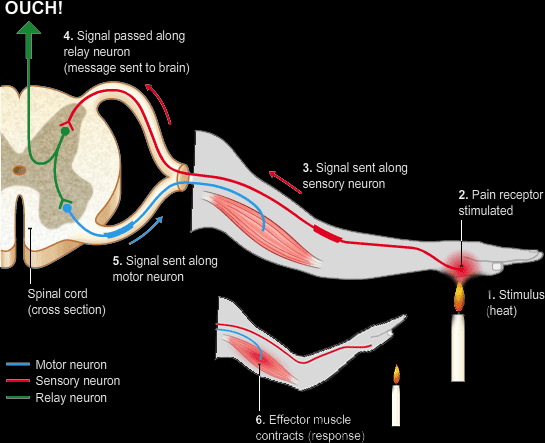
receptor detects a stimulus - change in the environment
sensory neurone sends signal to relay neurone
motor neurone sends signal to effector
effector produces a response
The neurones in a reflex go through the spinal cord or through an unconscious part of the brain.
When a stimulus is detected by receptors, impulses are sent along a sensory neurone to the CNS.
In the CNS the sensory neurone passes on the message to a relay neurone.
Relay neurones relay the impulses to a motor neurone.
The impulses then travel along the motor neurone to the effector
the muscle then contracts to move hand away.
The Nervous System
New Page
Information
- Description
- GCSE Biology Core (Topic 2, Responding to change) Note on The Nervous stystem, created by daniifarrell on 23/12/2013.
- Created by
- daniifarrell · Dec 2013
- Updated
- Feb 19, 2016
- Views
- 70
- Tags
- Rating
More on Reflexes and the Reflex Arc