
Notes
Chromosomes and Genes
Content of the notes (1)
Page 1
Introduction
A chromosome consists of many base pairs arranged into a double helix. For example, the DNA in the longest human chromosome contains about 300 million base pairs.
Complementary Base Pairs
The pattern of complementary base pairing means that if one strand of DNA molecule has the sequence TAGCAT, then the sequence on the partner strand must be ATCGTA. This are known as palindromic sequences. A palindrome is a word or sequence that reads the same way reading left to right and right to left. For example, DAD or NAVAN.
Genes
A gene is a sequence of many bases. The precise sequence of bases is called the genetic code. A gene works, or is expressed, when this code is sent to the cytoplasm (ribosome) to make a protein. This process is called translation.
Transcription
Transcription is the first step of gene expression, in which a particular segment of DNA is copied into RNA by the enzyme RNA polymerase. Both RNA and DNA are nucleic acids, which use base pairs of nucleotides as a complementary language that can be converted back and forth from DNA to RNA by the action of the correct enzymes. During transcription, a DNA sequence is read by an RNA polymerase, which produces a complementary, antiparallel RNA strand called a primary transcript. As opposed to DNA replication, transcription results in an RNA complement that includes the nucleotide Uracil (U) in all instances where thymine (T) would have occurred in a DNA complement.
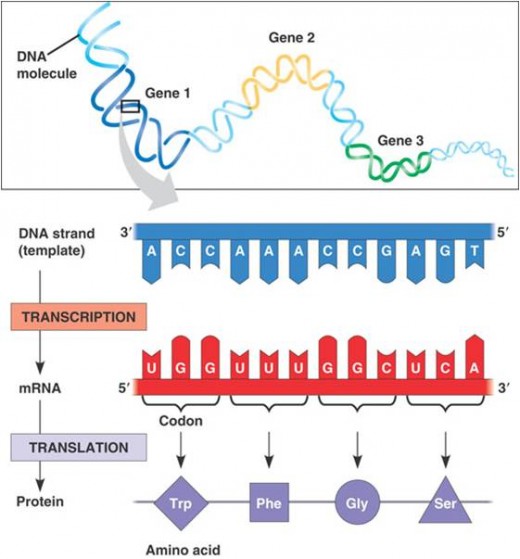
Protein Synthesis
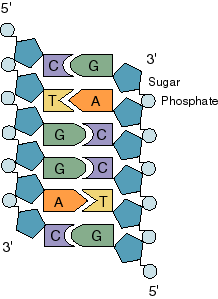
Structure of DNA - Complementary Base Pairs, Sugar group and Phosphate.
Translation
Translation is the process in which cellular ribosomes create proteins. It is part of the process of gene expression. In translation, messenger RNA (mRNA) produced by transcription is decoded by a ribosome complex to produce a specific amino acid chain, or polypeptide, that will later fold into an active protein.
Chromosomes and Genes
Information
- Description
- This note focuses on chromosomes and genes in the nuclei of all cells. DNA is contained within the chromosome. This would appeal to anyone studying intermediate level biology.
- Created by
- daniel.praecox · Jan 2014
- Updated
- Jan 4, 2017
- Views
- 165
- Tags
- History
-
- Created by jill.examtime · Jan 24, 2014
- Copied by daniel.praecox · Jan 24, 2014
- Rating