
Notes
Readings for Introduction
Content of the notes (15)
Page 1
Readings - Book: Doing Research In the Real World pages 1 - 7
Author: Gray, David. E 2014
Notes -
Chapter - objectives;
-Describe why research in the real world is of increasing importance
- explain the nature of theories
- outline the stages in the research process
- use this book effectively by making use of its features such as activities and top tips
Research in the real world
research in this context is a systematic and organised effort to investigate a specific problem that needs a solution.
Research is about how to solve real problems
research can be concerned with clarifying, validating or building a theory
Page 2
examples of real world research topics
Women firefighters - breaking down barriers to recruitment
Disability awareness training - does it change attitudes
Project management in virtual organisations
Identifying factors that influence youth club membership and attendance
Does targeted neighbourhood policing work
More...
Research methods modified or cancelled
Real world - organisations, businesses, government, networks...
How do we go about addressing the kind of research areas?
solve a problem - systematically
Page 3
More...
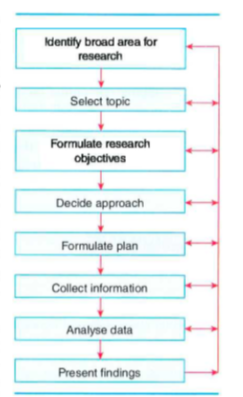
Above - an overview of the simplified research processFigure 1.1 shows the possible in principle to move from the identification of research focus right through the presentation of the findings in a neat sequence of steps. It implies that the research process is a highly practical one.
- identify the problem
-decide how to tackle it
- collect data
- analyse and present
The nature of theories
A theory is defined as ;
" a set of interrelated constructs (concepts) definitions and propositions that present a systematic view of phenomena by specifying relations among variables, with the purpose of explaining and predicting phenomena.
Page 4
An overview of the research process
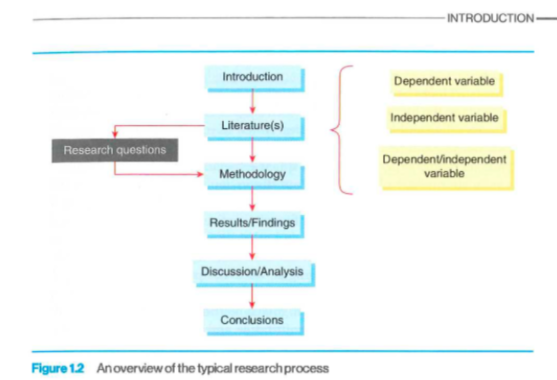
research comprises an investigation into the relationship between two or more variables.
undertake a research study, we need to know more about these variables and what studies, have we conducted into their relationship
we undertake a literature review, there we are interested in the literature on the dependant variable (the variable that forms the focus of the research) and the independent variable ( the variable that acts on or predicts the dependent variable)
third source of literature we also need to investigate and that is where studies have already been completed that have explored the relationships between healthy eating and campaigns designed to improve eating patterns
Literature review has another important purpose. It helps to define the focus and scope of the research project about to be undertaken.
research questions providing they are written accurately and concisely provide an essential bridge between the literature review and methodology.
Page 5
Theoretical perspectives and research methodologies
Book - Chapter 2 Theoretical Perspective and Research Methodologies Doing Research in the Real World Page 15-38
Author - Gray, David E 2014
Chapter Objectives
distinguish between ontology and epistemology in research
distinguish between inductive and deductive methods
explain the different perspectives taken by positivism and interpretivism
describe the different research methodologies and the conditions for their selection
distinguish between exploratory, descriptive, explanatory and interpretive research studies
Inductive and Deductive Reasoning
Inductive discovery - induction
deductive proof - deduction
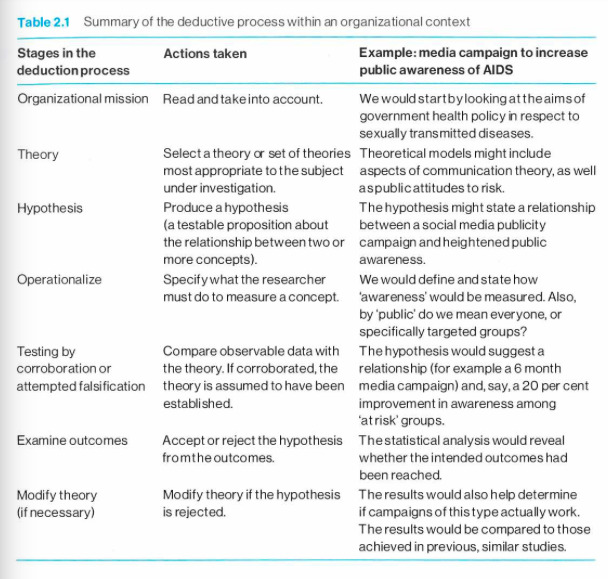
Deductive process -
moves towards hypothesis testing after which the principle confirmed, refuted or modified
hypotheses present an assertion about two or more concepts that attempts to explain the relationship between them.
Concepts are abstract ideas that form the building blocks of hypotheses and theories.
First stage is elaboration of a set of principles or allied ideas that are then tested through empirical observation or experimentation.
Page 6
Before experimentation can take place, concepts must be made measurable in a way that can be observed to confirm that they have occurred.
For example - measures and indicators are created, if research is to be conducted into doctor - patient communication and its impact on patient wellbeing we would first have to establish an operational defining of communication within the context of the doctor patient relationship. Through the creation of operational indicators there is a tendency to measure and collect dat only on what can actually be observed.
The inductive process
Inductive approach plans are made for data collection, which the data are analysed to see if any patterns emerge that suggest relationships between variables. To ensure a degree of reliability, the research often takes multiple cases or instances through for example, multiplying observations rather than basing conclusions on one case.
Inductive approach does not set out to corroborate or falsify a theory, instead through process of gathering data, it attempts to establish patterns, consistencies and meanings.
Page 7
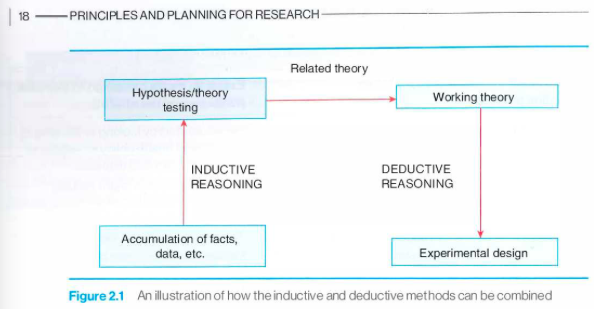
Combining the inductive and deductive methods
Inductive and deductive process are not mutually exclusive
For example formulation to a modern problem, let say a researcher has asked to investigate the problem of staff absenteeism. Selection of facts, the research is able to formulate the theory (inductive approach) that absenteeism is related to working patterns.
The researcher then becomes interested what other impact this form of control may have on working practices (deductive approach).
A working hypothesis becomes formulated that has produced low morale and there low productivity levels among sections of the workplace.
This hypothesis is tested by the introduction of new working methods in some sections, but not others.
To compare productivity levels between traditionally supervised sections and those using the new supervision methods.
Epistemological and ontological perspectives
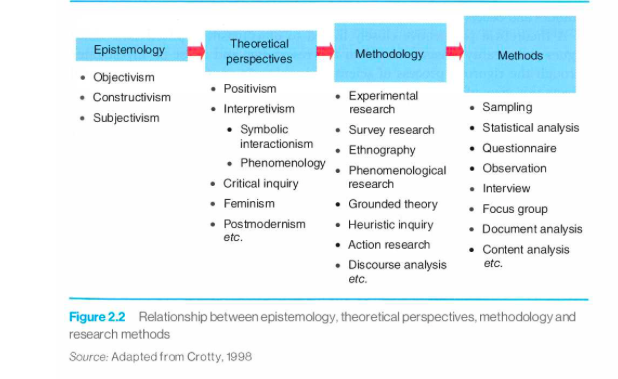
The researcher to select a data gathering method, the choice of methods will be influenced by the research methodology. The methodology in turn will be influenced by the theoretical perspectives adopted by the researcher, and in turn, by the epistemological stance.
Ontology is the study of being, the nature of existence and what constitutes reality. Ontology embodies understanding what is, epistemology tries to understand what it means to know.
Epistemology provides aa philosophical background for deciding what kinds of knowledge are legitimate and adequate.
Page 8
clarify issues of research design
set of objectives
A theoretical perspective closely linked to objectivism and positivism which argues that reality exists external to the researcher and must be investigated through the rigorous process of scientific inquiry.
Constructivism rejects the view of human knowledge, truth and meaning do not exist in some external world....
Theoretical perspectives
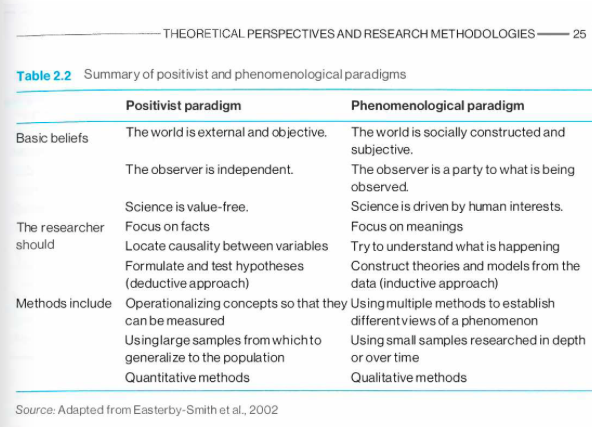
Positivism - dominant epistemological paradigm in social science from the 1930's and 1960's.
social world exists externally to the research and that its properties measured directly through observation.
In essence positivism argues that;
-reality consists of what is available to the senses, that is, what can be seen, smelt touched...
- inquiry should be based upon scientific observation and therefore on empirical inquiry
-the natural and human sciences share common logical and methodological principles dealing with facts and not with values.
paradigm suggests are especially important, extending the match between those facts and the paradigm's predictions and further articulation of the paradigm itself.
Interpretivism - culturally derived and historically situated interpretations of the social world
Five examples of interpretivist approach ;
symbolic interactionism -
People interpret the meaning of objects and actions in the world and then act upon those interpretations
Meanings arise from the process of social interaction
Meanings are handled in, are modified by and an interactive process used by people in dealing with the phenomena that are encountered.
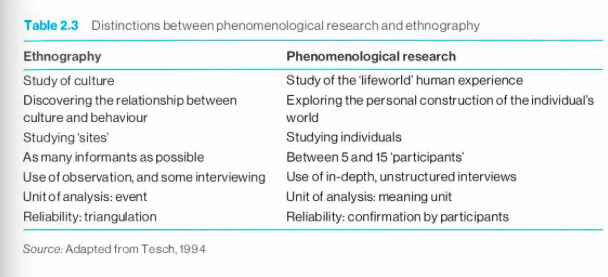
Phenomenology
holds that any attempt to understand social reality has to be grounded in peoples experiences of that social reality.
Page 9
Realism - begins from the position that the picture that science paints of the world is a true and accurate one..
Hermeneutics -the tradition is associated largely with 19th century germany philosophy, but also has connections with phenomenology and the psychoanalysis of freud.
Naturalistic Inquiry -multiple constructed realities that can be only studied holistically.
Page 10
Critical Inquiry
ideas are mediated by power relations in society
certain groups in society are privileged over others and exert an oppressive force on subordinate groups.
what are presented as facts cannot be disentangled from ideology and self interest of dominant groups
mainstream research practices are implicated in the reproduction of the systems of class, race, and gender oppression.
Feminism - Marxism and critical inquiry, feminist epistemologies take the view that what a person knows is largely determined by their social position.
Postmodernism -is far from a unified system of thought is sometimes interchangeably with concepts such as deconstructionism and post structuralism.
Pragmatism - an ideology is true only if it works and generates practical consequences for society.
Research Methodologies
... continue
Page 11
Experimental and quasi - experimental research
Experimental group receives the treatment and the results are compared with the control group that does not receive the treatment.
Therefore the researcher manipulates the independent variable ( the variable that the researcher has control over) to see its effect on the dependent variable ( the response that is measured).
Experimental and quasi-experimental research, then places an emphasis on;
- reproducing the techniques of the laboratory experiment with highly structured methods.
- the generation of initial hypotheses- the control of variables
- accurate (quantitative) measurement of outcomes
- generalisation from samples to similar populations
Phenomenological research
This is a method which is a theoretical perspective that uses relatively unstructured method of data collection. Advantage of phenomenology because of its emphasis on the inductive collection of large amounts of data, it is more likely to pick up factors that were not part of the original research focus.
It is about producing thick descriptions of people's experiences and perspectives within their natural settings.
General unstructured, phenomenological research may be difficult to replicate. Phenomenological research;
- emphasises inductive logic
- seeks the opinions and subjective accounts and interpretations of participants.
-relies on qualitative analysis of data
- is not so much concerned with generalisations to larger populations, but with contextual description and analysis
Analytical surveys
Attempt to test a theory in the field through exploring the association between variables. Analytical surveys are highly structured and place an emphasis on the careful random selection of samples, the results can be generalised to other situations or contexts.
Page 12
Truly experimental approach, analytic surveys emphasise;
- a deductive approach
- the identification of the research population
- the drawing of a representative sample from the population
- control of variables
-the generation of both qualitative and quantitative data
- generalisability of results
Action research
this method involves collaboration between researcher and practitioners, and places an emphasis on promoting change within organisations such as offices, hospitals, schools and prisons.
Action research;
- involves both researchers and practitioners
- can be highly structured and involve the use of experimental and control groups used to test a hypothesis
- can also be quite unstructured and used inductively
Heuristic Inquiry
is a process that begins with a question or a problem which the researcher tries to illuminate or find an answer to.
Heuristic research involves the researcher in;
- a deep personal questioning of what it is they wish to research
-living, sleeping and merging with the research question
- allowing inner workings of intuition to extend understanding of the question.
-reviewing all the data from personal experiences to identify tacit meanings
-forming a creative synthesis including ideas for and against a proposition.
Page 13
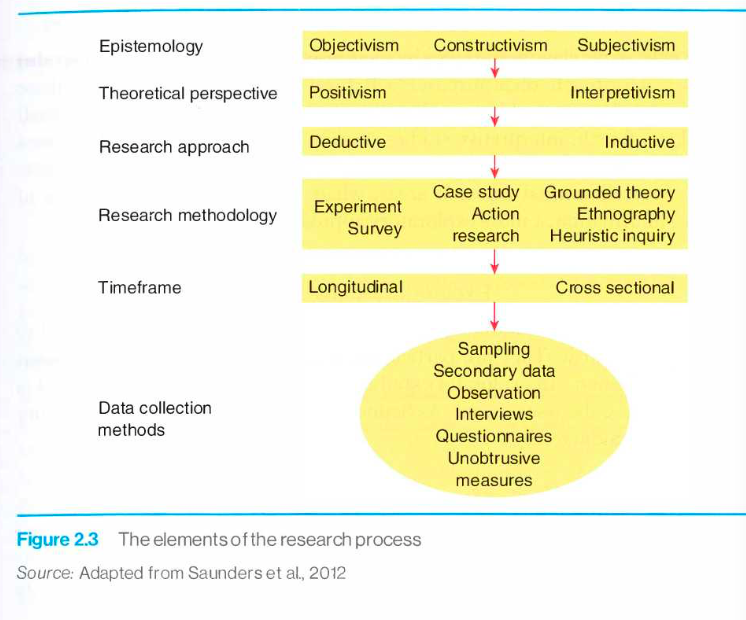
Selecting Research Approaches and Strategies
Page 14
Timeframes for research
Cross sectional studies often use a survey methodology. This is using a snap shot approach where the data are collected at one point in time.
Longitudinal study, to study change and development overtime.
Exploratory Studies - seek to explore what is happening and to ask questions about it.
- a search of literature
- talking to experts in the field
- conducting focus group interviews
Descriptive studies is to provide a picture of a phenomenon as it naturally occurs.
Explanatory studies - sets out to explain and account for the descriptive information.
Interpretive studies - seek to explore peoples experiences and their views or perspectives of these experiences.
Page 15
Summary
the dominant research paradigm for much of the 20th century was positivism at least the social sciences this has been largely replaced by anti - positivist or post - positivist stances such as interpretivism
inductive approach, data are accumulated and analysed to see if relationships emerge between variables. The deductive approach uses a theory to generate a working hypothesis concerning relationships between variables. The deductive approach uses a theory to generate a working hypothesis concerning relationships between variables. The hypothesis is operationalised and tested and is either accepted or rejected on the basis of the evidence.
the inductive and deductive methods are not mutually exclusive. A researcher may turn a collection of data into a set of concepts, models or even theories (inductive approach) which are then tested through experimentation (deductive).
approaches to research include both - truth seeking perspective - seeking methods.
Information
- Description
- BAR300 Research in Arts (Introduction ) Note on Readings for Introduction , created by Brooke Little on 06/08/2016.
- Created by
- Brooke Little · Aug 2016
- Updated
- Aug 16, 2016
- Views
- 0
- Rating