
Quiz
Spoken Language Acquisition Quiz
This quiz has question types that open in the usual player.
Questions in this quiz (13)
1• Leslie [blank_start]Rescorla[blank_end] – [blank_start]1980[blank_end]
Studied children's [blank_start]overextensions[blank_end] and established 3 main types:
1) Categorical = a word for a member of one category is extended to other members of the same category.
eg. using 'apple' to label all fruit
2) [blank_start]Analogical[blank_end] = a word for one object used for another object that bears a similar function of physical attribute.
eg. calling a hat a 'hairbrush' (as both are used on head)
3) [blank_start]Predicate[blank_end]/Mismatch Statements = a word used to make a statement in relation to another object.
eg. saying 'Dolly' upon seeing an empty doll's bed
Findings showed that the majority of a child's overextensions were [blank_start]categorical[blank_end].
- [blank_start]25[blank_end]% mismatch statements
- 15% [blank_start]analogical[blank_end]- ARescorla
- B1980
- Coverextensions
- DAnalogical
- EPredicate
- Fcategorical
- Ganalogical
- H25
2What type of theorist was Chomsky?
- ABehaviourist
- BNativist
- CConstructivist
- DGenetic epistemologist
3What type of theorist was Skinner?
- ABehaviourist
- BConstructivist
- CNativist
- DGenetic epistemologist
4What type of theorist was Bruner?
- AGenetic epistemologist
- BNativist
- CConstructivist
- DBehaviourist
5What type of theorist was Piaget?
- ANativist
- BBehaviourist
- CGenetic epistemologist
- DConstructivist
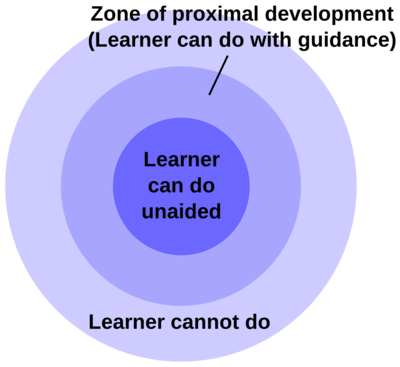
6What is the Zone of Proximal Development?
- AAll the different things a child needs to learn in order to progress.
- BThe difference between what a learner can do without help and what he or she can do with help.
7What is 'scaffolding'?
- AA term closely related to ZPD, developed by other sociocultural theorists applying Vygotsky's ZPD to educational contexts.
- BThe process of increasing a child's self-confidence by working closely with their peers until they no longer need the support.
- CScaffolding is a process through which a teacher or more competent peer gives aid to the student in her/his ZPD as necessary, and tapers off this aid as it becomes unnecessary, much as a scaffold is removed from a building during construction.
8Complete the table to show the stages of cognitive development according to Piaget's theory.
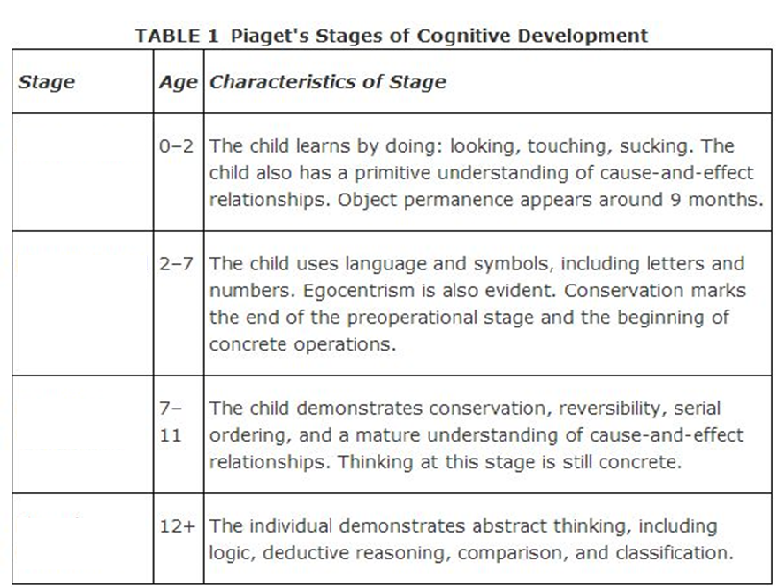
- ASensorimotor
- BPreoperational
- CConcrete Operations
- DFormal Operations
9Genetic [blank_start]epistemology[blank_end] (theory of [blank_start]cognitive[blank_end] development):
[blank_start]Piaget[blank_end] believed that cognitive development is [blank_start]facilitated[blank_end] by providing activities or situations that engage learners and require adaptation.
[blank_start]Assimilation[blank_end] = a cognitive process that manages how we take in new information and incorporate that new information into our [blank_start]existing[blank_end] knowledge.
[blank_start]Accommodation[blank_end] = the altering of previous concepts in the face of new [blank_start]information[blank_end].- Aepistemology
- Bcognitive
- CPiaget
- Dfacilitated
- EAssimilation
- Fexisting
- GAccommodation
- Hinformation
10Piaget - [blank_start]Egocentrism[blank_end]
Childrens' thoughts and communications are typically egocentric (i.e. about [blank_start]themselves[blank_end]).
Egocentrism = child's [blank_start]inability[blank_end] to see a situation from another person's point of view.
According to Piaget, the egocentric child assumes that other people see, hear, and feel exactly the [blank_start]same[blank_end] as the child does.- AEgocentrism
- Bthemselves
- Cinability
- Dsame
11Who studied the acquisition of children's inflections?
- AKatherine Nelson - 1973
- BBrown - 1973
- CJean Aitchison - 1987
12In 1973, [blank_start]Brown[blank_end] studied children's language development between 20 and 36 months and found a regularly occurring sequence in the acquisition of [blank_start]inflections[blank_end].
1) [blank_start]-ing[blank_end]
2) plural 's'
3) [blank_start]possessive 's'[blank_end]
4) past tense -ed
5) [blank_start]3rd person singular verb ending[blank_end] eg. he sings
6) auxilarly verb [blank_start]'to be'[blank_end] eg. I am dancing- ABrown
- BAitchison
- CCruttenden
- Dinflections
- Elexis
- F-ing
- Gpossessive 's'
- H3rd person singular verb ending
- I'to be'
13Cruttenden [blank_start]1979[blank_end], divided the acquisition of inflections into 3 stages:
1) Children memorise words [blank_start]on an individual basis[blank_end].
2) Awareness of general rules of inflections develops.
[blank_start]Overgeneralisations[blank_end] occur at this stage, eg. 'runned' instead of 'ran'
3) Correct inflections are used.- AOvergeneralisations
- BUndergeneralisation
- CPredicate statements
- Don an individual basis
- Ein groups
- F1979
- G1989
- H1999
Information
- Description
- Quiz of key information about child language acquisition theorists.
- Author
- Izzy Backhouse
- Language
- English
- Views
- 67
- Tags
- Rating
- No ratings yet Rate this quiz