
Quiz
Why were the Bolsheviks able to seize power? Quiz
This quiz has question types that open in the usual player.
Questions in this quiz (27)
1Who was the leader of the newly-formed Provisional Government?
- AAlexander Kerensky
- BGeneral Kornilov
- CM. Rodzianko
2The Provisional Government shared power with the Petrograd Soviet between February/March and October/November 1917.
- ATrue
- BFalse
3Disastrously, the Provisional [blank_start]Government[blank_end] - because it was only a [blank_start]temporary[blank_end] government - did not really carry out any major [blank_start]reforms[blank_end]. All it did was abolish the Okhrana and press [blank_start]censorship[blank_end], and allow political [blank_start]freedom[blank_end]. This gave the government's opponents - such as Lenin's [blank_start]Bolsheviks[blank_end] - the freedom to attack the government for the [blank_start]problems[blank_end] it was not solving.
The main problem of the Provisional Government was that it tried to [blank_start]continue[blank_end] the war. In June 1917, it organised an attack on Austria. When the attack failed, people began to turn [blank_start]against[blank_end] the government. Instead, they started to follow [blank_start]Lenin[blank_end] whose welcome message was: 'Peace, [blank_start]bread[blank_end], land'.- AGovernment
- Btemporary
- Creforms
- Dcensorship
- Efreedom
- FBolsheviks
- Gproblems
- Hcontinue
- Iagainst
- JLenin
- Kbread
4What were the main problems facing the Provisional Government?
- AMembers were unused to making decisions.Any decisions made were questioned by the Petrograd Soviet, and they could only put them in place with the backing of the Soviet as the soldiers were told they need not accept any orders from the Duma-based Provisional Government.
- BThe Provisional Government was temporary, however, elections were difficult to organise whilst trying to continue the war.
- CMost Russians wanted to end the war. However, Kerensky realised that Russia needed support from the Western allies. He hoped Russian victories would raise morale.
- DThe peasants demanded land from landlords. However, the Provisional Government needed to keep support from the influential upper classes, and no decision about land was made. Meanwhile, the peasants simply took the land for themselves, encouraging many soldiers to desert in order to get their share.
- EThe economic situation got worse; inflation continued. Shortages and levels of starvation only ease slightly because of the summer season.
- FAll of the above!
5It was not obvious at the time, but it was the small [blank_start]Bolshevik[blank_end] party that posed the biggest threat to the [blank_start]Provisional[blank_end] Government. Its leader, [blank_start]Lenin[blank_end], returned in April 1917 from exile in Switzerland. The [blank_start]German[blank_end] government provided a special train to take him to Russia via Sweden and Finland. The Germans hoped that Lenin would cause [blank_start]chaos[blank_end] and reduce Russia's [blank_start]war effort[blank_end].
When Lenin arrived at the Finland Station in Petrograd, he surprised even the Bolsheviks by reading out what has become known as his [blank_start]April Theses[blank_end]. This was his plan of action for the Bolsheviks, calling for the [blank_start]overthrow[blank_end] of the Provisional Government. His famous slogans included 'All [blank_start]Power[blank_end] to the Soviets' and 'Peace, [blank_start]Bread[blank_end] and Land'.- ABolshevik
- BProvisional
- CLenin
- DGerman
- Echaos
- Fwar effort
- GApril Theses
- Hoverthrow
- IPower
- JBread
6In July 1917, there were large but disorganised demonstrations against the government, led by soldiers and sailors, often with Bolshevik support. Kerensky crushed the demonstrators and 400 of them were killed. After the riots had been killed and Lenin fled back into exile, the Bolsheviks appeared weaker. Many anti-Bolsheviks were openly accusing Lenin of causing the troubles, and alleged that he had been paid to do so by the German government.
- ATrue
- BFalse
7What were these events called?
- AThe July Days
- BThe July Revolution
- CLenin's Revolt
8In Sebtember 1917, a pro-[blank_start]tsarist[blank_end], General Kornilov, leads a revolt against the [blank_start]Provisional Government[blank_end]. He wanted to restore discipline, destroy the Petrograd [blank_start]Soviet[blank_end] and gain control of the Provisional Government. His right-wing views appealed to many of the [blank_start]upper[blank_end] and middle classes. With the support of many army generals, he marched on Petrograd. In desperation, the government had to ask the [blank_start]Bolsheviks[blank_end] for help to defeat him as they did not have enough [blank_start]troops[blank_end]. He released Bolshevik leaders from jail and helped to arm their [blank_start]Red Guards[blank_end]. The Petrograd Soviet took charge and the Bolsheviks persuaded many of Kornilov's men to [blank_start]desert[blank_end]. Kornilov's attempt failed and the Bolsheviks were seen by many as the [blank_start]saviours[blank_end] of Russia. They then proceeded to [blank_start]keep[blank_end] the weapons Kerensky had loaned them!
- Atsarist
- BProvisional Government
- CBolsheviks
- DSoviet
- Eupper
- Ftroops
- GRed Guards
- Hdesert
- Isaviours
- Jkeep
9Who were the Red Guards?
- AArmed factory workers under the control of the Bolsheviks.
- BCommunist Security.
- CSaviours of the Provisional Government.
10Trotsky was not originally a supporter of the Bolshevik campaign.
- ATrue
- BFalse
11Label either the date or event of each section of the timeline.
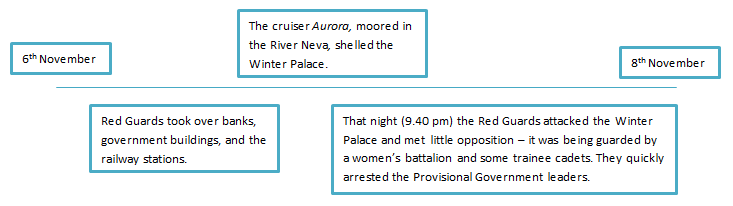
- ATook over bridges and telephone exchange
- B7th November
- C7th November (2)
- D7th November (3)
- ELenin announced new Communist Government
12What was the main difference between the Oct/Nov Revolution and the Feb/March Revolution?
- AThe time of year.
- BThe Bolshevik uprising was planned meticulously, however, the Feb/March revolution was a spontaneous event.
- CThe intentions of the revolters.
13The Bolsheviks described how the workers had supported the Bolsheviks in getting rid of the tyrants - first the Tsar then the Provisional Government.
- ATrue
- BFalse
14Lenin and Trotsky saw the importance of [blank_start]cinema[blank_end]. There were over 1000 cinemas in Russia in 1917, and a network of [blank_start]travelling[blank_end] cinemas who used the railway network. The propaganda films attracted large [blank_start]audiences[blank_end] who wanted to know what the new [blank_start]communist[blank_end] government was going to do. The most famous film, October, was by a Bolshevik film director in 1927 to mark the 10 year anniversary of the [blank_start]revolution[blank_end]. The takeover of the Winter Palace was transformed into a [blank_start]heroic[blank_end] struggle between the Bolsheviks and their [blank_start]enemies[blank_end] - the [blank_start]Storming[blank_end] of the Winter Palace.
- Acinema
- Btravelling
- Caudiences
- Dcommunist
- Erevolution
- Fheroic
- Genemies
- HStorming
15When the Bolsheviks seized control, most of Russia was not involved so a common reaction was that the Bolsheviks would soon be toppled from power.
- ATrue
- BFalse
16What did Lenin's decrees involve?
- A- calling on all governments involved in the First World War to open negotiations for peace
- B- confiscating land from the nobles
- C- banning the use of all titles
- D- introducing an 8hr day for industry
- E- disbanding local soviets
- F- taking food from the peasants
- G- commandeering education for all
- H- re-introducing censorship and banning all other political parties
17Who did the Red Guards become?
- AThe Cheka
- BThe Okrhana
- CThe Red Army
- DThe Czech Legion
18In [blank_start]January[blank_end] 19[blank_start]18[blank_end], elections took place for members to be elected to a [blank_start]Constituent[blank_end] Assembly. This assembly was supposed to decide how Russia would be [blank_start]governed[blank_end]. However, the Bolsheviks only won 1[blank_start]75[blank_end] out of 7[blank_start]07[blank_end] members, and Lenin knew that [blank_start]Bolshevik[blank_end] rule could not survive. After one day, the SR majority assembly was prevented from meeting at [blank_start]gunpoint[blank_end].
- AJanuary
- B18
- CConstituent
- Dgoverned
- E75
- F07
- GBolshevik
- Hgunpoint
19Why did Russia sign an armistice with Germany in December 1917?
- AThey hoped to delay peace treaties as they thought there might be a communist revolution in Germany.
- BThey had no soldiers left to fight.
- CThey were not worried about the terms of any peace treaties.
20How much of its population did Russia lose at the Treaty of Brest-Litovsk in March 1918?
- A26%
- B27%
- C74%
21How did the treaty worsen food shortages in Russia?
- AThe Ukraine, Russia's main source of grain, was lost.
- BThe Germans took food as reparations.
- CThe crippling reparations left no money for transport, meaning food could not be taken to the cities.
22The reasons the civil war broke out were:
- AThe communists had seized power suddenly and repressed elected governments.
- BThe people were worried about the extent of their power.
- CAnti-communist army officers were no longer fighting Germany and so they could now attack the communists.
- DThe communists wanted their ideals to spread worldwide. Many countries felt that they had to prevent this.
23Enemies of the Bolsheviks included:
- AOther revolutionary groups such as the SRs who had the support of the peasants.
- BThe Kadets (Constitutional Democrats) who wanted the return of the Constituent Assembly.
- CLandowners who wanted a return to the monarchy.
- DChurch leaders who wanted the recovery of confiscated lands.
- EForeign countries that wanted a government that would bring Russia back into the war, such as the USA, France and Britain.
- FVarious national groups who had won independence from the Russian Empire and wanted to guarantee it.
- GAll of the above!
24The amount of opposition groups meant that the Bolsheviks (the '[blank_start]Reds[blank_end]') were forced to fight a coalition of '[blank_start]Whites[blank_end]' led by former [blank_start]Tsarist[blank_end] Generals such as Denikin, Yudenich and Kolchak. The Romanovs provided many whites with a possible [blank_start]replacement[blank_end] for the Bolsheviks.
A complicating factor was the existence of the Czech [blank_start]Legion[blank_end] of 50,000 Czechs who had been fighting for Austria and had been captured by the Russians. Now, in 1918, they wanted to continue fighting in Europe against [blank_start]Germany[blank_end]. It had been agreed that they would be sent to France via the [blank_start]Trans-Siberian[blank_end] Railway and then by sea. However, when the Czechs were told by Trotsky to disarm, they seized [blank_start]control[blank_end] of the railway and began to head back towards [blank_start]Moscow[blank_end] to fight against the Bolsheviks.- AReds
- BWhites
- CTsarist
- Dreplacement
- ELegion
- FGermany
- GTrans-Siberian
- Hcontrol
- IMoscow
25Having no common aim weakened the Whites as they were all fighting for different things so felt no loyalty to one another.
- ATrue
- BFalse
26What was war communism?
- AThe attempt to spread communism through invading and conquering foreign countries.
- BThe economic and political system that existed in Soviet Russia during the Russian Civil War, from 1918 to 1921, where land and businesses were nationalised, surplus food surrendered to the government, and troops prioritized in order to win the Civil War.
27The kulaks (rich peasants) were angry at the policies of war communism so cut down the amount they produced so that there were less 'surplus' supplies to be requisitioned the next year.
- ATrue
- BFalse
Information
- Description
- GCSE History (Russia, 1914-1924) Quiz on Why were the Bolsheviks able to seize power? Quiz, created by Leah Firmstone on 14/11/2015.
- Author
- Leah Firmstone
- Language
- English
- Views
- 176
- Tags
- Rating
- 4.0 out of 5 · 3 ratings Rate this quiz