
Quiz
Krebs Cycle and other Fun Stuff
This quiz has question types that open in the usual player.
Questions in this quiz (5)
1Fill in your favorite thing about Biochemistry: points of regulation! Type all the molecules/processes that hinder progression to the next step on the left in the RED column, and type all the molecules/processes that encourage progression to the next step on the right in the GREEN column. Good luck! You'll need it.
Also, within each red and green column, column one is allosteric regulation by substrate, column two is any modifying enzyme, and column three is any active site regulation by substrate. The substrate priorities from top to bottom is smaller to larger molecules (i.e: ATP derivatives, NADH derivatives, and then larger molecules). The priorities from left to right within the enzyme regulation column is listed similarly. Don't put any substrates (like pyruvate under PDH) because you should know them by now :)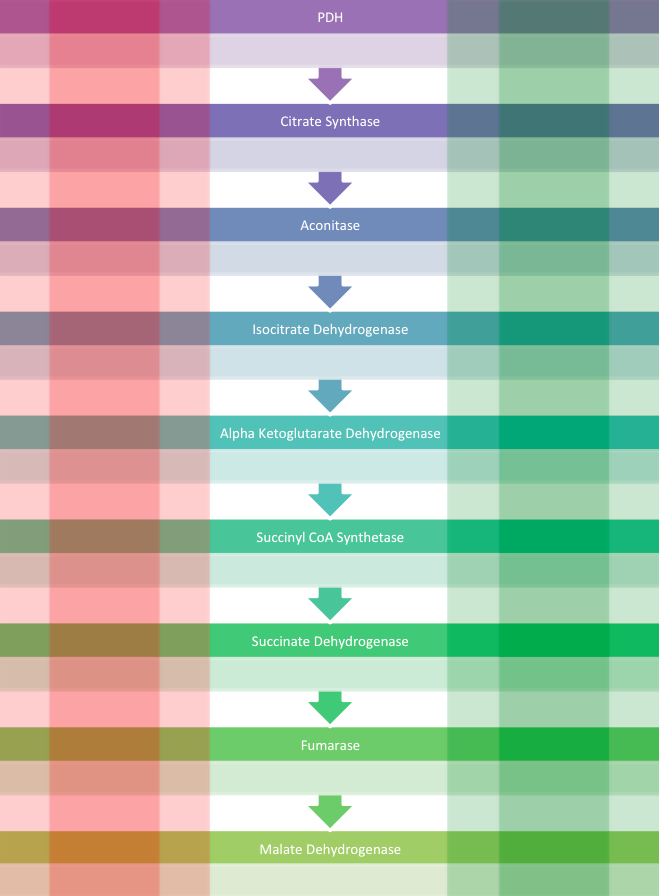
- APDH Phosphatase
- BPDH Kinase
- CCa2+
- DInsulin
- EATP
- FNADH
- GAcetyl CoA
- HNAD+
- INADH
- JAcetyl CoA
- KADP
- LH2O
- MADP
- NATP
- ONADH
- PATP
- QNADH
- RSuccinyl CoA
- SGDP
- TNAD+
- UNAD+
- VNAD+
- WH2O
- XFe-S
- YFAD
- ZFAD
2Follow the electron in the Light Reaction in Rhodopseudomonas!
Special Pigment Pair: [blank_start]P960[blank_end]
1st Electron Acceptor: [blank_start]Bacteriochlorophyll b[blank_end]
2nd Electron Acceptor: [blank_start]Bacteriopheophytin[blank_end] (this does not have an [blank_start]Mg[blank_end] cofactor)
Immobile [blank_start]Quinone A[blank_end] becomes a Semiquinone
Fully reduced QH2 ([blank_start]Quninone B[blank_end])
[blank_start]Cytochrome bc1 Complex[blank_end]: pumps [blank_start]2[blank_end] H+ into the Periplasm
Completes the Cycle: [blank_start]Cytochrome C[blank_end] (has a [blank_start]Heme[blank_end] group)
Its purpose is to neutralize the charge left behind in [blank_start]P960[blank_end] by photoinduced charge separation.- AP960
- BBacteriochlorophyll b
- CBacteriopheophytin
- DMg
- EQuinone A
- FQuinone B
- GCytochrome bc1 Complex
- H2
- ICytochrome C
- JHeme
- KP960
3Follow the electron in the light reaction of a plant!
[blank_start]Oxygen Evolving Complex[blank_end] (4 photons to oxidize 2 H2O, held by [blank_start]Mn4+[blank_end] clusters)
Special Pigment Pair: [blank_start]P680[blank_end] (PSII)
1st Electron Acceptor: [blank_start]Pheophytin[blank_end]
Immobile Quinone: [blank_start]Plastoquinone[blank_end] (can become QH2)
[blank_start]Cytochrome bf Complex[blank_end] (pumps 2H+ per photon)
1 Electron Carrier: [blank_start]Plastocyanin[blank_end] (soluble and faces thylakoid lumen, has reducible Cu2+)
Special Pigment Pair: [blank_start]P700[blank_end]
1st Electron Acceptor: [blank_start]Chlorophyll A0[blank_end]
Immobile Quinone [blank_start]A1[blank_end]
1 Electron Carrier: [blank_start]Ferredoxin[blank_end] (can also reduce [blank_start]Thioredoxin[blank_end], which activates [blank_start]Calvin Cycle[blank_end] enzymes)
[blank_start]Ferredoxin NADP Reductase[blank_end] (stepwise reduction of [blank_start]FAD[blank_end] to [blank_start]FADH2[blank_end] 1 electron at a time)
Converts [blank_start]NADP+[blank_end] to [blank_start]NADPH[blank_end] per 2 electrons
Notes:
If no [blank_start]NADP+[blank_end] is available, the electrons can go from [blank_start]Ferredoxin[blank_end] to the [blank_start]Cytochrome bf Complex[blank_end] (pumps 2H+ per photon).
The net charge between the stroma and thylakoid lumen is balanced by [blank_start]Mg2+[blank_end] ions, which flow [blank_start]out[blank_end] as H+ flows [blank_start]in[blank_end].- AOxygen Evolving Complex
- BMn4+
- CP680
- DPheophytin
- EPlastoquinone
- FCytochrome bf Complex
- GPlastocyanin
- HP700
- IChlorophyll A0
- JThioredoxin
- KCalvin Cycle
- LFerredoxin
- MA1
- NFerredoxin NADP Reductase
- OFAD
- PFADH2
- QNADP+
- RNADPH
- SNADP+
- TFerredoxin
- UCytochrome bf Complex
- VMg2+
- Wout
- Xin
4Let's start off this final with a bang! Fill in the blanks for what happens at the start of each important process.
[blank_start]Calvin Cycle[blank_end]:
[blank_start]Rubisco[blank_end] first [blank_start]dehydrogenates[blank_end] Ru-1,5BP. It follows this up with a [blank_start]carboxylation[blank_end] reaction. Then, the resulting unstable 6 carbon compound is [blank_start]hydrolyzed[blank_end] into [blank_start]3-Phosphoglycerate[blank_end]. This 3 carbon molecule is built into hexose using first [blank_start]ATP[blank_end] then [blank_start]NADPH[blank_end].
[blank_start]Pentose Phosphate Pathway[blank_end]:
[blank_start]Glycerol 6-Phosphate[blank_end] first gets [blank_start]dehydrogenated[blank_end], producing [blank_start]NADPH[blank_end]. Then, the lactone gets opened. The product gets [blank_start]dehydrogenated[blank_end] again, producing [blank_start]NADPH[blank_end] and [blank_start]CO2[blank_end]. This 5 carbon ketose is turned into a different 5 carbon ketose or a 5 carbon aldose by [blank_start]Phosphopentose Isomerase[blank_end] or [blank_start]Phosphopentose Epimerase[blank_end], respectively.
[blank_start]Beta-Keto Oxidation[blank_end]:
[blank_start]Acyl CoA Synthetase[blank_end] attaches a [blank_start]CoA[blank_end] group onto the fatty acid chain. This requires [blank_start]2[blank_end] ATP because AMP is the byproduct. The molecule then must be associated with [blank_start]Carnitine[blank_end], which utilizes a [blank_start]translocase[blank_end] to dump the molecule into the [blank_start]Mitochondria[blank_end].- Adehydrogenates
- Bcarboxylation
- CRubisco
- Dhydrolyzed
- EATP
- FNADPH
- GCalvin Cycle
- HPentose Phosphate Pathway
- IGlucose 6-Phosphate
- Jdehydrogenated
- KNADPH
- Ldehydrogenated
- MNADPH
- NCO2
- OPhosphopentose Epimerase
- PPhosphopentose Isomerase
- QBeta-Keto Oxidation
- RAcyl CoA Synthetase
- SCoA
- T2
- UCarnitine
- Vtranslocase
- WMitochondria
- X3-Phosphoglycerate
5[blank_start]Pyruvate[blank_end] first gets converted by [blank_start]PDH[blank_end] into [blank_start]Acetyl CoA[blank_end], leaving behind a [blank_start]CO2[blank_end] and generating [blank_start]NADH[blank_end]. Recall, our 3 carbon sugar comes in as a pair from [blank_start]glycolysis[blank_end]. Then, [blank_start]Acetyl CoA[blank_end] combines with [blank_start]Oxaloacetate[blank_end] (which is the first to bind due to [blank_start]ordered kinetics[blank_end]) to form [blank_start]Citroyl CoA[blank_end] which is held firm by [blank_start]Citrate Synthase[blank_end]. What drives the 6 carbon sugar to formation is the [blank_start]Thioester[blank_end] bond. Several [blank_start]Histidine[blank_end] and [blank_start]Aspartic[blank_end] Acid residues assist in activating each species for [blank_start]Enol[blank_end] attack. Only when [blank_start]Citroyl CoA[blank_end] is produced, [blank_start]Hydrolysis[blank_end] occurs, and [blank_start]Citrate[blank_end] leaves. [blank_start]Aconitase[blank_end] converts that into [blank_start]Isocitrate[blank_end] via a [blank_start]Dehydration[blank_end] and [blank_start]Hydration[blank_end] reaction. Several [blank_start]Fe-S[blank_end] prosthetic groups are used to attract the carboxylate groups for the catalyzation. [blank_start]Isocitrate Dehydrogenase[blank_end] then produces [blank_start]Alpha-Ketoglutarate[blank_end], and [blank_start]NADH[blank_end] first is generated then [blank_start]CO2[blank_end] falls off. [blank_start]Alpha-Ketoglutarate Dehydrogenase[blank_end] follows up this transformation with another [blank_start]CO2[blank_end] and [blank_start]NADH[blank_end] production, very similar to PDH's mechanism, and creating [blank_start]Succinyl CoA[blank_end]. We still have the [blank_start]2[blank_end] carbons from Acetyl CoA. [blank_start]Succinyl CoA Synthetase[blank_end] forms [blank_start]Succinate[blank_end] using a [blank_start]Phosphate[blank_end] from solution to displace the CoA. This [blank_start]Phosphate[blank_end] is then grabbed by a [blank_start]Histidine[blank_end] residue and transferred to a waiting [blank_start]GDP[blank_end] group. Then, [blank_start]Succinate Dehydrogenase[blank_end], located on the Mitochondrial [blank_start]Inner[blank_end] Membrane, facilitates in the oxidation reaction for generation of [blank_start]Fumarate[blank_end]. In the process, [blank_start]FADH2[blank_end] is produced. [blank_start]Fumarase[blank_end] is the enzyme that produces [blank_start]Malate[blank_end], utilizing a [blank_start]Hydration[blank_end] reaction, which then can be converted back into [blank_start]Oxaloacetate[blank_end] by [blank_start]Malate Dehydrogenase[blank_end], producing [blank_start]NADH[blank_end], which is the only reaction that has a [blank_start]Positive[blank_end] Delta G value. The disappearance of [blank_start]Oxaloacetate[blank_end] is the driving force for the reaction.
- APyruvate
- BPDH
- CAcetyl CoA
- DCO2
- ENADH
- Fglycolysis
- GAcetyl CoA
- HOxaloacetate
- Iordered kinetics
- JCitroyl CoA
- KCitrate Synthase
- LThioester
- MHistidine
- NAspartic
- OEnol
- PCitroyl CoA
- QHydrolysis
- RCitrate
- SAconitase
- TIsocitrate
- UDehydration
- VHydration
- WFe-S
- XIsocitrate Dehydrogenase
- YAlpha-Ketoglutarate
- ZNADH
- AACO2
- ABAlpha-Ketoglutarate Dehydrogenase
- ACCO2
- ADNADH
- AESuccinyl CoA
- AF2
- AGSuccinyl CoA Synthetase
- AHSuccinate
- AIPhosphate
- AJPhosphate
- AKHistidine
- ALGDP
- AMSuccinate Dehydrogenase
- ANInner
- AOFumarate
- APFADH2
- AQFumarase
- ARMalate
- ASHydration
- ATOxaloacetate
- AUMalate Dehydrogenase
- AVNADH
- AWPositive
- AXOxaloacetate
Information
- Description
- Quiz on Krebs Cycle and other Fun Stuff, created by Sean Lim on 02/05/2016.
- Author
- Sean Lim
- Language
- English
- Views
- 93
- Tags
- Rating
- No ratings yet Rate this quiz