
Quiz
DNA and RNA
This quiz has question types that open in the usual player.
Questions in this quiz (13)
1During which phase of the cell cycle does nuclear DNA replicate?
- AS phase
- BG1 phase
- CG2 phase
- DMitosis
2The first stage of DNA replication is [blank_start]unwinding[blank_end] of DNA, which is aided by the enzyme [blank_start]gyrase[blank_end]. Next, the two strands are [blank_start]unzipped[blank_end], thanks to an enzyme called DNA [blank_start]helicase[blank_end], which breaks the [blank_start]hydrogen[blank_end] bonds holding the bases together. Then, new strands of DNA are synthesised by an enzyme called [blank_start]DNA[blank_end] [blank_start]polymerase[blank_end]. In this stage, free nucleotides are joined to their complementary bases and each other by forming h[blank_start]ydrogen[blank_end] bonds and p[blank_start]hosphodiester[blank_end] bonds. They're added in the [blank_start]5[blank_end]' to [blank_start]3[blank_end]' direction.
- Aunwinding
- Bgyrase
- Cunzipped
- Dhelicase
- Ehydrogen
- FDNA
- Gpolymerase
- Hydrogen
- Ihosphodiester
- J5
- K3
3DNA replication is said to be s[blank_start]emi[blank_end] c[blank_start]onservative[blank_end].
- Aemi
- Bonservative
4Which of the following statements is true about mutations?
- AMutations arise when there's an error when matching complementary bases.
- BMutations occur when there's an evolutionary need for a new adaptation.
- CMutations are always harmful to the organism.
- DMutations can always be seen in the phenotype of the organism.
5The region of a molecule which is complementary to its substrate is called the [blank_start]active[blank_end] [blank_start]site[blank_end].
- Aactive
- Bsite
6The sequence of nucleotide bases in DNA dictates the primary structure of proteins.
- ATrue
- BFalse
7DNA is read three bases at a time, these are called [blank_start]triplets[blank_end].
DNA is found in nearly all living organisms, so it is [blank_start]universal[blank_end].
There are often several ways of coding for one amino acid, so DNA is [blank_start]degenerate[blank_end].
DNA bases are read one after the other, so it is [blank_start]non-overlapping[blank_end].- Atriplets
- Bamino acids
- CmRNA
- Dtrios
- Euniversal
- Fdegenerate
- Gnon-overlapping
- Hunique
- Idegenerate
- Joverlapping
- Kuniversal
- Lstored in nucleosomes
- Mnon-overlapping
- Ndegenerate
- Ocalled a codon
- Puniversal
8[blank_start]Transcription[blank_end] is the process of RNA being created according to a region of DNA (catalysed by [blank_start]RNA[blank_end] [blank_start]polymerase[blank_end]), whereas [blank_start]translation[blank_end] is the process of joining amino acids together according to the sequence of bases on a strand of RNA.
- ATranscription
- BRNA
- Cpolymerase
- Dtranslation
9RNA is double-stranded.
- ATrue
- BFalse
10rRNA stands for [blank_start]ribosomal[blank_end] RNA, while tRNA stands for [blank_start]transfer[blank_end] RNA. Both are formed in the [blank_start]nucleus[blank_end] and exit through nuclear [blank_start]pores[blank_end], but rRNA is s[blank_start]tructural[blank_end] and tRNA is f[blank_start]unctional[blank_end].
- Aribosomal
- Btransfer
- Cnucleus
- Dpores
- Etructural
- Functional
11Label this tRNA molecule.
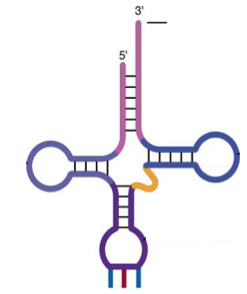
- AAmino acid attachment site
- BTriplet
- CAmino acid
- DHydrogen bonds
- EAnti-codon
- FAmino acid attachment site
- GAmino acid
- HCodon
12Three bases on an mRNA molecule require a specific [blank_start]amino acid[blank_end]. The [blank_start]anticodon[blank_end] on a tRNA molecule is matched to a [blank_start]triplet[blank_end] on an mRNA molecule. Also, tRNA molecules with a specific [blank_start]anticodon[blank_end] will have a specific [blank_start]amino acid attachment site[blank_end], and therefore binds a specific [blank_start]amino acid[blank_end].
- Aamino acid
- Bmetabolism
- Ctranscription
- Dtranslation
- Eanticodon
- Ftriplet
- Gamino acid binding site
- Hloop
- Itriplet
- Jamino acid binding site
- KtRNA molecule
- Lbase
- Manticodon
- Ntranscription
- Otranslation
- Parrangement
- Qamino acid attachment site
- Rtriplet
- Scodon
- Thydrogen bonding arrangement
- Uamino acid
- VmRNA molecule
- Wribosome
- X80s ribosome sub-segment
13The role of chaperone proteins is to...
- AAid in folding polypeptides
- BAid in transcription in the nucleus
- CDegrade mRNA after translation
- DModulate membrane potential
Information
- Description
- Biology (Nucleotides and Nucleic Acids) Quiz on DNA and RNA, created by Daniel Brand on 24/02/2017.
- Author
- Daniel Brand
- Language
- English
- Views
- 3,910
- Tags
- Rating
- No ratings yet Rate this quiz