
Globalization
Slides in this set (9)
-
-
- Globalization is the process by which the world is
- becoming increasingly interconnected as a result of massively increased
- trade and cultural exchange. Globalization has increased the production
- of goods and services. The biggest companies are no longer national
- firms but multinational corporations (MNCs) with subsidiaries in many
- countries.
- Globalisation has been taking place for hundreds of years, but has
- speeded up enormously over the last half-century. Although globalisation
- is probably helping to create more wealth in developing countries, it
- is not helping to close the gap between the world’s poorest countries
- and the world’s richest.
- Short: Globalisation is the worldwide movement toward economic, financial, trade, and communications integration.
-
- Globalization 1.0 (1492-1800)
- Physical power of countries and governments
- Countries struggle for colonies
- Imperialism
- World "shrank" from large to medium
- Globalization 2.0 (1800-2000)
- Multinational companies, global markets
- Companies struggle for success/profit
- Industrialization, falling costs
- expansion; steam engine & railroad
- world shrank from medium to small
- Globalization 3.0 (2000 until now)
- personal computer; workflow software, fibre optic cable
- more opportunities to work
- world went from small to tiny
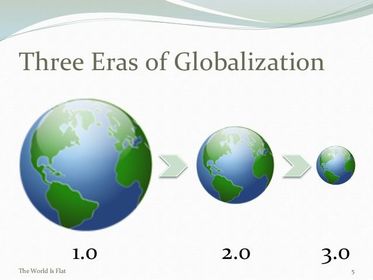
- Caption: The world becomes smaller due to higher interconnection
-
Opportunities, dangers and fears
- Developing countries:
- hope to get work and prosperity
- new jobs are available and access to world market
- many people still suffer from malnutrition or die of diseases
- increasing independence on foreign support, credits and investment
- unfair/inhumane working conditions
- dependency on developed countries
- Industrial world/Economy:
- exports improve economy (international/free trade)
- wide range of products/food at any time
- growing prosperity for producers
- countries can help each other Industrial world/Economy:
- people in industrial countries lose jobs
- financial crisis in one country can affect others as well (global crisis)
- Politics
- spread of freedom, democracy & human rights
- reduction of wars and conflicts worldwide
- peaceful, borderless world of shared universal values, ecological stability Politics:
- massive illegal immigration
- danger of increasing corrupt governments
- increasing of power of global players (loss of control)
- international affairs more important than national
- clash between political systems
-
Opportunities, dangers and fears
- Culture:
- greater understanding & tolerance
- spread of traditions and culture
- clash of cultures
- regional and ethnic tensions (racism)
- fear that individual cultures will blend into a single global culture (loss of cultural diversity)
- Environment:
- pollution
- higher co2 emissions
- global warming
- For humankind in general:
- fast/better communication and exchange
- technological progress
- easier travelling, wider range of products
- international cooperation to solve problems (global challenges)
- wider gap between rich and poor
- diseases can easily spread all around the globe (pandemia) (example: Ebola)
-
- Inward investment by big global companys (MNCs) helps countries by providing new jobs and skills for local people.
- MNCs bring wealth and foreign currency to local economies when they
- buy local resources, products and services. The extra money created by
- this investment can be spent on education, health and infrastructure.
- The sharing of ideas, experiences and lifestyles of people and
- cultures. People can experience foods and other products not previously
- available in their countries.
- Globalisation increases awareness of ecents in faraway parts of the
- world. For example, the UK was quickly made aware of 2004 tsunami tidal
- wave and sent help rapidly in response.
- Globalisation may help to make people more aware of global ussues
- such as deforestation and global warming – and alert them to need for
- sustainable development.
-
- Globalisation operates mostly in the interests of the richest
- countries, which continue to dominate the world trade at the expense of
- developing countries. The role of LEDCs (less economically developed
- country [„third world country“] ) in the world market is mostly to
- provide the North and West with cheap labour and raw materials.
- Transnational companies (TNC), with their massive
- economies of scale, may ruin local companies. If it
- becomes cheaper to operate in another country, the TNC might close down
- the factory and make local people redundant.
- An absence of strictly enforced international laws means that MNCs
- may operate in LEDCs in a way that would not be allowed in for example a European country. They
- may pollute the environment, run risks with safety or impose poor
- working conditions and low wages on local workers.
- Globalisation is viewed by many as a threat to the world’s
- cultural diversity. It is feared it might drown out local economies,
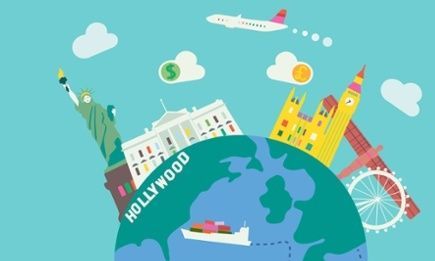
- traditions and languages. An example of this is that Hollywood
- film is far more likely to be successful worldwide than one made in
- India or China.
- Industry may begin to thrive in LEDCs at the expense of jobs in manufacturing in the UK and other MEDCs, especially in textiles
-
- Eras of Globalization
- Economy, Technology, Culture - Globalization / Abitur Englisch
- Pros and Cons of Globalization
- https://www.youtube.com/watch?v=JJ0nFD19eT8 (Embed)
- Caption: Get an overview with this video
Information
- Description
- Bereite dich auf das Englischabitur vor
- Created by
- Laura Overhoff
- Views
- 2,762
- Tags
- Rating