
Electronic Structure
Slides in this set (7)
-
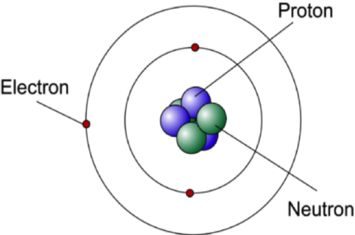
- The GCSE model used to explain electron structure (2,8,8 etc) is called the Bohr model. This predicted that atoms and ions with noble gas structure should be stable.
-
- In A level, new information includes;
- electrons are arranged into energy levels numbered 1, 2, 3, 4 etc. 1 is closest to the nucleus
- these are split into sub energy levels labelled s, p, d and f: s holds up to 2 electrons, p up to 6, d up to 10 and f up to 14
- these are split into orbitals which hold up to two electrons of opposite spin
- Principle level: 1 2 3 4
- Sub level: 1s 2s, 2p 3s, 3p, 3d 4s, 4p, 4d, 4f
- An atom fills up its sub shells in order of increasing energy (note 3d has greater energy than 4s and so gets filled after the 4s)
- 1s-->2s-->2p-->3s-->3p-->4s-->3d-->4p-->5s-->4d-->5p
-
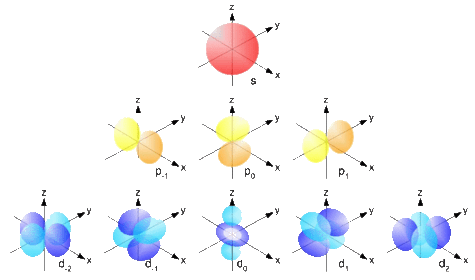
- Each orbital has its own approximate 3D shape, unique from the others. This does not represent a physical concept, just the probability of finding an electron at any point within certain spatial distributions around the nucleus. Therefore it is impossible to accurately draw orbitals precisely as they are an approximation of an idea.
- S orbitals are spherical
- P orbitals are shaped like dumbbells
- D orbitals are shaped like clover leaves
-
- One of the main ways of writing electron structure is using letters and numbers to represent the number of electrons in each orbital. S, p, d and f orbitals have been mentioned on previous slides; this notation is where they are used.
- Example:
- gallium = 1s2, 2s2, 2p6, 3s2, 3p6, 4s2, 3d10, 4p1
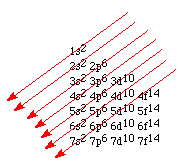
- The first numbers denote which energy level the orbital is in(1, 2, 3, 4). The letter states what type of orbital is present (s, p, d) and the final number tells us how many electrons are contained in that orbital. S orbitals can contain a maximum of two electrons, p six and d ten. The order in which they are written relies on the Aufbau principle, which states that electrons will fill the s orbitals of an energy level first before moving on to p and d ones. The diagram (left) shows the order in which orbitals are filled.
- NB - the notation is usually without commas but as I cannot put the second numbers in superscript I thought it would be less confusing.
-
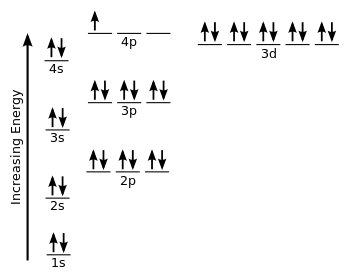
- Another way of writing electronic configurations is using an orbital diagram. Left is the orbital diagram from gallium. It is basically a visual representation of the information written on the previous slide. Here each arrow represents a single electron and each under-line represents an orbital. The arrows going in opposite directions represent the different spins of the electrons within the orbitals. Remember when yo are filling up sub-levels to fill each orbital with a single electron before pairing them up. This will be extremely useful for future topics!
- It is worth noting that the 4s orbital is filled before the 3d orbital in most cases because it takes slightly less energy to fill. However there are two exceptions: copper and chromium.
-
Finding orbitals on the Periodic Table
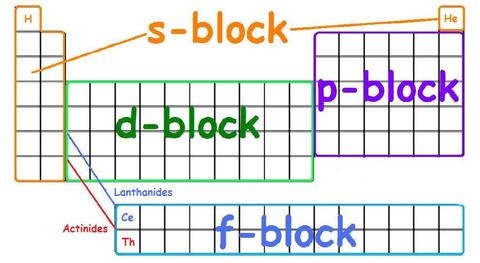
- Caption: The periodic table is split into electron blocks. A p-block element is one whose outer electron is in a p sub-shell.
-
- When a positive ion is formed electrons are lost:
- Mg = 1s2, 2s2, 2p6, 3s2
- Mg2+ = 1s2, 2s2, 2p6
- When a negative ion is formed electrons are gained:
- O = 1s2, 2s2, 2p4
- O2- = 1s2, 2s2, 2p6
Information
- Description
- Chemistry (Atomic Structure and The Periodic Table) Slide Set on Electronic Structure, created by Kirsten Rowland on 03/01/2017.
- Created by
- Kirsten Rowland
- Views
- 0
- Rating