
Flashcards
Biology -B2
Cards in this deck (44)
- 1Biology - B24 Constituents of blood: Red blood cells, white blood cells, platelets and plasma.
- 2Cell -> Tissue -> Organ -> Organ system -> OrganismInside of the heart is divided into two sections so that the two types of blood (oxygenated and deoxygenated) are kept apart.
- 3How does the blood clot at/to form an open wound?Fibrinogin forms a web (scab) when exposed to air to protect the cut to protect the red blood cells from escaping.
- 4How is oxygen transported?Using red blood cells and as oxyhaemaglobin.
- 5Name some parts of the heartAorta, atrium, pulmonary artery, pulmonary vein, septum, valve, ventricle, vena cava.
- 6What are platelets?Tiny cells that stop your blood clotting. If your platelet level is low then your blood could very easily clot an you could have a heart attack etc.
- 7What is double circulation?Blood goes through the heart twice each time and goes round the body.
- 8Arteries carry blood away from the heart. Veins carry blood towards the heart. blood vessel carries blood.Capillaries are the smallest blood vessel that go between arteries and veins, delivering blood to the cells.
- 9Respiration is a chemical reaction, breathing is just air going in and out.Glucose + Oxygen -> Water + Carbon Dioxide (+energy)
- 10What part of the cell does respiration occur?The mitochondria.
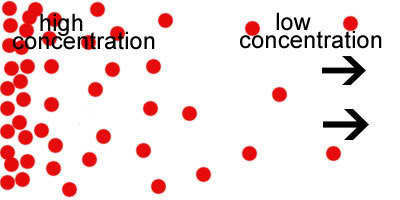
- 11What is diffusion?The net movement of particles from a region of their high concentration to a region of their lower concentration.
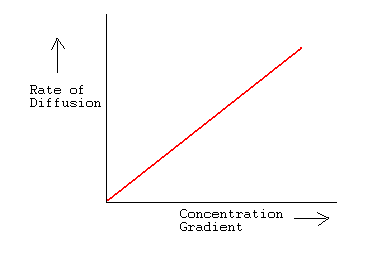
- 12The steeper the concentration gradient the rate increases, therefore diffusion happens quicker.
- 13What is osmosis?The net movement of water molecules from an area of high water concentration to an area of lower water concentration through a partially permeable membrane.
- 14How do glucose and oxygen reach the cells?They diffuse from the cappilaries
- 15Why does exercise increase the heart rate?Exercise increases the heart rate as it has to pump/circulate oxygenated blood harder/quicker around the body, so the oxygenated blood can reach the muscles faster and there is more glucose produced faster. Also you are able to release more carbon dioxide.
- 16Where does photosynthesis happen?In the chloroplast, which contains chlorophyll.
- 17How are the chloroplasts (containing chlorophyll) and the stoma adaptations that help the plant to photosynthesise?Stoma have more holes to allow more gas to diffuse through and out of the leaf or plant. chlorophyll in chloroplasts captures light energy needed for photosynthesis.
- 18How is a root cell adapted to its function?A root hair cell is adapted to its function as it has a long thin structure which means it has a large surface area. a larger surface area means it can pick up/collect more water.
- 19What is a limiting factor?In any process that is affected by several factors, the maximum rate at which the process can occur is controlled by the factor that is in shortest supply. That factor is the limiting factor.
- 20What is an example of a limiting factor?Carbon dioxide concentration, water supply, light intensity, temperature.
- 21What is a potomiter?A potomiter is a piece of apparatus that helps to study the rate of water absorption in a plant, form the roots to the leaves, being pulled by evaporation.
- 22What is active transport?The movement of a substance against a concentration gradient, across a cell membrane.
- 23What is active transport?The movement of substances across a concentration gradient, across a cell membrane, using energy.
- 24What is a xylem vessel?The hollow tube in a plant that transports water and minerals up from the roots (against gravity). It does not use any energy to do this.
- 25What is a phloem vessel?The tube in a plant where food flows, the food can flow both ways (2-way flow).
- 26How do mineral salts get from the soil to the leaves of the plant?Using the xylem vessel and active transport, which requires energy.
- 27Diffusion is how oxygen leaves a leaf.Osmosis involves water only and is how a plant stays turgid.
- 28Active transport goes against a concentration gradient, requires energy and is how minerals get into root hair cells.Osmosis and active transport need a permeable membrane.
- 29Osmosis and diffusion is passive and goes from a high to a low concentration.Diffusion and active transport involves the transport of a solute.
- 30How many chromosomes are there in a normal human cell?23 pairs
- 31Chromosomes consists of long, coiled molecules of DNA. A gene is a section of DNA, which codes for a particular protein. A DNA molecule consists of 2 strands, which are coiled to form a double helix.The strands are linked by complimentary bases: Adenine (A), thymine (T), guanine (G) and cytosine (C).
Adenine is only ever linked to thymine: A-T
Cytosine is only ever linked to guanine: C-G - 32What is genetic engineering?It is removing a gene from one organism and inserting it into another. Genes can be inserted into animals, plants and microorganisms. If genes from one species are inserted into another they are called transgenic animals.
- 33What is a diploid cell?A cell that contains two copies (pairs) of each chromosomes e.g. a fertilized egg.
- 34What is a haploid cell?it is a cell that contains just one copy of chromosomes e.g.a sperm or egg cell.
- 35What happens in meiosis?A diploid cell divides twice to produce 4 haploid daughter cells that contain half the number of chromosomes. A diploid chromosome contains 2 sets of chromosomes, a haploid cell one set.
- 36What are enzymes?Enzymes are biological catalysis, which control the rate of chemical reactions that occur in living organisms.
- 37Enzymes are found in many parts of the body and act on substances called substrates.When enzymes are exposed to high temperatures or extreme pH they become denatured. This means that they are irreversibly damaged and no longer function. Denaturing means that the active site is damaged so the substrate no longer fits into the enzyme and the substrate cannot be broken down. (Lock and key hypothesis)
- 38What factors can affect enzyme action?Temperature, pH level
- 39Aerobic respiration: Blood transports oxygen and food in the form glucose to the body's cells. Special enzymes in the cells cause the glucose and oxygen to react, and energy is released.Glucose + Oxygen -> Energy + Water
Carbon dioxide - 40Anaerobic respiration: During vigorous exercise the lungs and blood cannot always deliver enough oxygen to the muscle cells to respire the available glucose aerobically and meet their energy requirements. When this happens the glucose can only be partly broken down, releasing a much smaller amount of energy.Anaerobic respiration produces a little bit of energy very quickly, but most of the glucose is changed to lactic acid, a waste product.
Glucose -> Energy
->Lactic Acid - 41Why do plants have broad, thin, flat leaves?Because they are full of air spaces which creates a large surface area and makes them efficient for photosynthesizing. They are filled with lots of palisade cells, which contain lots of chloroplasts (these contain chlorophyll which absorb light for photosynthesis).
- 42What is the word equation for photosynthesis?Light
Carbon dioxide+Water------>Glucose+Oxygen
Chlorophyll - 43What are the factors that affect photosynthesis?Temperature, carbon dioxide concentration and light intensity.
- 44Name one type of growthCell division: The process in which 2 cells are formed from one e.g. mitosis.
Cell elongation: The process in which cells, mainly in plants, elongate (stretch out). The actual cells get bigger, rather than reproduce.
Cell differentiation: The process through which an undifferentiated (unspecialised) cell can become a specific type of cell.
Information
- Description
- Biology B2 Additional (Triple) Science
- Created by
- HeidiCrosbie
- Views
- 1,540
- Tags
- Rating