
Flashcards
IB ESS Topic 1
Cards in this deck (46)
- 1Gaia hypothesisOur planet as a single living organism that self - regulates into a preferred homeostasis
- 2SustainabilityThe use and management of resources that allows full natural replacement of resources exploited and full recovery of ecosystems affected by extraction and use
- 3Environmental value system (EVS)A worldview or paradigm that shapes the way an individual or group of people perceive and evaluate environmental issues. It is influenced by cultural, religious, economic and political context.
- 4SocietyGroup of individuals who share common characteristics e.x. geographical location, historical time frame, culture, religion
- 5TechnocentricTechnological developments can provide solutions to environmental problems
A very positive view of the impact of humans (cornucopian view) - 6EcocentricPuts ecology and nature as central to humanity and emphasizes a less materialistic approach, bio-rights, education, self-restraint and a self-sufficient society
- 7AnthropocentricHumans must sustainably manage the global system through taxes, regulation and registration
- 8Deep ecologistPuts more value on nature than on humans
- 9Intrinsic valueSomething that has value in its own right
- 10HolisticA system studied as a whole
- 11SystemAn assemblage of parts and the relationships between them, which together constitute an entity or whole
- 12Systems approachA way of visualising a complex set of interactions which may be ecological or societal
- 13EcosystemA community of interdependent organisms and the physical environment they inhabit
- 14BiomesA collection of ecosystems sharing similar climatic conditions
e.x. tundra, desert, grassland, tropical rainforest, groves - 15BiosphereRefers to the part of the earth inhabited by organisms
- 16Open systemEnergy and matter exchanged with surroundings
e.x. people - 17Closed systemEnergy but not matter exchanged with surroundings
e.x. atoms and molecules - 18Isolated systemNo energy or matter can be exchanged.
As far as we know they don't exist but the universe may be one - 19ModelsSimplified description designed to show structure or workings of an object, system or concept
- 20First law of thermodynamicsConservation of energy; energy can be neither created nor destroyed, it can only change forms
- 21Second law of thermodynamicsEnergy is lost from systems when work is done, bringing about disorder (entropy) - the 10% rule
- 22EntropyA measure of the amount of disorder in a system. An increase in entropy reduces the energy available for work
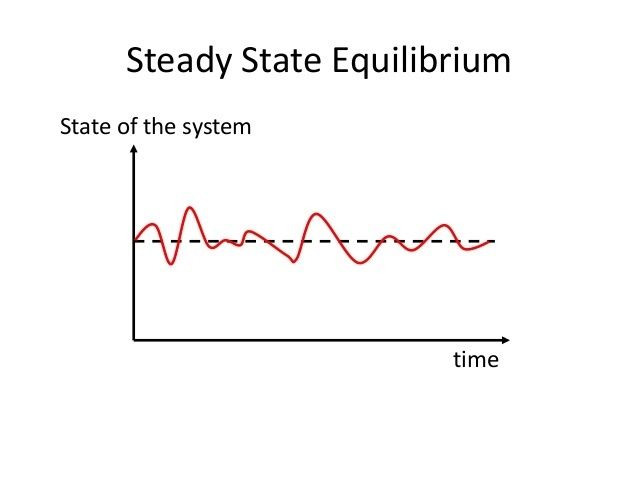
- 23Steady-state equilibriumIn an open system, there are no long-term changes only oscillations in the short-term
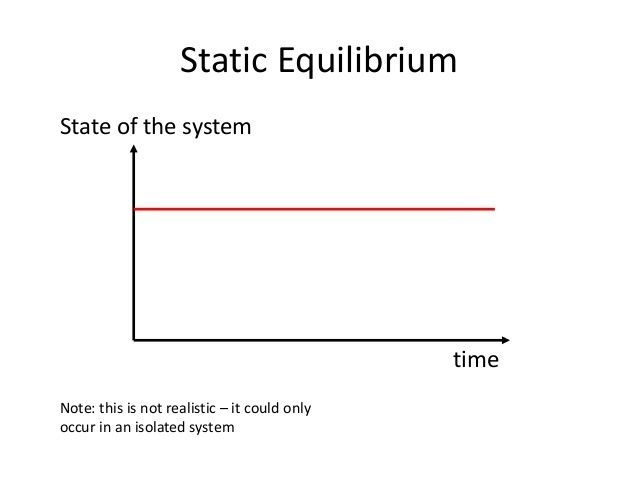
- 24Static equilibriumNo inputs or outputs, no change over time
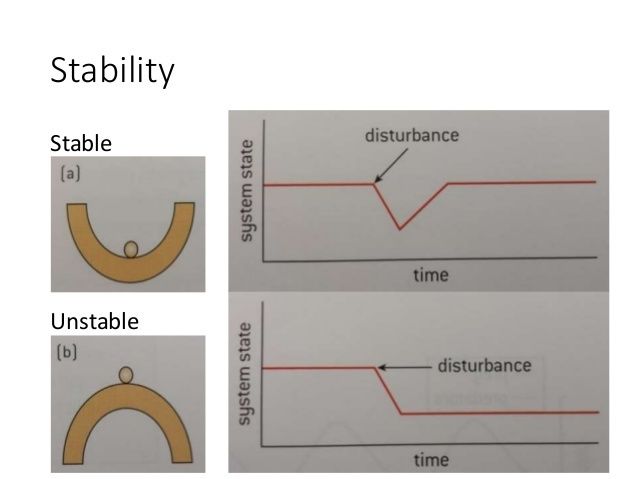
- 25Stable and unstable equilibrium
- 26Positive feedbackWhen change in the state of the equilibrium leads to an increased (negative) change, brings original equilibrium to instability
e.x. ice melting in the tundra - 27Negative feedbackFeedback counteracts with deviation from equilibrium and promotes stability
e.x. CO2 increases photosynthesis, more plants reduce CO2 - 28AlbedoReflection from the earth's surface - darker surfaces absorb more heat while lighter surfaces reflect it
- 29Tipping pointThe minimum amount of change within a system that will destabilize it
- 30Natural incomeThe yield (amount) obtained from natural resources / The portion of natural capital produced as interest
- 31Sustainable developmentMeeting the needs of the present without compromising the ability of future generations to meet their own needs (economic, social and environmental)
- 32Millenium ecosystem assessment (MIA)Specific appraisal of condition and trends in the world's ecosystem
- 33Millenium development goals1. Eradicate extreme hunger and poverty
2. Universal primary education
3. Gender equality and female empowerment
4. Reduce child mortality
5. Improve maternal health conditions
6. Combat HIV/AIDS, Malaria and others
7. Ensure environmental sustainability
8. Global partnership for development - 34Environmental impact assessment (EIA)Provide decision makers with information to consider the impact of a project
- 35Ecological footprintHypothetical area or land required by a society, group or individual to fulfil all their resource needs
- 36PollutionSubstances or energy produced by human activity that has a detrimental effect on organisms
- 37Point-source pollutionCan be tracked/identified
e.x. Chernobyl - 38Non-point source pollutionDispersed source, not easily identifiable
e.x. vehicles - 39Primary pollutionActive upon emission
e.x. Burning fossil fuels --> release CO2 - 40Secondary pollutionPrimary pollution that has undergone a chemical change, not active upon emission
- 41Acute pollutantsOccurs suddenly and unexpectedly, worst case scenario
e.x. oil spills - 42Persistent pollutantsCan not be broken down by living organisms
- 43Biodegradable pollutantsBroken down by biological processes
- 44DDTSynthetic pesticide, very useful for its purpose but harmful for humans and animals
- 45BioaccumulationBuild-up of persistent pollutants within an organism
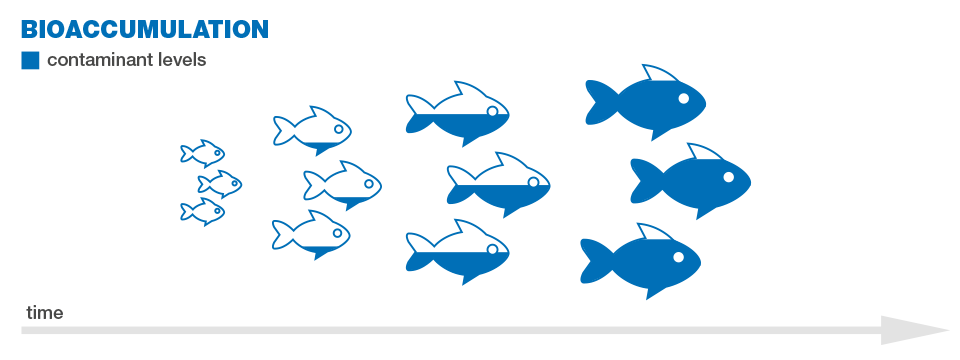
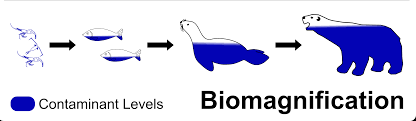
- 46BiomagnificationIncrease in the concentration of persistent/non-biodegradable pollutants along a food chain or across each trophic level
Information
- Description
- International Baccalaureate Environmental Studies (Topic flashcards) Flashcards on IB ESS Topic 1, created by Pilar Amusategui on 16/04/2019.
- Created by
- Pilar Amusategui · Apr 2019
- Updated
- Apr 16, 2019
- Views
- 13
- Rating