
Flashcards
C4 - The Periodic Table

Cards in this deck (21)
- 1How did John Dalton describe atoms?As solid spheres
- 2What did J J Thomson concluded from his measurements of charge and mass of atoms?That an atom must contain negatively charged particles
- 3What was J J Thomson's model known as?Plum Pudding model
- 4What theory did Rutherford come up with?The nuclear atom
The atom has a nucleus surrounded by a cloud of negatively charged electrons - 5How did Bohr's Model add to the theory of an atom's structure?Included the idea that an atom was surrounded by 'shells' of electrons rather than a 'cloud' of electrons
- 6What does the nucleus contain?Protons and neutrons
- 7What charge does the nucleus have?Positive
- 8Where is almost the whole mass of the atom held?In the nucleus
- 9What charge do electrons have?Negative
- 10What is the mass of an atom?
- 11What is the radius of an atom

- 12Fill in the blanks
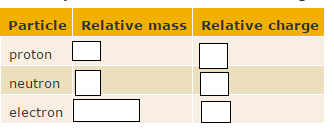
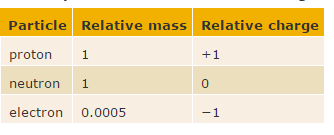
- 13Why do neutral atoms have no charge?They have an equal number of protons and electrons
- 14What is the mass number?Total number of protons and neutrons
- 15What is the atomic number?The number of protons
- 16What does a new period show in the periodic table?Another full shell of electrons
- 17How do the group numbers relate to the number of electrons on the outer shell of the atom?They are the same
e.g. group 1 atoms have 1 electron on their outer shell - 18Why is an atom described as stable if it has an outer shell of 8 electrons?Its outer shell is full and so is no very reactive
- 19What are isotopes and how are they identified?Different forms of the same element
They have the same number of protons but a different number of neutrons - 20What is an ion?An atom or molecule that has lost or gained an electron to become charged
- 21What are ionic bonds formed from?Metals and non-metals
Information
- Description
- Chemistry module C4 - The Periodic Table
- Created by
- Tom Mitchell
- Views
- 60
- Tags
- Rating