
Flashcards
The Earth in the Universe
Cards in this deck (28)
- 1The UniverseThe science that studies the origin and evolution of Universe is astronomy,
The Universe or Cosmos is defined as everything that exists. - 2The Big Bang theoryThere was a huge explosion and this is the origin of everything that exits.
- 3The theory of inflationTime 0: Big Bang
The first second: After inflation, the universe expanded rapidly and created the particles that compose atoms: electrons, protons and neutrons. - 4The position of the Earth in the Universe- Geocentric model:
- The Earth is spherical and is the centre of the Universe.
* The sun, the moon and the planets revolve in concentric circles around the Earth
- The stars are fixed on a dome
* Heliocentric model:
-The Sun does not move and is in the centre of the Universe.
- All the planets revolve around the Sun in concentric circles.
- The Earth rotates on its axis and the Moon revolves around the Earth.
- The stars are fixed on a dome that does not move. - 5Distances in the universe Light yearA light year is equivalent to the distance travelled by light in one year. Light travels at a speed of 300000 km per second.
9.5 billion kms - 6ParsecA parsec (pc) is equivalent to 3.26 light years.
- 7Astronomical unitAn astronomical unit is the distance between the earth and the sun.
1500000000 kms - 8GalaxiesGalaxies are huge groups of stars, nebulae and interstellar dust and gas held together by the force of gravity.
Group together forming clusters. - 9NebulaeNebulae are huge clouds of gas. Concentration of hydrogen, hellium and interestellar dust.
- 10The Milky WayThe Milky Way is a spiral galaxy, located in a galaxy cluster called Local Group, together with other galaxies such as the Andromeda Galaxy and the Magallanic Clouds
- 11ConstellationsStars in the Milky Way are grouped in different imaginary shapes called constellations.
- 12StarsStars are large spheres of gas spheres made mostly of hydrogen and hellium. Stars release energy in the form of light and heat.
- 13The Solar SystemThe solar system consists of the Sun and the celestial bodies that orbit it.
- 14The SunThe Sun rotates in its axis in an anticlockwise direction. One rotation takes 28 days.
- Inner layers: Heaviest materials. Core.
- Outer layers: lightest materials. Photosphere. - 15The structure of the Solar System- Dwarf planets
- Asteroid belt
- Comets
- Planets
- Satellites - 16The movements of the planets- Revolution is the movement of the planets around the sun. A year.
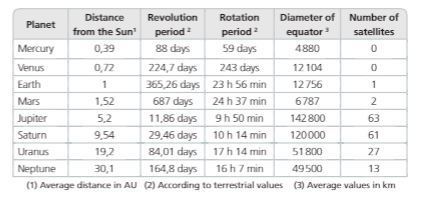
- Rotation is the movement a body makes on its own axis. A day. - 17Planets in the Solar System
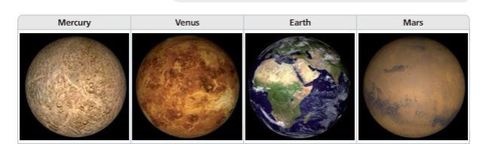
- 18Inner planetsSmall, have very little or no atmosphere and have a rocky surface.
- 19Outer planetsVery large and have a gaseous atmosphere. Sourrounded by rings and their surface is in a gaseous or liquid state.
Jupiter, Saturn, Uranus and Neptune - 20The Earth movements The Earth's revolutionThe Earth moves around the sun in an eliptical orbit. 365 days, 5 hours and 49 minutes.
Every 4 years a leap year. - 21The Earth's seasonsSpring, summer, autumn and winter
Solstices:Difference between the lenght of night and day is the biggest.
Equinoxes: Spring and autumn. Day and night have the same lenght. - 22The Earth's rotationThe Earth takes 23 hours and 56 minutes to complete one rotation on its axis. Causes day and night.
- 23Time zonesStarting from the Greenwich meridian an hour is added for each time zone
- 24The importance of the Earth's movements for the living thingsLiving things adapt to their environment:
- Many trees lose thir leaves in autumn and sprout new leaves in spring.
- Flowering and forming of fruits
- Mating and breeding seasons
- Migration - 25The Sun, Earth and MoonThe Moon is a satellite
- 26The phases of the MoonThe phases of the moon are the different images of the Moon we can see as it moves aroud the Earth.
New moon, first quarter, full moon and last quarter. - 27EclipsesAn eclipse occurs when a body comes between two others, so that one is hidden from the other.
Total or parcial. - 28TidesTides are the periodic rising and falling of sea levels due to the gravitational pull of the Moon.
Information
- Description
- The earth in the universe: planets, galaxies, etc
- Created by
- gomezolvega007
- Views
- 81
- Tags
- Rating