
Flashcards
Computer Science Revision Card
Cards in this deck (33)
- 1Unit/Modular TestingThe testing of the application modules to verify each unit (module) itself meets the accepted user requirements, design and development standards. This is done early on in the development cycle.
- 2Integration TestingTesting the modules together - all in the same environment, database instance, network and related applications, as it would function in production.
- 3Alpha TestingThis is the first round of testing, alpha testing is testing the program 'in-house' before releasing the software onto the market.
- 4Beta TestingAfter Alpha Testing; the developers will then trial the software with a limited number of users. The users report any problems to the developers. This is called BETA testing.
- 5Acceptance TestingFormally testing the software with the customer to prove that it meets the Requirement Specification so the project is completed and the developers get paid.
- 6Test PlanA formal set of tests designed to use all possible types of input and all paths through the program; designed to check that the output is as expected for specific types of inputs.
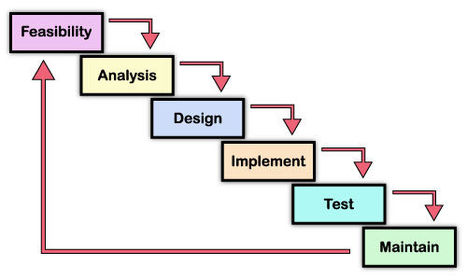
- 7SDLC Models -Waterfall Model
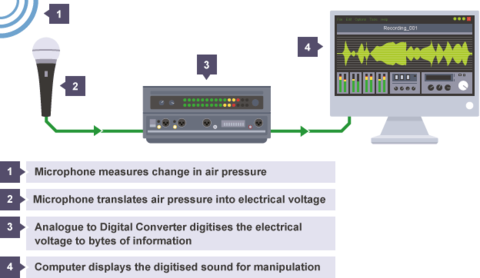
- 8Sound - Diagram
- 9TopologiesNetwork topology refers to how computers are connected to a network. There are three main types of network topology: bus, ring and star.
- 10Sound - InformationSounds created on a computer exist as digital information encoded as audio files.
Digital sound is broken down into thousands of samples per second.
Each sound sample is stored as binary data. - 11Sound - Information 2Factors that affect the quality of digital audio include:
Sample rate - the number of audio Samples captured every second
Bit depth - the number of bits available for each clip
Bit rate - the number of bits used per second of audio - 12What is RAM?Random Access Memory (RAM): Memory that is constantly being written to and read from. It does not retain its contents without a constant supply of power, ie when a computer is turned off, everything stored in its RAM is lost.
- 13SoftwareThe programs, applications and data in a computer system. Any parts of a computer system that aren't physical.
- 14TranslatorProgram translators convert program code into machine code to be executed by the CPU. There are three types of translator: interpreter, compiler and assembler.
- 15TransistorsMicroscopic devices that open and close circuits to communicate electrical signals. CPUs contain millions of transistors.
- 16InterpreterA program that translates high-level programming languages into machine code. Programs can either be interpreted or compiled.
- 17Volatile MemoryThe memory used to store computer program data while is being executed. RAM is the main type of volatile memory. It is volatile because when power is switched off it no longer retains any data.
- 18StorageThe hardware of a computer that stores data long term, such as a memory card or hard drive.
- 19What is ROM?Read Only Memory (ROM): memory or storage that has data stored on it that cannot be changed. E.g. Bootstrap, used to boot up the OS
- 20Non-Volatile MemoryA form of computer memory that stores data even when not powered.
- 21Heat SinkA component used on computer motherboards to cool the CPU.
- 22FirmwareThe software that has been written onto a hardware device.
- 23CoreA processing unit within a CPU. CPUs can have multiple cores.
- 24Control UnitThe component of the CPU that manages instructions.
- 25BIOSBasic input output system - the basic firmware that is embedded in the computer ROM chip used to start a computer.
- 26Clock SpeedThe speed of a computer CPU, measured in hertz
- 27Flash MemoryA form of memory in a computer that uses electronic transistors to store data.
- 28GPUGraphical processing unit - a computer chip dedicated to processing graphics.
- 29Operating SystemThe software that runs a computer. -IOS, Windows, Linux etc.
- 30USB Memory StickA physically small storage device. It normally plugs into a USB port. They are also called USB sticks, memory sticks, thumb or flash drives. These devices use solid state memory with no moving parts.
- 31AlgorithmA sequence of logical instructions for carrying out a task. In computing, algorithms are needed to design computer programs.
- 32AssignmentSetting the value of a variable in a computer program
- 33Constant
Information
- Description
- Key terms and topics to revise for AQA Computer Science
- Created by
- Olivia Hewett · May 2016
- Updated
- Dec 20, 2016
- Views
- 69
- Tags
- Rating