
Atomic Structure flowcharts
27 flowcharts by 26 users
This page gathers over 10 community-made Atomic Structure flowcharts, covering mass spectrometry, atomic models and particle counts. School students can use them to practise these topics at secondary level, while teachers can find ready-made material. Choose a flowchart to begin.
Select topic
- Atoms, Elements and Compounds233
- Atomic Theory and Models276
- Subatomic Particles92
- Isotopes and Atomic Mass225
- Mass Spectrometry50
- Electron Configuration and Shells163
- Atomic Orbitals and Quantum Numbers55
- Emission Spectra and Flame Tests8
- Ions120
- Periodic Table and Trends317
- Ionisation Energy64
- Chemical Bonding163
- Separating Mixtures17
- Radioactivity11
- Moles and Quantitative Chemistry10
Flowcharts
-
Untitled
-
History of the Atom - Revision Sheet
-
Untitled
-
Development of the Model Atom (4.1.1.3)
-
Chemistry - Mass Spectrometer
-
The Theory of Atomic Structure
-
Untitled
-
atom
-
Mass spectrometry
-
chemestry
-
Untitled
-
WHAT ARE MATERIALS MADE OF?
-
ATOMS
-
Untitled
-
Untitled
-
Untitled
-
Untitled
-
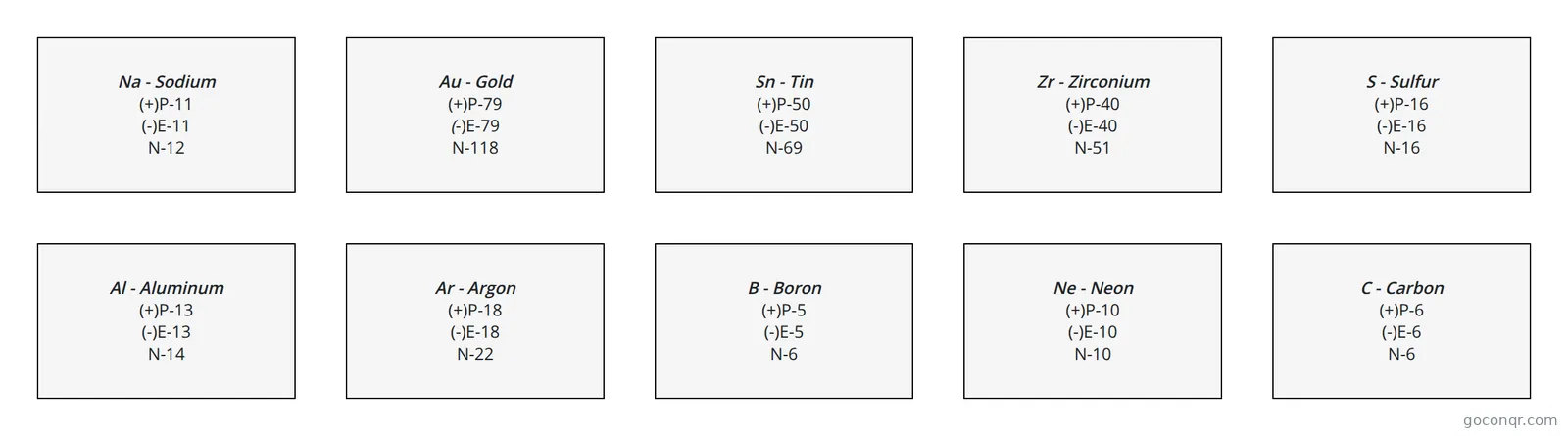 Breaking Down Atoms Practice Break down atoms to list the number of neutrons, electrons, and protons.
-
Untitled
-
Untitled
-
Venn Diagram for Atomic Number and Atomic Mass
-
Untitled
-
mass spec stages (AS) topic 7
-
Untitled
-
Untitled
-
Untitled
-
History of Atoms 101
More Atomic Structure resources
About atomic structure flowcharts
GoConqr OriginalUsing Atomic Structure flowcharts
Start with The Theory of Atomic Structure if you want to follow changes in the atomic model. Its flowchart presents ideas in sequence, giving you a route through the topic. For particle practice, Breaking Down Atoms Practice lists examples with proton, electron and neutron counts.
For mass spectrometry, compare Mass spectrometry with Chemistry - Mass Spectrometer. Both include ionisation, so you can follow the steps in each and compare how they are presented.
Move between formats
Read a flowchart once, then cover part of it and try to recall the next step or example. Return to the chart to check what you remembered. If you want to test an idea with questions, switch to a quiz on the Atomic Structure unit page. A mind map can help when you want to see a topic arranged in branches instead. Pick a flowchart and follow it at your own pace.
Frequently asked questions
Which flowchart should I start with?
Start with The Theory of Atomic Structure for a sequence of ideas about the atomic model. If you want examples of particle counts instead, Breaking Down Atoms Practice lists atoms alongside their proton, electron and neutron counts. Choose the one that matches the topic you are revising.
Are the flowcharts free to use?
Yes. Every flowchart listed here is free to open and study without an account. The resources were made by GoConqr users, not by GoConqr. A free account also lets you save quiz scores and make your own quizzes, mind maps, flashcards and notes.
What do the flowcharts on this page cover?
They cover atomic models, particle counts and mass spectrometry. For example, Venn Diagram for Atomic Number and Atomic Mass compares atomic number and atomic mass, while Mass spectrometry includes ionisation. School students can use the collection for revision, and teachers can find material for these topics.