
Geometry Basics and Shapes flowcharts
18 flowcharts by 16 users
This page gathers over 10 community-made Geometry Basics and Shapes flowcharts on angles, triangles, quadrilaterals and coordinate questions. They give school students practice in recognising shapes and following geometric decisions, and offer teachers revision material. Most resources are at secondary level, with a few for primary pupils. Pick a flowchart and follow its steps.
Select topic
Flowcharts
-
Properties of Triangle – types & formulas
-
Proving Quadrilaterals
-
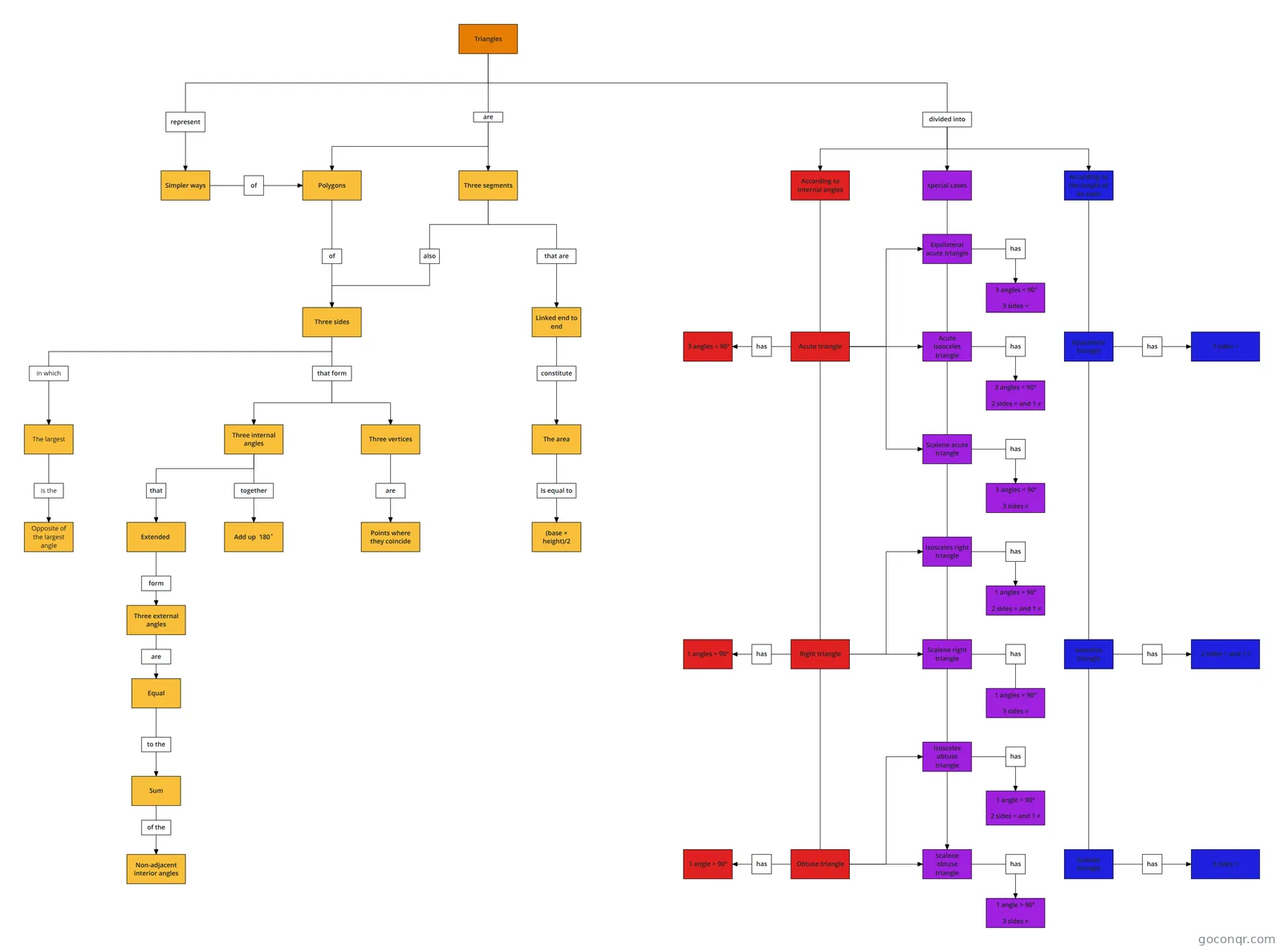 Triangles: concepts, properties and types This is a conceptual map that encloses the main concepts of triangles, essential in the understanding of po...
-
Angles
-
Midpoint and Endpoint Question Decisions
-
Untitled
-
Proving Quadrilaterals
-
Untitled
-
Untitled
-
Quadrilaterals
-
Geometric terms
-
Untitled
-
Shapes
-
Untitled
-
Untitled
-
Untitled
-
triangle proof project
-
Getting the outside area of a cilinder
More Geometry Basics and Shapes resources
About geometry basics and shapes flowcharts
GoConqr OriginalGeometry Basics and Shapes flowcharts
These flowcharts organise geometry ideas in different ways. Angles groups angles by their measure and by their sum. Quadrilaterals sets out shapes and their characteristics, while the triangle flowcharts cover properties, types and a proof.
For coordinate questions, Midpoint and Endpoint Question Decisions begins by asking what information the question gives you. The two resources titled Proving Quadrilaterals take different approaches: one sets out conditions for a parallelogram, while the other uses questions about slopes and sides.
How to revise with a flowchart
Start with Angles if you want to review classifications, or choose the midpoint flowchart if you are working through coordinate questions. Follow each branch, then cover it and explain the route in your own words. When you want to check your recall, switch to a quiz on the unit page. A mind map can help you review a topic more broadly.
Choose a flowchart to begin your revision.
Frequently asked questions
Which flowchart should I start with?
Start with Angles if you want to review how angles are classified by measure and sum. For coordinate questions, Midpoint and Endpoint Question Decisions offers a route based on what the question gives you. Both let you follow the information in a clear sequence.
What do the quadrilateral flowcharts cover?
Quadrilaterals sets out shapes such as rectangles, rhombuses and squares alongside their characteristics. The two flowcharts titled Proving Quadrilaterals explore ways to identify quadrilaterals: one lists conditions, while the other asks questions about slopes, parallel sides and perpendicular sides.
Are the flowcharts free to use?
Yes. Every flowchart listed here is free to open and study without an account. The resources were made by GoConqr users. A free account also lets you make your own flowcharts’ companion resources, including quizzes, mind maps, flashcards and notes, and save quiz scores.